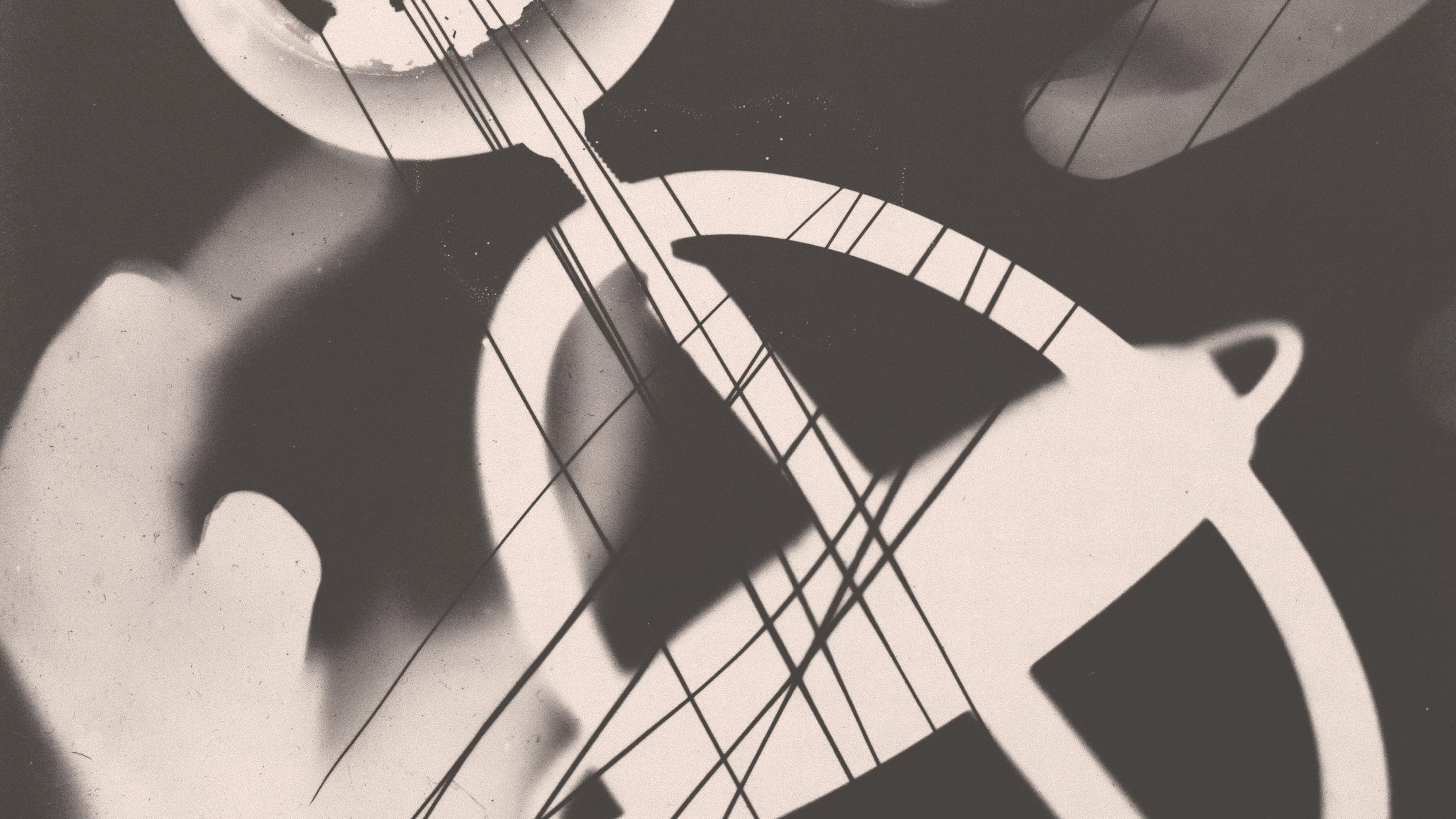
Published in December 1922, Man Ray’s Champs délicieux (Delicious Fields) is an album of twelve rayographs: cameraless photographs made by placing objects directly onto sensitive paper and exposing them to light.[1] The artist issued the album in an edition of forty numbered copies, each with a hand-sewn colored wrapper and a preface by Tristan Tzara. Given that rayographs are unique and made without negatives, Man Ray had to make photographs of each of the twelve works to produce printing negatives for the multiple sets of gelatin silver prints that comprise the edition.
In addition to the forty editioned copies of Champs délicieux, there is an artist’s working proof (no. 0) and a post-edition working copy (no. 41) that consists of twelve crossed-out, or canceled, images (figs. 1–3).[2] Plate cancellation is a long-standing printmaking practice used to ensure that no further impressions can be taken from a printing matrix (a copper plate, a block, or a stone) once an edition is complete. Cancellation involves deliberately defacing or disabling the matrix so it can no longer produce clean impressions. This may be accomplished by scoring or gouging lines across the image, drilling holes through the plate, scraping or burnishing key areas, or even cutting the plate into pieces. Often a final impression, or “cancellation proof,” is printed after this act to document the alteration of the matrix.[3]
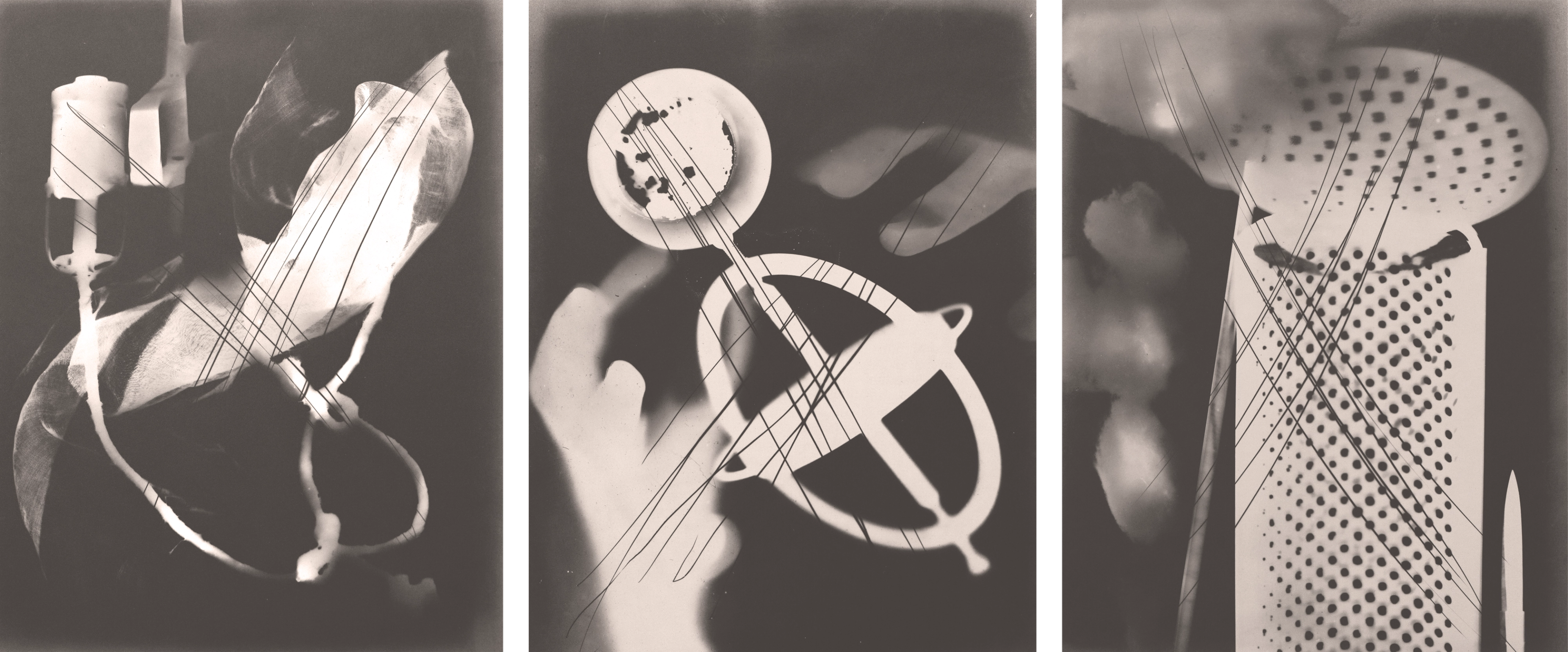
Figs. 1–3. Man Ray, Champs délicieux (Delicious Fields), 1922. Three of the twelve gelatin silver prints with cancellation marks in the portfolio. Post-edition number 41/40, 15 3/4 x 11 13/16 x 13/16 in. (40 x 30 x 2 cm). Collection of Jean-Claude Vrain, Paris. Left to right: plate 3, plate 4, and plate 12. © Man Ray Trust / 2026 Artists Rights Society (ARS), New York
Photography has no similar tradition. In the case of Champs délicieux, canceling the portfolio was a complex act: the images were, first of all, a set of unique rayographs, and secondly, prints from a set of glass-plate negatives taken from the original rayographs. The negatives are the closest analogue, in photographic terms, to a traditional printmaking matrix, but Man Ray may have also retained his original rayographs (their whereabouts, if they were kept by the artist, remains unknown). For the forty-first copy of Champs délicieux, this raises the question: Which matrix was canceled, and how? Two possibilities present themselves. In the first scenario, the original rayographs were physically crossed out, then rephotographed to produce new negatives, which were printed for no. 41. In the second, the original rayographs remained untouched and the glass negatives were directly canceled. To do this, Man Ray would have dragged a stylus or sharp object across the emulsion side of each plate, scratching away the gelatin binder. When printing, light would pass freely through those scratches to produce dark, disfiguring lines across each image. In both cases, the lines would be a seamless part of the silver photographic image.
Microscopic examination of no. 41 in the photograph conservation laboratory at The Met points toward the second possibility. The lines on the prints are a uniform, deep black (fig. 4)—consistent with unimpeded light passing through clear channels in the negative. A drawn or painted mark on a rayograph, subsequently rephotographed, would likely have some variation in image tonality. The lines on the prints of no. 41 also terminate in tapered points and are at times jagged (fig. 5)—more consistent with incision than with a freely moving hand. Most telling are the small white spots visible along the edges of some lines (figs. 6, 7). These appear to be small curls of displaced gelatin emulsion made as a stylus or other sharp tool was dragged across the plate. The medium was pushed aside rather than removed, much like the burr at the edges of a drypoint line, and the clumps of gelatin binder effectively blocked the light during printing, creating the white spots along the lines in the final prints.[4] A drawn line rephotographed and printed would leave no such trace.
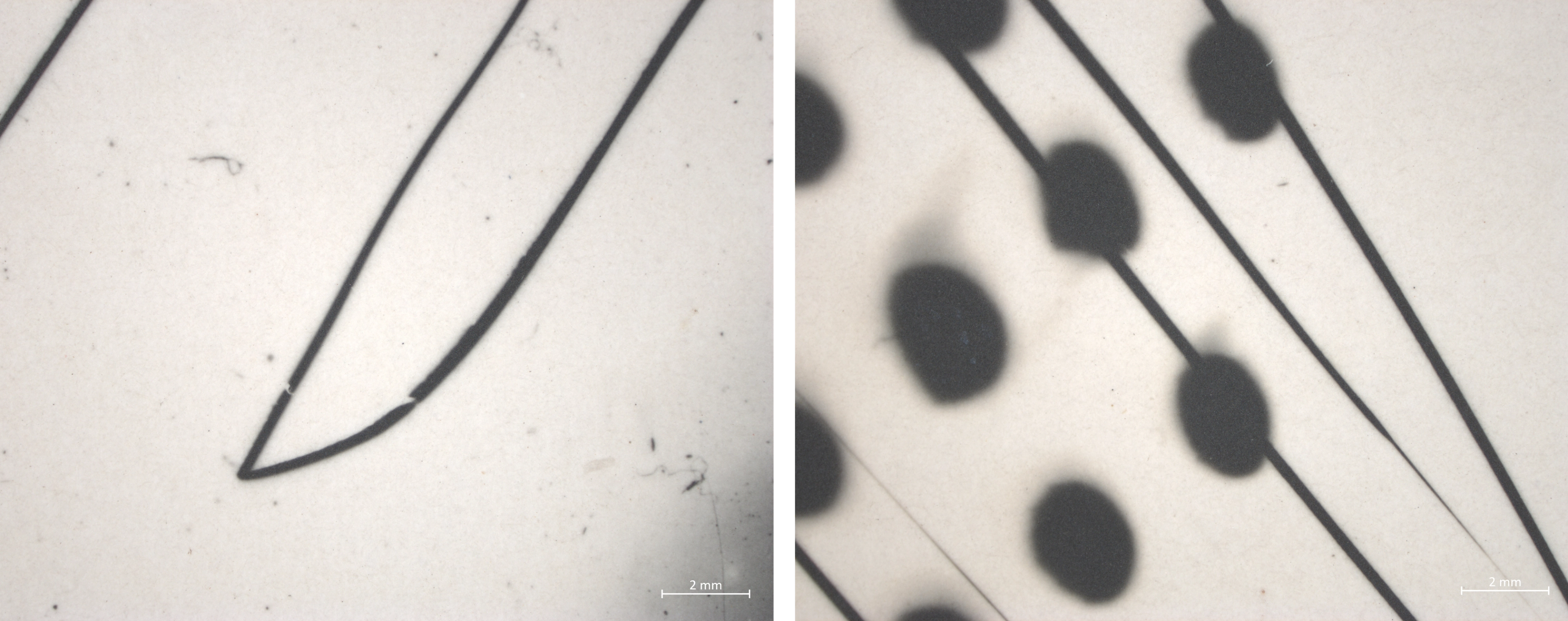
Fig. 4. Micrograph of plate 4 taken under 7x magnification, illustrating the deep black color and the jagged nature of the line. Fig. 5. Micrograph of plate 12 taken under 7x magnification, showing lines with tapered ends
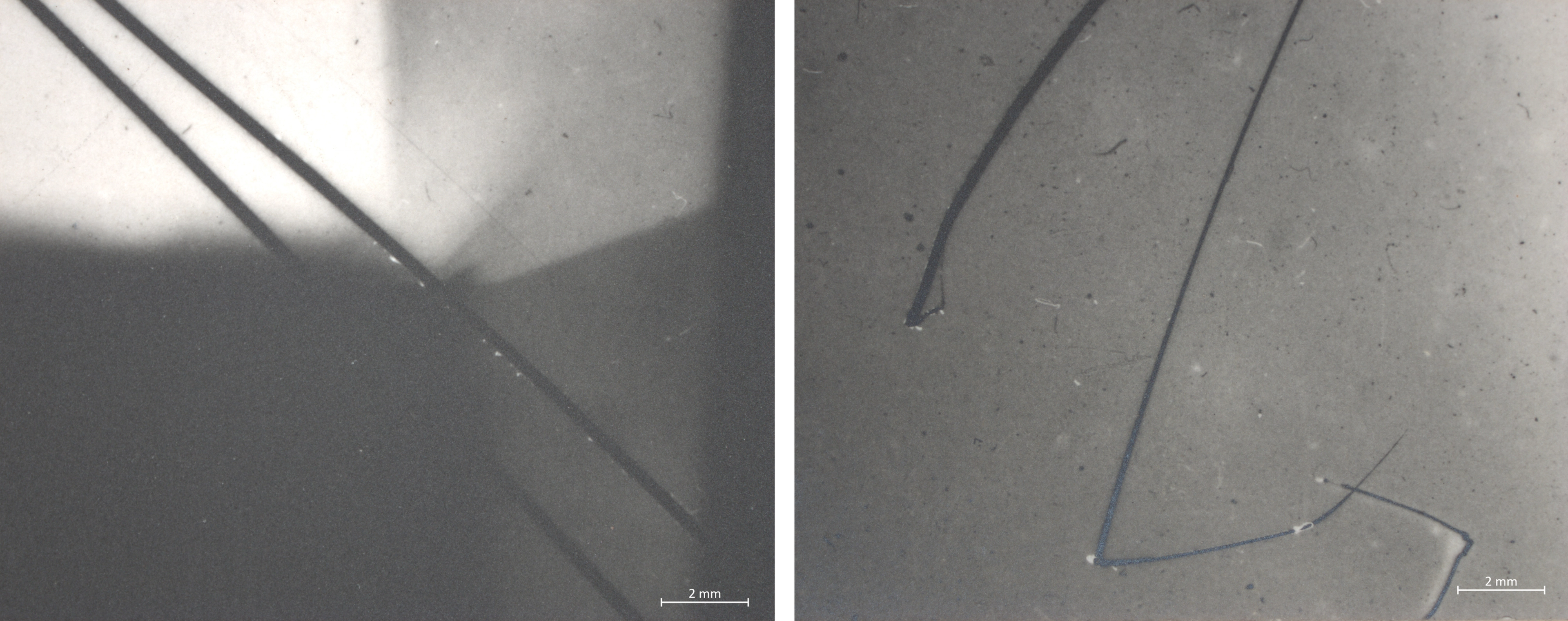
Figs. 6, 7. These micrographs of plate 3 (left) and plate 4 (right) taken under 7x magnification provide two examples of the small white spots visible along several of the lines, indicating that the gelatin emulsion was displaced in the likely act of scratching lines directly onto the glass-plate negatives.
This examination comfortably leads to the conclusion that Man Ray canceled the portfolio through direct work on the glass negatives, and that no. 41 is a documented proof of the altered plates. With the lines of cancellation printed into every image, this last example of Champs délicieux is, in the purest material sense, a proof of its own ending.
Notes
For more background on the album, see Lee Ann Daffner and Jane Pierce, “Man Ray’s Champs Délicieux Turns 100,” MoMA Magazine, February 3, 2022, https://www.moma.org/magazine/articles/688; and Stephanie D’Alessandro and Stephen C. Pinson, Man Ray: When Objects Dream, exh. cat. (The Metropolitan Museum of Art, 2025), 23–48.
See D’Alessandro and Pinson, Man Ray, 25–27, for a discussion of the portfolio. No. 41, which was inscribed later than the rest, may not have been created at the time of the original portfolio.
For more on printmaking practices, see B. Gascoigne, How to Identify Prints: A Complete Guide to Manual and Mechanical Processes from Woodcut to Inkjet, 2nd ed. (Thames and Hudson, 2004), 202; and Antony Griffiths, Prints and Printmaking: An Introduction to the History and Techniques (University of California Press, 1996), 139.
For a description of the characteristics of drypoint lines, see Gascoigne, How to Identify Prints, 52–53.
