Model of a Granary with Scribes
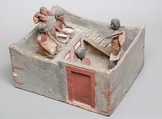
The four corners of this model granary are peaked in a manner that is sometimes still found in southern Egypt today presumably to offer additional protection against thieves and rodents. The interior is divided into two main sections: the granary proper, where grain was stored, and an accounting area. Keeping track of grain supplies was crucial in an agricultural society, and it is noteworthy that the six men carrying sacks of grain here are outnumbered by nine men taking care of measuring and accounting. Of the four scribes two are using papyrus scrolls, two write on wooden writing boards.
All the accessible rooms in the tomb of Meketre had been robbed and plundered already during Antiquity; but early in 1920 the Museum's excavator, Herbert Winlock, wanted to obtain an accurate floor plan of the tomb's layout for his map of the Eleventh Dynasty necropolis at Thebes and, therefore, had his workmen clean out the accumulated debris. It was during this cleaning operation that the small hidden chamber was discovered, filled with twenty-four almost perfectly preserved models. Eventually, half of these went to the Egyptian Museum, Cairo, and the other half came to the Metropolitan Museum in the partition of finds.
Link to a blog about ancient architectural models
Modeling the World: Ancient Architectural Models Now on View
Link to a blog about scribes in Ancient Egypt
Showing Signs: Hieroglyphs and Palettes in the Stela of Irtisen
Artwork Details
- Title: Model of a Granary with Scribes
- Period: Middle Kingdom
- Dynasty: Dynasty 12
- Reign: early reign of Amenemhat I
- Date: ca. 1981–1975 B.C.
- Geography: From Egypt, Upper Egypt, Thebes, Southern Asasif, Tomb of Meketre (TT 280, MMA 1101), serdab, MMA excavations, 1920
- Medium: Wood, plaster, paint, linen, grain
- Dimensions: L. 74.9 (29 1/2 in); W. 56 cm (22 1/16 in); H. 36.5 (14 3/8 in);
average height of figures: 20 cm (7 7/8 in.) - Credit Line: Rogers Fund and Edward S. Harkness Gift, 1920
- Object Number: 20.3.11
- Curatorial Department: Egyptian Art
Audio
102. Models from the Tomb of Meketre, Part 1
In 1920, Met Egyptologist Herbert Winlock was clearing a tomb that was thought to have been completely robbed in ancient times. Winlock’s team discovered a hidden side chamber - left untouched for about 4000 years. This is the way he described his first glimpse into the chamber:
“There was nothing . . . to see but a ragged hole in the rock . . . , but when one by one we lay flat on the ground and shot a beam of light into that crack, one of the most startling sights it is ever a digger’s luck to see flashed before us. At first we hardly realized what we were looking into . . . . This much, however, was certain. We had found a small, totally untouched chamber crammed with myriads of little brightly painted statuettes of men and animals and models of boats.”
On the wall of this gallery is a large black and white photograph showing how these boats, miniature scenes, and statuettes were found. And if you look around in this room you see many of these finds--preserved in a pristine state even after 4000 years.
Look at the low case near the photograph. Here we have a garden with a pond and next to it is a busy bakery and brewery that shows various work stages such as crushing and grinding grain, baking bread, and bottling beer. Note the hands of the men working the dough - they are painted white since they are dusted with flour. Further on there is a granary, a slaughtering house, and a stable. These ancient models were part of the funerary equipment of a high official called Meketre. They were intended to provide sustenance and furnish the rituals needed for his afterlife.
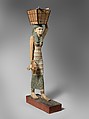
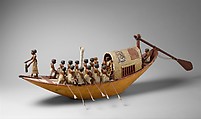
Meketre also possessed a veritable fleet of boats that is across the room. But before you leave this gallery, please look at the large figure of a female offering bearer in the center of this room. She is artistically the most striking of the group, a true masterpiece of woodcarving. Walk around her, look at her back and the movement of her hips while she steps forward. Her feathered garment and her size compared to the other figures, suggest the offering bearer may even be a goddess.
While you look at her I would like to tell you more about how these objects came to the Museum. Press the play button to listen, and afterwards we’ll continue on to our next stop – the Temple of Dendur.
Listen to more about this artwork
More Artwork

Related Content
Research Resources
The Met provides unparalleled resources for research and welcomes an international community of students and scholars. The Met's Open Access API is where creators and researchers can connect to the The Met collection. Open Access data and public domain images are available for unrestricted commercial and noncommercial use without permission or fee.
To request images under copyright and other restrictions, please use this Image Request form.
Feedback
We continue to research and examine historical and cultural context for objects in The Met collection. If you have comments or questions about this object record, please contact us using the form below. The Museum looks forward to receiving your comments.
Content Notice
The Metropolitan Museum of Art presents over 5,000 years of art from around the world, and our online collection reflects ongoing work conducted over the course of our more than 150-year history. You may encounter objects or images that may be inappropriate for some viewers or information that may be outdated.