
When Entomologie: Les Lepidopteres arrived in Watson Library’s Sherman Fairchild Lab for Book Conservation for the conservators to review, we all gasped at the beautifully illustrated pages—we’d never seen anything like it before.
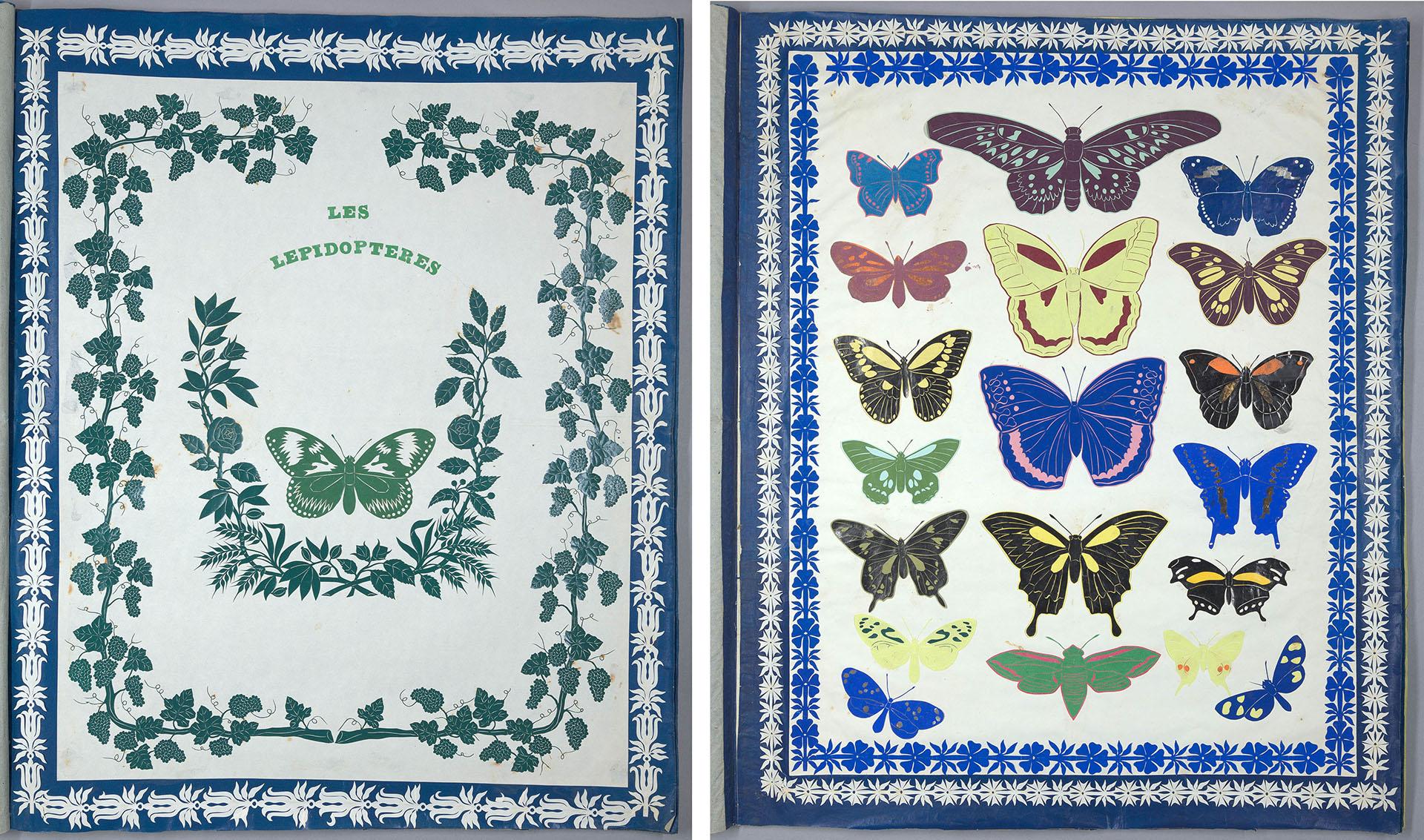
The second title page and specimen page 7 from Entomologie: Les Lepidopteres (58.5 x 46.0 cm).
Judging from the types of paper used and the style of illustrations, Les Lepidopteres was likely produced in Switzerland in the early half of the nineteenth century. It’s a slim but large-format volume, containing seventeen lavishly decorated pages filled with colorful illustrations of lepidopterans, that is, butterflies and moths. The insects are displayed on the page in the same manner that specimens might be mounted for a scientific study collection and are pictorialized using two unusual and distinctive styles of illustration: scherenschnitte and lepidochromy.
The book is not attributed to any specific artist or author, nor is there any text, so we have to hypothesize what this book might be for and why it was made: A scientific study? A record of place? A young lady’s accomplishment? Chief Librarian of Watson Library, Ken Soehner, described it as “a mood-altering book,” which is exactly what it is.
Scherenschnitte
Scherenschnitte, which translates from German as “scissor cuts,” is an illustrative technique that has been practiced in Switzerland and Germany since the sixteenth century. The lace-like images are cut from paper using small, sharp, pointed scissors. The French titles and liberal use of elaborate borders and symmetrical elements (made by cutting the paper while folded) are clues that this book’s origin is likely Swiss. Every page of the album contains cut paper elements. Even the words “Entomologie” and “Les Lepidopteres” are cut from green-painted paper and pasted in an arc across the two title pages. The titles are surrounded by lavish borders of grapes, leaves, birds, and flowers—all cut from paper.
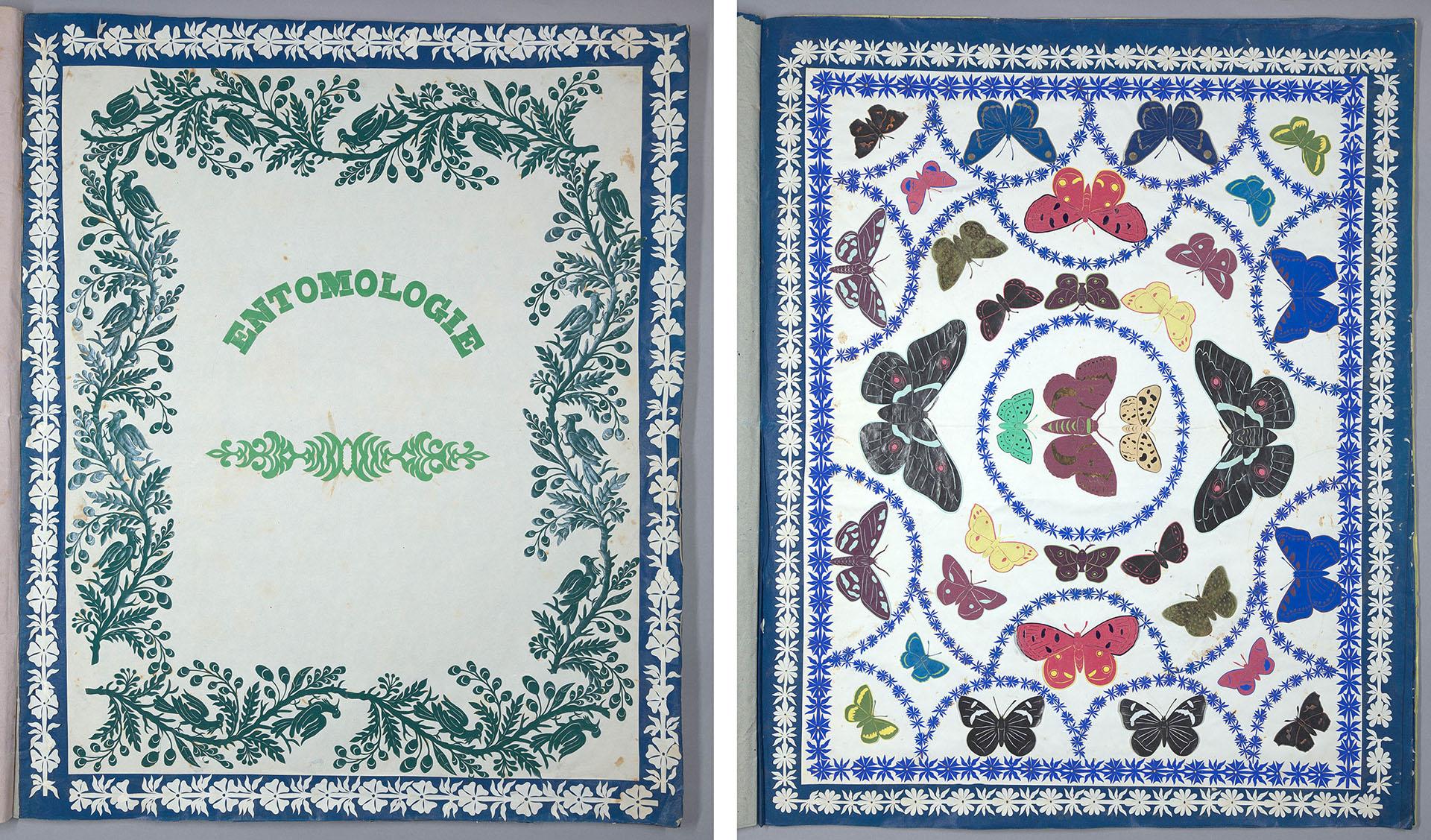
The first title page (left) and specimen page 14 (right) of Les Lepidopteres, showing the lavish borders and symmetrical design typical of Swiss scherenscnitte, which may be clues to the country of origin of this book.
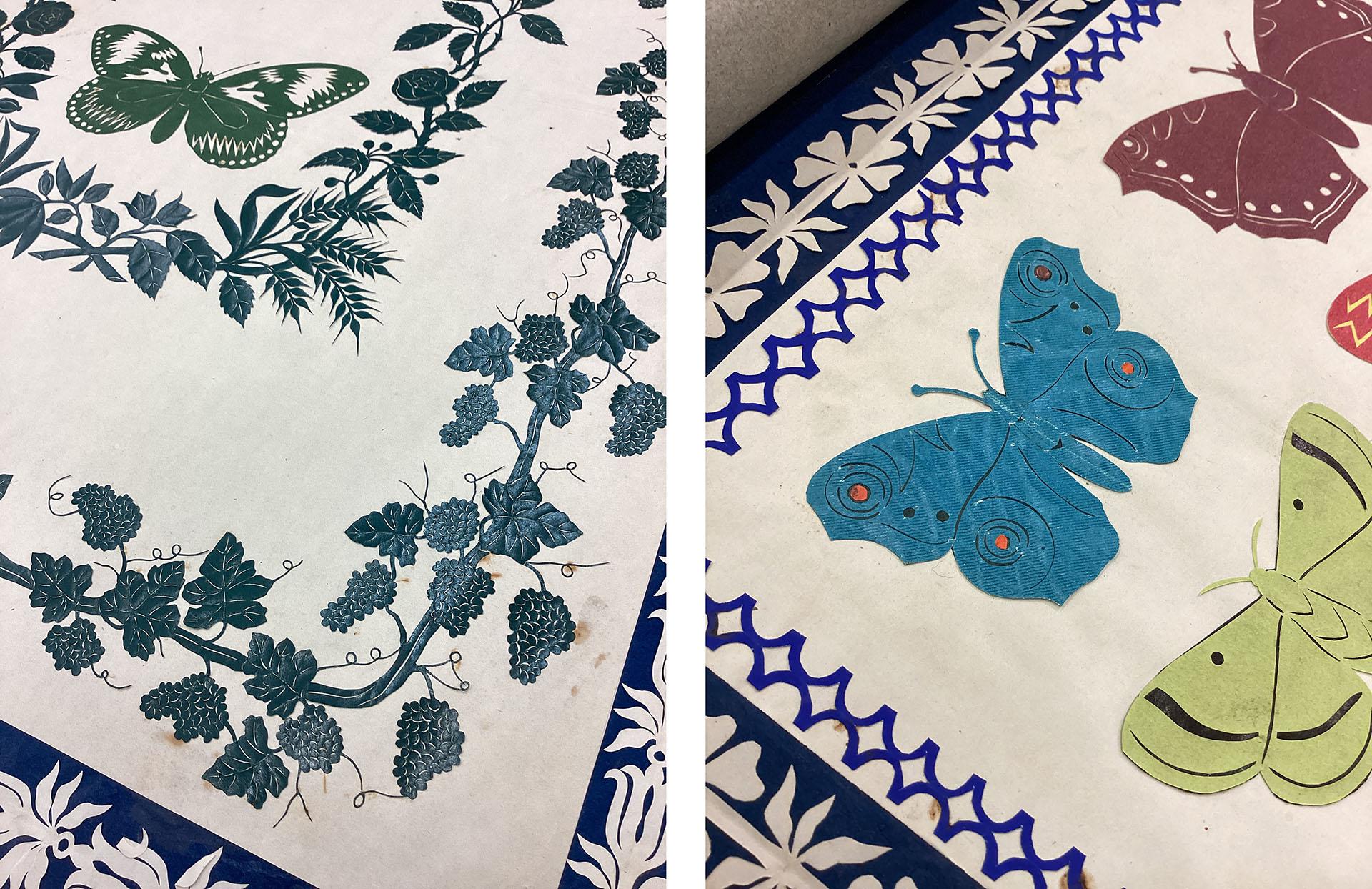
Details of the finely cut grape-vine paper border on the second title page (left), and of the layered, cut-paper butterflies on page 12 (right). The creased folds made to create symmetrical designs are clearly visible as a vertical line through the center of the butterflies’ body and the flowers of the border.
The thirteen specimen pages illustrated with this technique each have an array of individually applied butterflies and moths, 316 in all, which illustrate scores of unique species. The paper is applied in layers, with different colors showing through carefully cut lines and open shapes. The paper used is a combination of hand painted and industrial coated papers which appear to date from the early nineteenth century: metallics, paste papers, glossy, fluorescent-looking, and embossed patterned papers are all used in the illustrations. Even the pages themselves are layered, with a large hand painted blue sheet as the base, and a slightly smaller white sheet pasted on top as the background for the brightly colored specimens. Although the individual species aren’t labeled, it is possible to identify some of the subjects by the wing patterns.
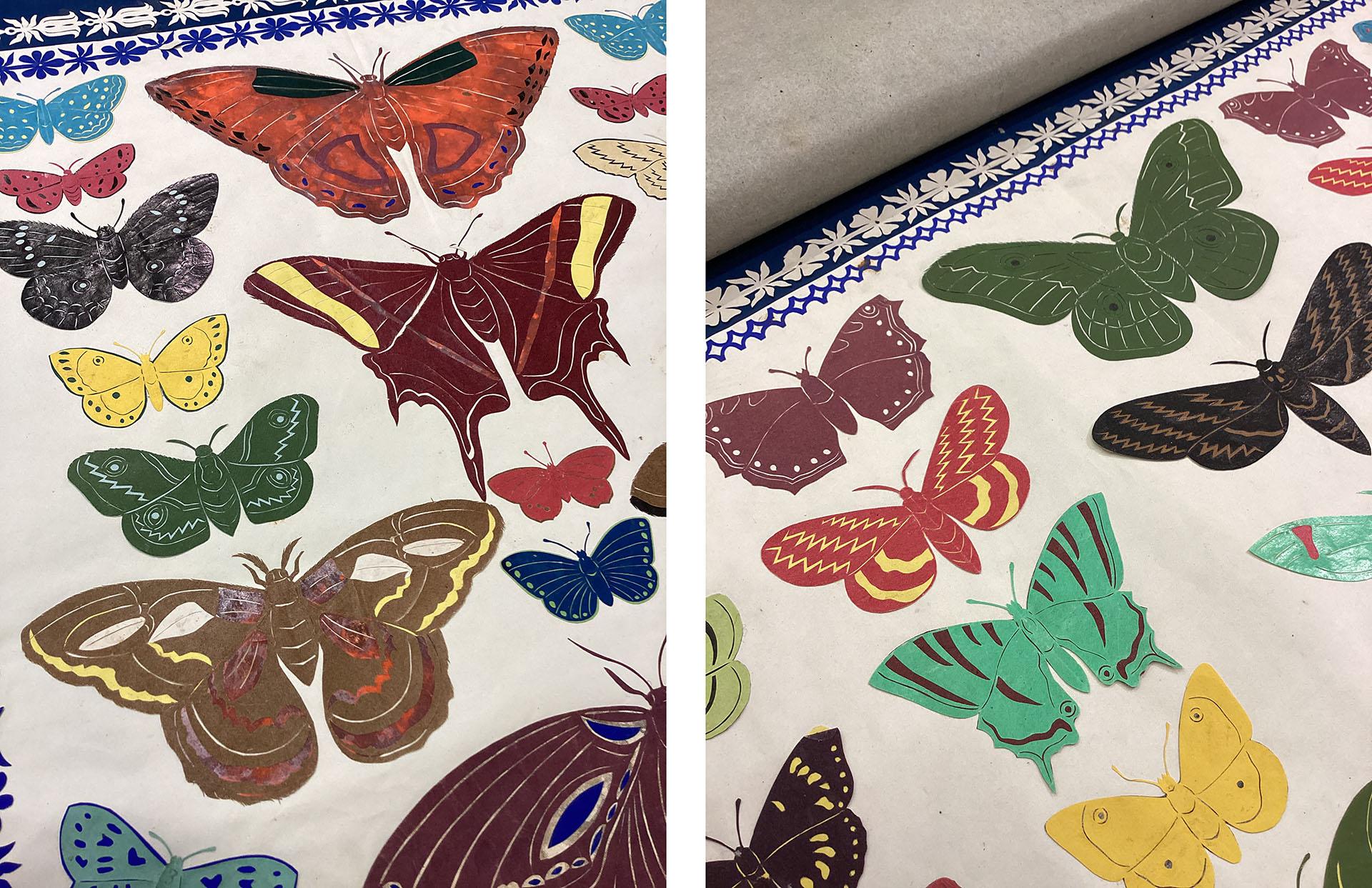
The specimens on page 13 (left) show how different types of paper—smooth, vibrantly colored, glossy black, silver metallic, and multicolored decorated paper—are used in layers to color each individual illustration. The specimens on page 12 (right) show easily identified representations of a tiger moth (red) and a swallowtail butterfly (bright green).
Lepidochromy
The last two illustrated pages are mounted with specimens made using a technique of nature printing called lepidochromy. Lepidoptera, the name of the order of these insect families, is derived from the Greek word meaning “scaly winged.” The wings of lepidopterans are covered with very small scales that act like tiny prisms. They refract light, which is picked up by our eyes as brilliant colors. Since it is impossible to reproduce the colors created by the scales using mere pigments, lepidochromy was developed to literally capture them by transferring the scales to paper.
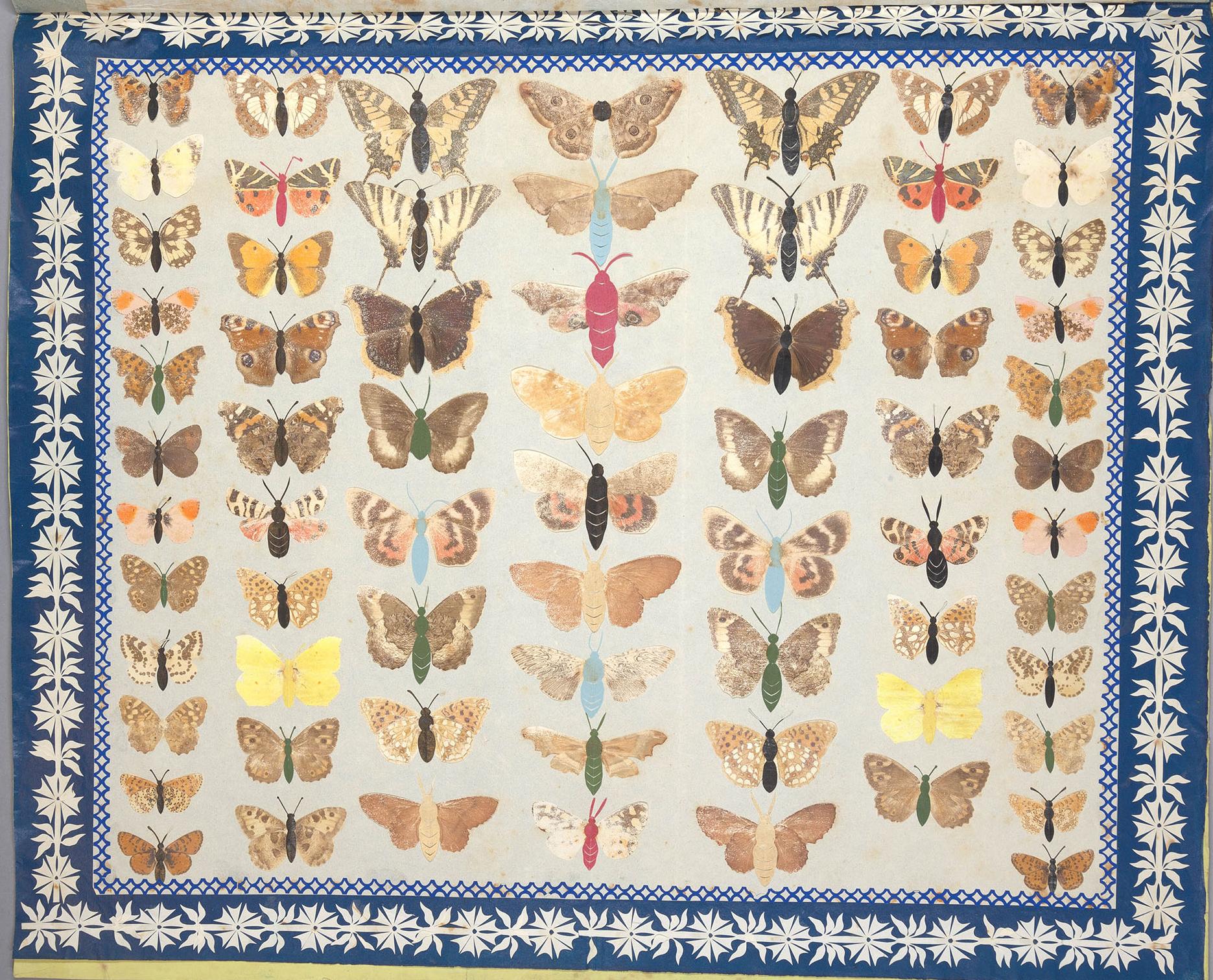
Page 17 has a symmetrical arrangement of 78 mounted lepidochromes representing 38 species of European lepidopterans, surrounded by cut paper borders.
The process was first used by the Dutch painter Otto Marseus van Schrieck (1613–1678) to press butterfly wings onto the canvas of some of his paintings, and was first described as a scientific technique by British naturalist George Edwards (1694–1773) in the last chapter of his Natural History of Birds published in 1770. He described the process as pressing clipped, humidified, and relaxed wings onto a thin white paper coated with a thick layer of gum Arabic. When the gum Arabic is dry but still tacky, the clipped wings are arranged on the sheet so that they appear to be flying. The paper is folded over to cover both sides of the wings, then pressed and rubbed with a hard, smooth instrument. When the papers are separated, the scales from both sides remain on the sheet and the transparent wing can be pulled off. The body of the insect is then filled in by drawing.
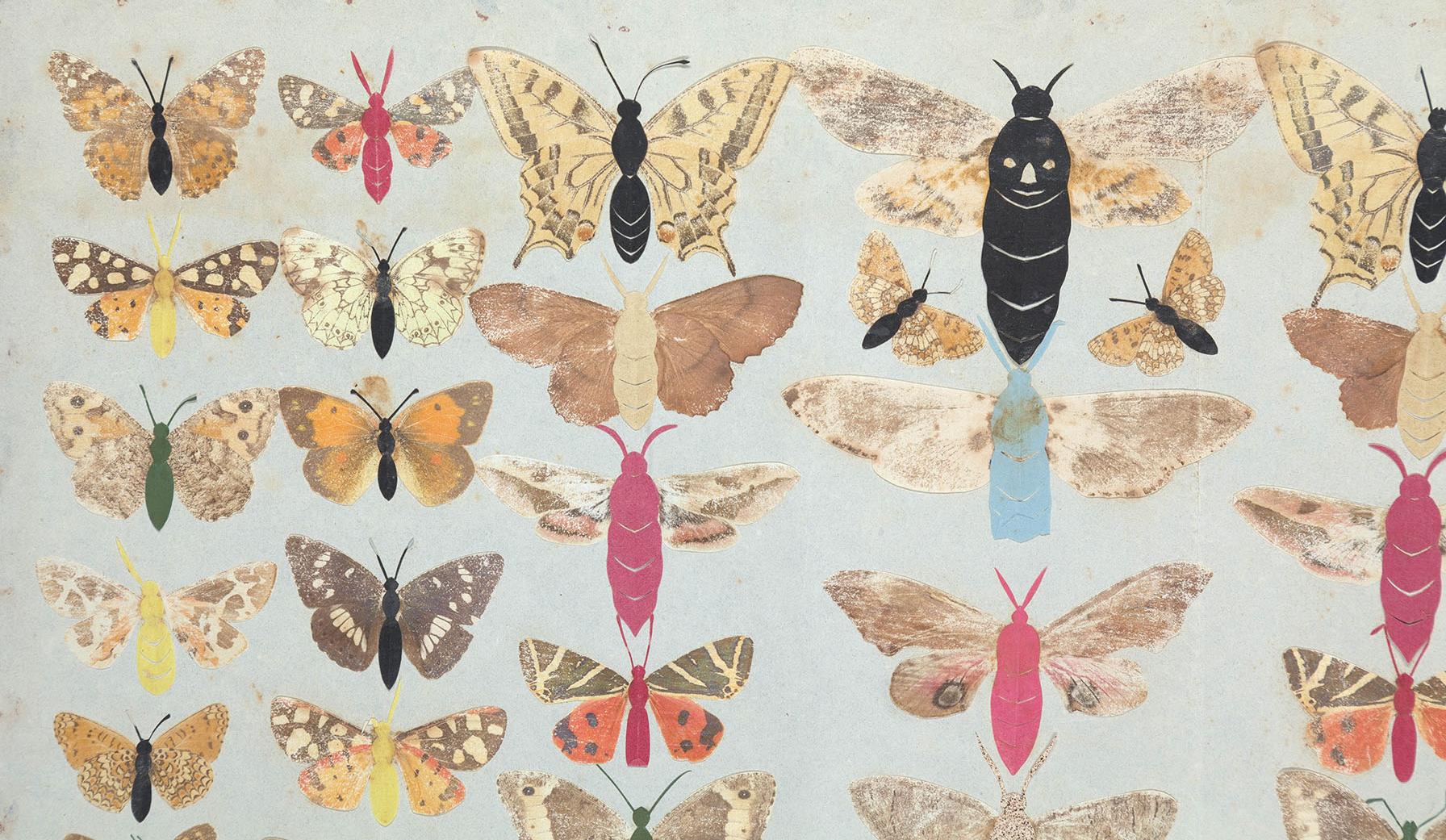
A detail of page 16 which includes lepidographs of a smiling death’s head hawk-moth, swallowtails, a clouded yellow, and several tiger moths amongst the captured species. The bodies of the insects are reproduced using scherenschnitte.
In this album, the transferred scales from the top-side of the wings are cut from nearly 140 individual prints, and each one is mounted with a cut-paper body. The transferred scales might look a little dull compared to the bright colored papers of the previous eleven pages, but when viewed under the microscope, the preserved scales and their reflected colors clearly shimmer and lift your mood to the sky.
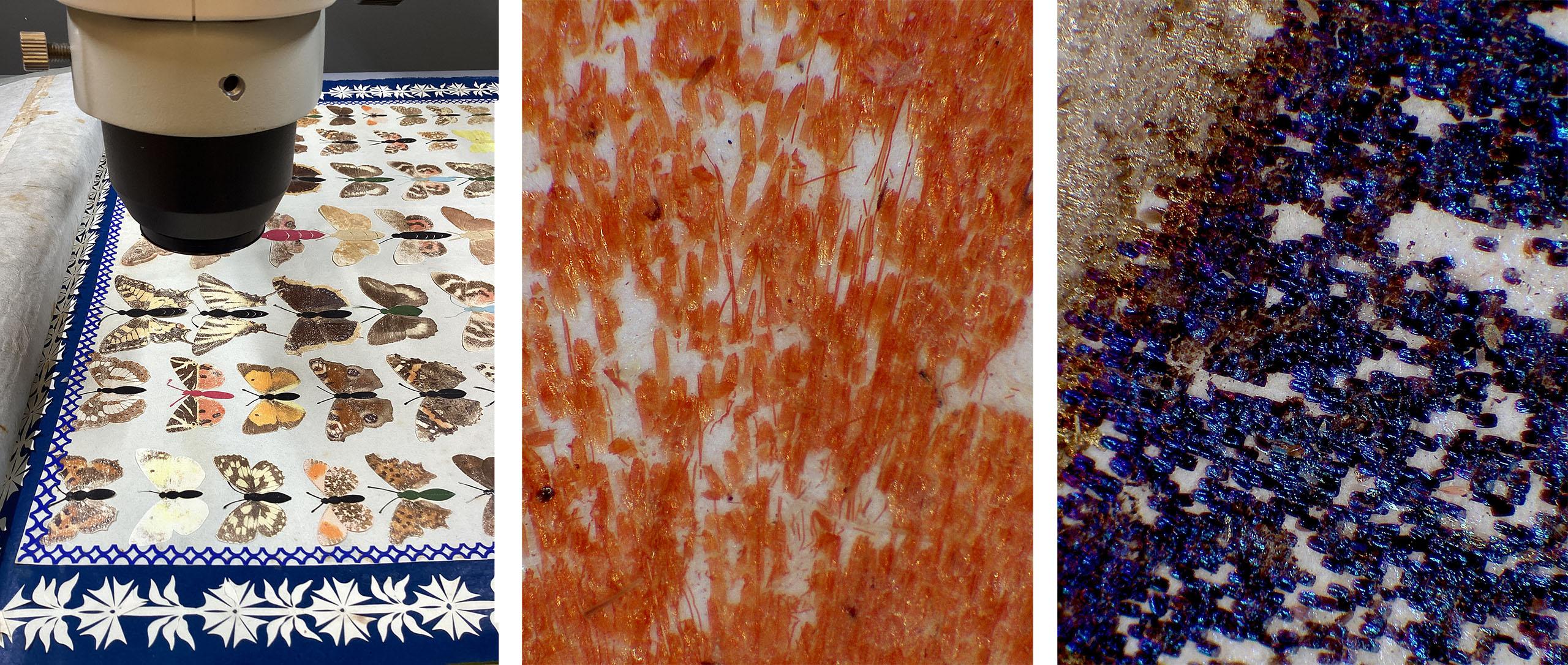
Photomicrographs of the wings of the red tiger moth (center) and peacock butterfly (right) taken from the mounted specimens on page 17 of Les Lepidopteres.


