Exhibition Dates: October 1, 2026—January 5, 2027
Exhibition Location: The Met Fifth Avenue, Gallery 690
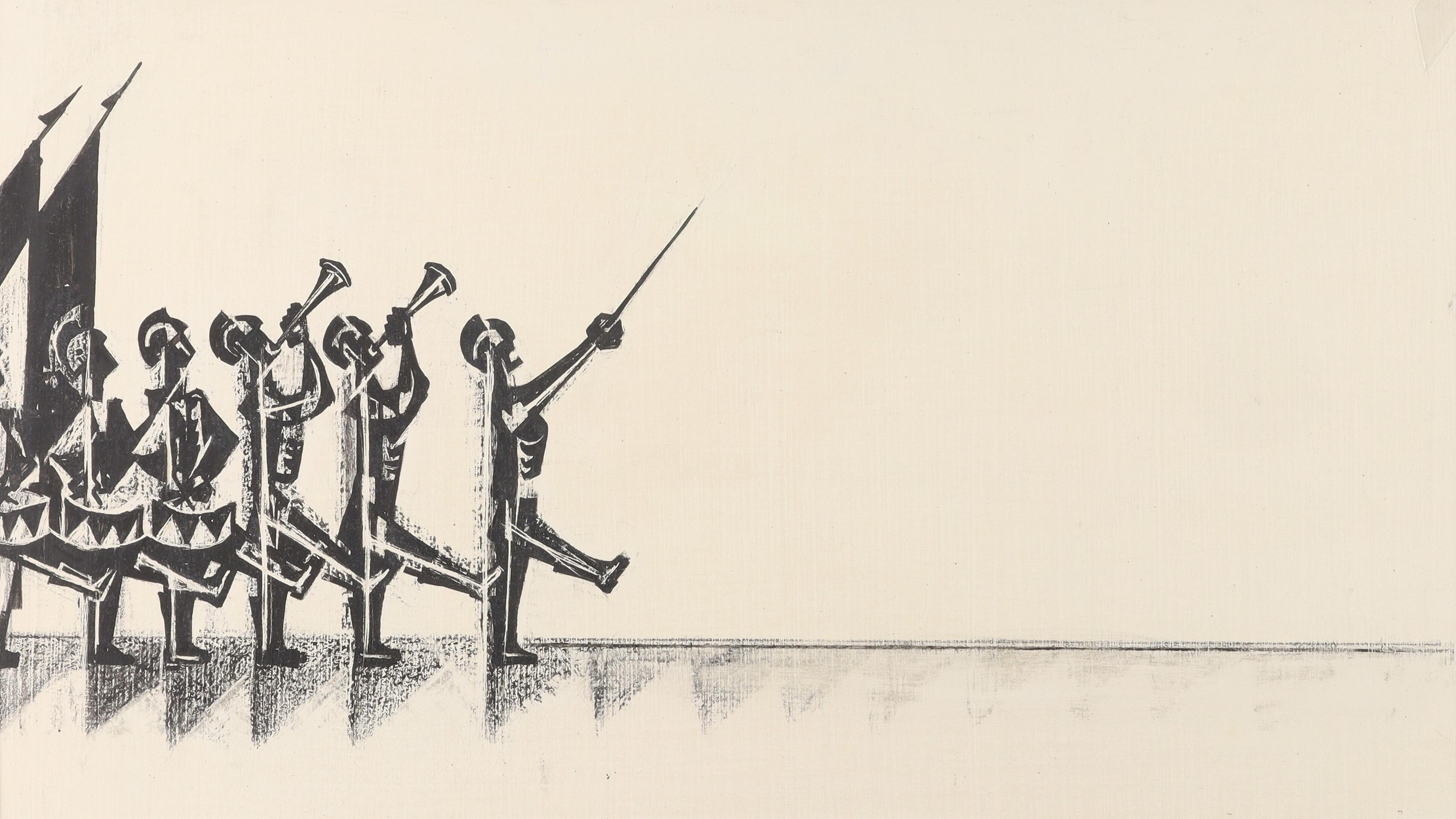
(New York, July 31, 2026)—This fall, The Metropolitan Museum of Art will present The Parade (ca. 1950), a work comprised of 63 drawings by Polish-born artist Si Lewen (1918–2016). On view from October 1, 2026, through January 5, 2027, the presentation is the first public exhibition of the work since the Museum acquired it in 2024. Created in the years following World War II, the epic sequence of charcoal, pencil, and ink drawings is informed by Lewen’s extraordinary life. Born in Poland to Jewish parents and raised in Germany, Lewen fled Nazi persecution with his family in 1933, spending a brief period in France before immigrating to the United States. During World War II, he served in the U.S. Army as one of the Ritchie Boys, a specialized unit of German-speaking soldiers. After seeing action in Normandy, he was present at Buchenwald concentration camp shortly after its liberation in 1945, experiences that shaped The Parade into a powerful meditation on war, memory, and the human condition.
“The Parade is a remarkable achievement of 20th-century art that is at once deeply personal and profoundly charged," said Max Hollein, The Met's Marina Kellen French Director and Chief Executive Officer. “It is a major acquisition for The Met, ensuring that Si Lewen’s uniquely moving, enormously relevant, and extraordinarily engaging work can reach a wider public and speak with renewed urgency, especially during these challenging times. As we look toward the future of the Museum's modern and contemporary art program in our new Oscar L. Tang and H.M. Agnes Hsu-Tang Wing, opening in 2030, we remain committed to expanding the stories of modern art by bringing artists like Lewen to wider recognition.”
The exhibition's title, There Are No Words: Si Lewen's Parade, recalls Lewen's own description of his work. Inspired by the wordless novels of modernist printmakers such as Frans Masereel, Lewen explained, "there are no words...just the picture itself is the narrative." At the same time, the title reflects his conviction that the horrors of war ultimately defy language.
Across 63 drawings, The Parade traces a visual journey from military pageantry to conflict, devastation, and mourning, revealing the cyclical nature of violence through the cumulative force of its imagery. Lewen later reflected that the military parades he witnessed as a child in Germany gave way to the death marches of World War II, a transformation that became central to the work's structure. Although rooted in the artist's own experiences, The Parade transcends any single historical moment, inviting viewers to reflect on the long-lasting human consequences of war.
"Made in the years following World War II, The Parade makes use of the formal possibilities of drawing to create an immersive narrative that unfolds as viewers move around the gallery,” said Maria Castro, The Met’s Jacques and Natasha Gelman Associate Curator in the Department of Modern and Contemporary Art. “As sparse compositions focused on small groups of figures give way to densely packed, chaotic darker scenes, Lewen’s visual narrative draws viewers into a rhythmic and chilling march across frames. The work’s emotional power lies in its ability to speak across generations through the cumulative force of its images."
There Are No Words: Si Lewen's Parade is a highlight among the Department of Modern and Contemporary Art's displays of recent acquisitions, offering audiences an early glimpse of the collection's future direction. As The Met prepares for the opening of the Tang Wing in 2030, focused exhibitions such as this reveal the breadth of the department's holdings and expand public access to 20th- and 21st-century art.
Credits and Related Content
There Are No Words: Si Lewen's Parade is curated by Maria Castro, The Met’s Jacques and Natasha Gelman Associate Curator in the Department of Modern and Contemporary Art.
The Met will host a variety of related programs in conjunction with the installation. Details will be announced at a later date.
About Modern and Conteporary Art
The Met’s Department of Modern and Contemporary Art studies, collects, and exhibits art from 1890 to the present. The collection encompasses modernist movements and contemporary practices from across the globe. Featuring important holdings of European modernism, American art and modern design, and contemporary art, the department continues to expand its collection through strategic acquisitions, with a focus on artists and works from Latin America, Asia, the Middle East, North Africa, Turkey, and African diasporas. With strengths in painting, sculpture, and works on paper, the collection also includes international decorative arts, design, installation art, and time-based media. In addition to its gallery displays, the department engages in mission-driven activities such as special exhibitions, site-specific commissions by contemporary artists, and collaborations within and beyond the Museum. It also prioritizes collections care through maintenance, cataloging, research, and the support of fellows and interns.
The Met has been acquiring the art of its time since its founding in the 19th century, even though a dedicated Department of Contemporary Arts was only established in 1967. The department’s early years were shaped by curators like Henry Geldzahler and, later, Lowery Stokes Sims, who joined the Museum in 1972. The department’s holdings have grown significantly through acquisitions, generous gifts, and bequests. Notable collections include the Leonard A. Lauder Cubist Collection, featuring nearly 90 Cubist masterpieces; the Alfred Stieglitz Collection; works from the Souls Grown Deep Foundation; a monumental promised gift of major works by Philip Guston; and the Azari collection of contemporary Iranian art.
The department found a permanent home in the Lila Acheson Wallace Wing in 1987 and later also mounted exhibitions at The Met Breuer (2016–2020). Looking ahead, the department’s collections will find a new home in the Tang Wing for Modern and Contemporary Art, slated to open in 2030.
###
July 31, 2026
Image: Si Lewen (American 1918–2016). The Parade (detail), ca. 1950. Manufactured charcoal, pencil, crayon, ink, scratching, and hand applied gesso on paperboard. The Metropolitan Museum of Art, New York, Purchase, Estate of Louise Graham, Lila Acheson Wallace and Mark Fisch and Jessica Kayll Gifts, 2024. Image Courtesy the Estate of Si Lewen and James Cohan, New York