Alone
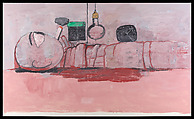
Alone is also one of a handful of paintings related to Poor Richard, a series of drawings produced by Guston in the summer of 1971. Inspired by the novel Our Gang, written by his friend Philip Roth and published the same year, Guston satirized the then president Richard Nixon through caricatured sketches of the politician’s early life and career. In 1971, the Nixon administration faced strong public criticism, especially following the publication of the so-called Pentagon Papers, which exposed the U.S. government’s covert actions in Vietnam. "I was pretty disturbed about everything in the country politically," Guston later recalled, "the administration specifically, and I started doing cartoon characters."[2]
Several Poor Richard drawings and related studies depict Nixon as an undergraduate at Whittier College outside Los Angeles. The future president is portrayed lying in bed, dreaming wistfully of his political future. However, the young student in Poor Richard brims with ambition while the figure in Alone seems less optimistic. Here the claustrophobic interior and profusion of objects suggest a character more trapped than energized, more inert than galvanized; not even the basketball, perched on a slope, evinces the possibility of movement.
Whereas Poor Richard featured pointed, even grotesque digs at Nixon, in his late figurative work Guston rarely ventured into pure polemic. Guston drew parallels between the Nixon figure in Alone and his own identity as a painter. "Here in the studio—just finished a large image of a guy (me?)" he mused in a letter in early 1972.[3] For the artist, solitude was a painful requirement to produce good work. "You have to be more alone to paint," he once offered.[4] "You hope even your own ideas get out of the room, so that you’re really alone with nowhere to go."[5] Both the painter and the politician, Guston suggests, are figures caught between privacy and publicity, forced to face themselves as much as they court the wider public, whether that public be art viewers or the national electorate.
[1] Philip Guston. Letter to Bill Berkson, January 4, 1972, quoted in Musa Mayer, Resilience: Philip Guston in 1971 (Hauser & Wirth Publishers, 2019), p. 169.
[2] Philip Guston. "On the Nixon Drawings." In Philip Guston: Collected Writings, Lectures, and Conservations, edited by Clark Coolidge (University of California Press, 2011), p. 228.
[3] Guston. Letter to Berkson, p. 169.
[4] Guston. "Interview with Karl Fortess." In Philip Guston, p. 74.
[5] Guston. "On Survival." In Philip Guston, p. 237.
Artwork Details
- Title: Alone
- Artist: Philip Guston (American (born Canada), Montreal 1913–1980 Woodstock, New York)
- Date: 1971
- Medium: Oil on canvas
- Dimensions: 52 × 93 1/2 in. (132.1 × 237.5 cm)
- Classification: Paintings
- Credit Line: Promised Gift of Musa Guston Mayer
- Object Number: PG.Guston.P71.130.56
- Rights and Reproduction: © Estate of Philip Guston
- Curatorial Department: Modern and Contemporary Art
More Artwork
Research Resources
The Met provides unparalleled resources for research and welcomes an international community of students and scholars. The Met's Open Access API is where creators and researchers can connect to the The Met collection. Open Access data and public domain images are available for unrestricted commercial and noncommercial use without permission or fee.
To request images under copyright and other restrictions, please use this Image Request form.
Feedback
We continue to research and examine historical and cultural context for objects in The Met collection. If you have comments or questions about this object record, please contact us using the form below. The Museum looks forward to receiving your comments.
Content Notice
The Metropolitan Museum of Art presents over 5,000 years of art from around the world, and our online collection reflects ongoing work conducted over the course of our more than 150-year history. You may encounter objects or images that may be inappropriate for some viewers or information that may be outdated.