
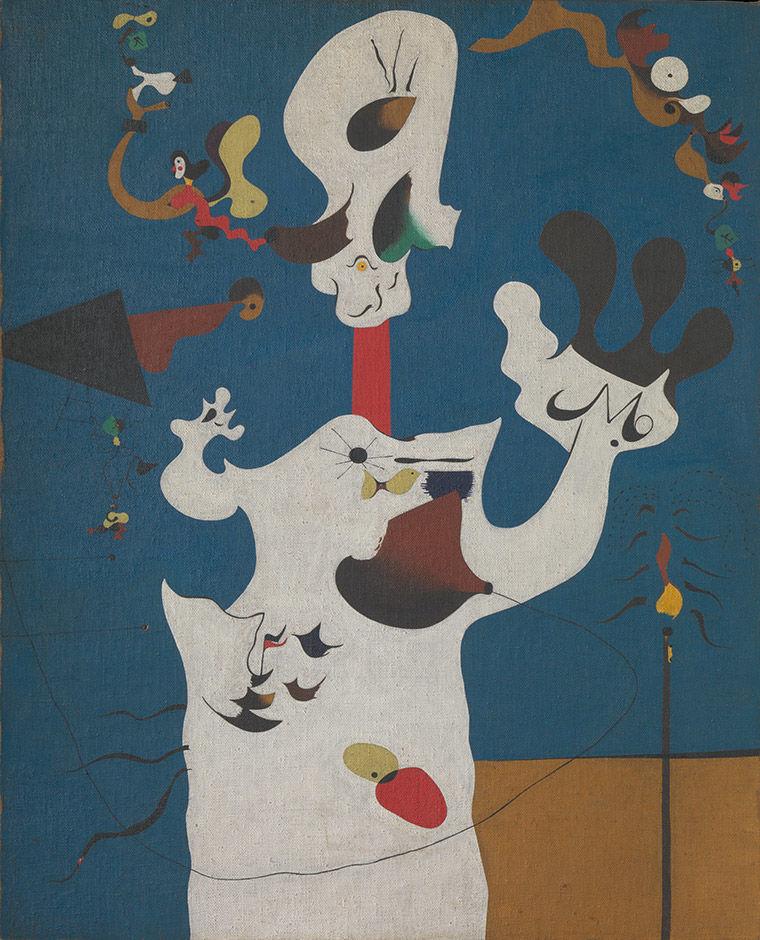
Joan Miró (Spanish, 1893–1983). Potato, 1928. Oil on canvas, 39 3/4 x 32 1/8 in. (101 x 81.6 cm). The Metropolitan Museum of Art, New York, Jacques and Natasha Gelman Collection, 1998 (1999.363.50). © 2018 Artists Rights Society (ARS), New York
In 1928, the Spanish modernist Joan Miró (1893–1983) travelled to the Netherlands and stopped at the Rijksmuseum in Amsterdam, where he was struck by two Dutch Golden Age pictures by Jan Steen and Hendrick Sorgh. The paintings, Steen's Children Teaching a Cat to Dance and Sorgh's The Lute Player, left such an impression that he had to have them—or at least some version of them. He bought postcards of the pictures and brought them home.
In his studio, he reworked the images to his liking and made three new paintings responding directly to the Old Master compositions. Dutch Interior III (1928), which became part of The Met collection in 1995, was one result; another related work, Potato, was made the same year and came to the Museum in 1999. The paintings share certain characteristics: large, bold shapes with vivid colors; a flattened sense of perspective; and a surreal relationship between parts, which seem to float all over. These are distinctly works by Miró, and they were presented along with their Dutch inspirations at the Museum in 2010.
Yet the artist, who is today so well known for his surrealist visions, refused to be tied down by any label. As Rachel Boate writes in a new Timeline of Art History essay on Miró's life and career, "he considered his art to be free of any 'ism.' He experimented feverishly throughout his career with different media—painting, pastel, printmaking, sculpture, ceramics, collage, muralism, and tapestry—and unconventional materials as a way of making work that expressed the contemporary moment without relying on the tools of mimetic realism."
The entirety of Boate's essay, along with more than one thousand others spanning the full range of the Museum's collection, is available on our Heilbrunn Timeline of Art History.


