English
DonateMembershipTickets

Search for Art

Search Tips
1-42 of 694 results for satyr-faun
Sort by:
Show only
Images
Date
For BCE dates, enter a negative number. E.g. For 2000 BCE, enter -2000.
Artist / culture
Object type / material
Match
 
Show results matching
selected filters.
Geographic location
Match
 
Show results matching
selected filters.
Department
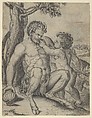
Satyr and Child, Marcantonio Raimondi  Italian, Engraving
Marcantonio Raimondi
After Raphael (Raffaello Sanzio or Santi)
ca. 1515–16
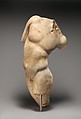
Marble statue of a young satyr turning to look at his tail, Marble, Roman
Roman
1st or 2nd century CE
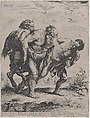
The drunken Silenus, supported by a satyr and a faun, Schelte Adams à Bolswert  Dutch, Engraving; second state of three
Schelte Adams à Bolswert
After Peter Paul Rubens
1625–59
Stephen Thompson
1870s
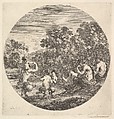
Two satyrs and a faun seated to right watching two child satyrs and another satyr with an child on his shoulders dance to left, from "Six Animal Subjects" (Six Sujets d'Animaux), Stefano della Bella  Italian, Etching
Stefano della Bella
ca. 1643–48
Roman
1st–2nd century CE
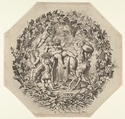
A Bacchanal: a satyr holds Silenus as he lies on a donkey's back and picks a leaf from a garland, two putti carry an amphora and a basket with grapes at left, and a faun carries a sack at right, Giovanni Battista Costantini  Italian, Engraving
Giovanni Battista Costantini
After Guido Reni
1619
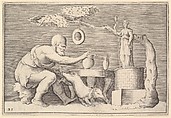
A Faun or Satyr Preparing a Pig for Sacrifice, from "Ex Antiquis Cameorum et Gemmae Delineata/ Liber Secundus/et ab Enea Vico Parmen Incis", Anonymous, Italian, 16th century  Italian, Engraving; third state
Multiple artists/makers
published ca. 1599–1622
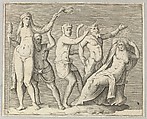
Two Figures, a Faun, and a Satyr approach a Recliniing Woman, from "Ex Antiquis Cameorum et Gemmae Delineata/ Liber Secundus/et ab Enea Vico Parmen Incis", Anonymous, Italian, 16th century  Italian, Engraving; third state
Multiple artists/makers
published ca. 1599–1622
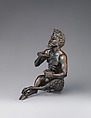
Seated satyr with a shell, Andrea Briosco, called Riccio  Italian, Bronze, Italian
Workshop of Andrea Briosco, called Riccio
after 1600
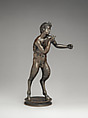
Satyr, Antico (Pier Jacopo Alari Bonacolsi)  Italian, Bronze, with remains of dark brown lacquer, Italian, Mantua
Antico (Pier Jacopo Alari Bonacolsi)
ca. 1510–ca. 1520
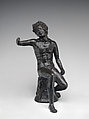
Seated Faun, Andrea Briosco, called Riccio  Italian, Bronze, Italian, Padua
Manner of Andrea Briosco, called Riccio
ca. 1540–50
Satyr, Ivory, Flemish
Flemish
17th century
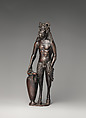
Satyr with vase (one of a pair), Andrea Briosco, called Riccio  Italian, Bronze, Italian, Padua
Andrea Briosco, called Riccio
ca. 1540–50
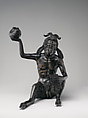
Seated satyr with silvered eyes, Andrea Briosco, called Riccio  Italian, Bronze, silver inlay (eyes), Italian, Padua
Andrea Briosco, called Riccio
second quarter of the 16th century
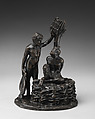
Apollo and Marsyas, Andrea Briosco, called Riccio  Italian, Bronze, Italian, Padua
Manner of Andrea Briosco, called Riccio
19th–20th century
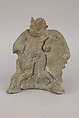
Satyr, Reuben Nakian  American, Terracotta
Reuben Nakian
ca. 1950
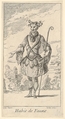
Habit de Faune: a faun wearing a tonnelet with a flute attached, a cane in his right hand and vines around his horns, from "New designs for costumes" (Nouveaux desseins d'habillements à l'usage des balets operas et comedies), François Joullain  French, Etching
François Joullain
After Claude Gillot
ca. 1721
Bronze statuette of a satyr with an amphora, Bronze, Roman
Roman
1st century CE
Bronze statuette of a satyr, Bronze, Etruscan
Etruscan
6th century BCE
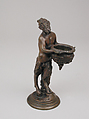
Seated satyr with an inkwell and a candlestick, Bronze, Northern Italian
Northern Italian
ca. 1530–40
Sitting Satyrs, G. King  British, Etching and engraving
G. King
after 1732
Bacchanal: A Faun Teased by Children, Gian Lorenzo Bernini  Italian, Marble, Italian, Rome
Gian Lorenzo Bernini
and Pietro Bernini
ca. 1616–17
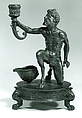
Satyr, Desiderio da Firenze  Italian, Copper alloy with a reddish brown patina; the base and shell with a dark brown patina.
Workshop of Desiderio da Firenze
Workshop of Severo Calzetta da Ravenna
ca. 1530
Satyr, Ivory, Flemish
Flemish
17th century
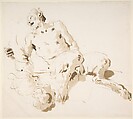
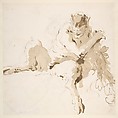
Seated Satyr Holding a Garland, Giovanni Battista Tiepolo  Italian, Pen and brown ink, brush with pale and dark brown wash, over leadpoint or black chalk
Giovanni Battista Tiepolo
1696–1770
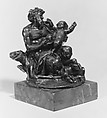
Satyr Father and Son, Joseph-Charles Marin  French, Bronze, French
After a composition by Joseph-Charles Marin
18th–19th century
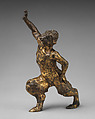
Satyr, Gilt bronze, Northern Italian
Northern Italian
16th–17th century
Satyr, Bronze, European
European
16th–17th century
Head of a satyr for attachment to a jug, Faience
246–222 BCE
Satyr Holding a Vessel, Andrea Briosco, called Riccio  Italian, Brass, probably Flemish
Imitator of Andrea Briosco, called Riccio
early 17th century
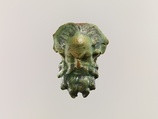
Bronze attachment with satyr head, Bronze, Etruscan
Etruscan
late 6th century BCE
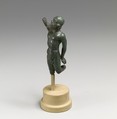
Bronze satyr, Bronze, Greek
Greek
late 5th–4th century BCE
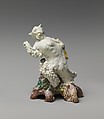
Satyr, Villeroy  French, Soft-paste porcelain, French, Villeroy
Factory Villeroy
ca. 1740
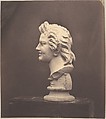
Laughing Satyr, Roger Fenton  British, Salted paper print from glass negative
Roger Fenton
1854–58
Seated Satyr Holding a Garland, Giovanni Battista Tiepolo  Italian, Pen and dark brown ink, brush with pale and dark brown wash, over leadpoint or black chalk
Giovanni Battista Tiepolo
1696–1770
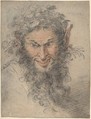
Head of a Satyr, Antoine Watteau  French, Black and red chalk, heightened with yellow chalk with traces of white chalk on brown paper
Circle of Antoine Watteau
n.d.
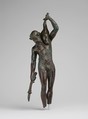
Bronze statuette of a satyr with a torch and wineskin, Bronze, Greek
Greek
3rd–2nd century BCE
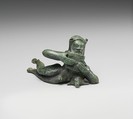
Bronze statuette of a reclining satyr, Bronze, Etruscan
Etruscan
late 6th century BCE
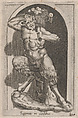
Satyr (Satyrus in caedibus), from "Speculum Romanae Magnificentiae", Anonymous, Engraving
Anonymous
After Philippe Thomassin
Publisher Antonio Lafreri
16th century
Satyr Leading Goat on which a Infant Rides, from "Ex Antiquis Cameorum et Gemmae Delineata", Anonymous, Italian, 16th century  Italian, Engraving; third state
Multiple artists/makers
published ca. 1599–1622
Serge Lifar in "Afternoon of the Faun", George Platt Lynes  American, Gelatin silver print
George Platt Lynes
early 1930s

Content Notice

The Metropolitan Museum of Art presents over 5,000 years of art from around the world, and our online collection reflects ongoing work conducted over the course of our more than 150-year history. You may encounter objects or images that may be inappropriate for some viewers or information that may be outdated.