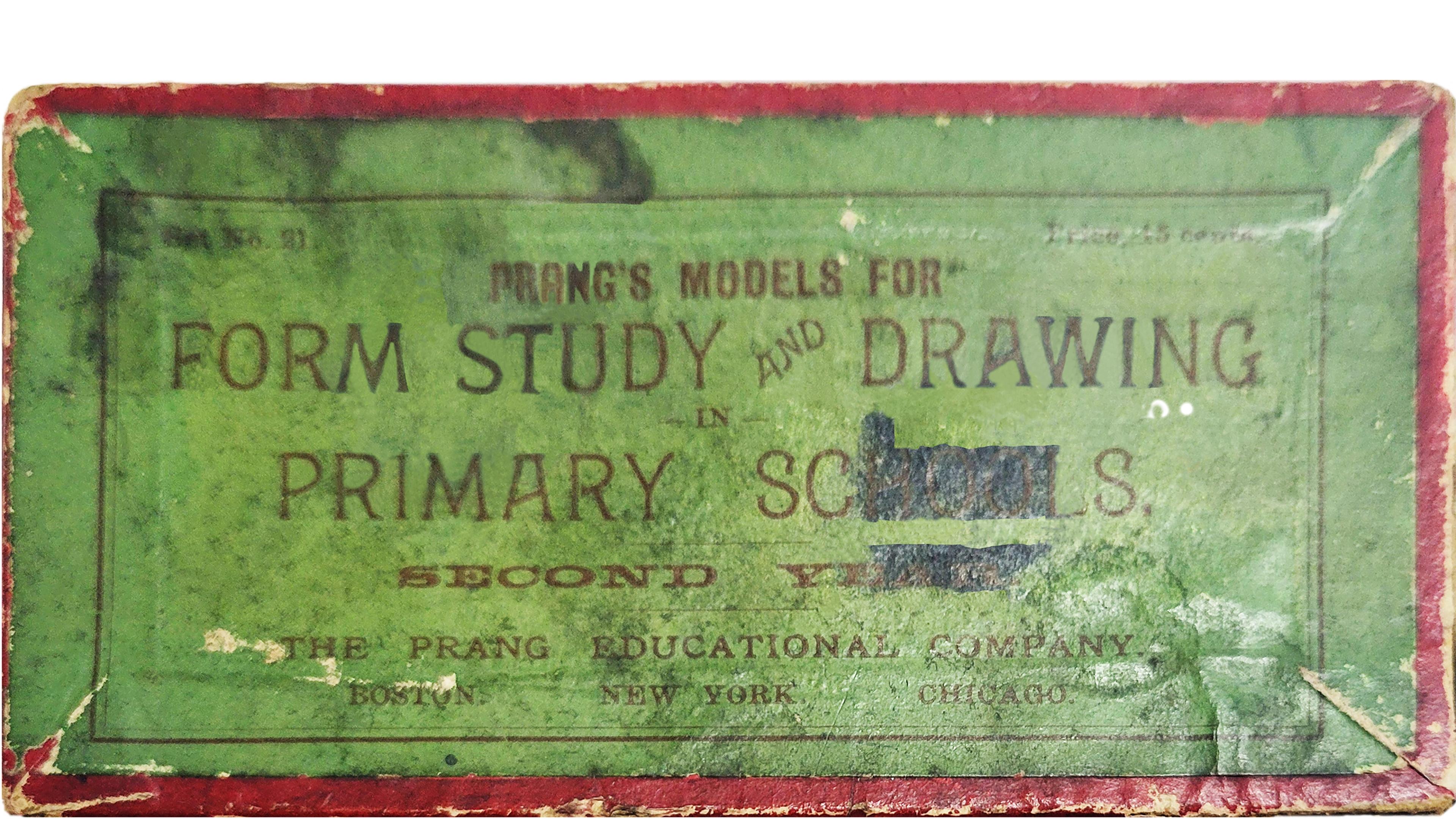
Consider two scenarios, only a year and a continent apart. In 1904, Paul Cézanne, the French painter who sought to “organize sensation,” overturning the priorities of European painting, wrote to Émile Bernard: “Treat nature by means of the cylinder, the sphere, the cone, everything brought into proper perspective, so that each side of an object or a plane is directed toward a central point.”[1] In 1905, the young American Emmanuel Radnitzky began tracing those shapes and more, learning to draw with the help of the Prang Educational Company’s Models for Form Study and Drawing—boxed stencils and three-dimensional geometric forms marketed as instructional aids (fig. 1).[2] It has been a long time since anyone reduced Cézanne’s practice to the set of rigid geometric forms that, in one of the most productive misreadings in the history of art, would link his work to Cubism.[3] But in 1944, more than twenty years after becoming an artist, Man Ray recalled that connection in the context of a game: “Chessmen,” he claimed, “begin with Cézanne and terminate in end-games.”[4]
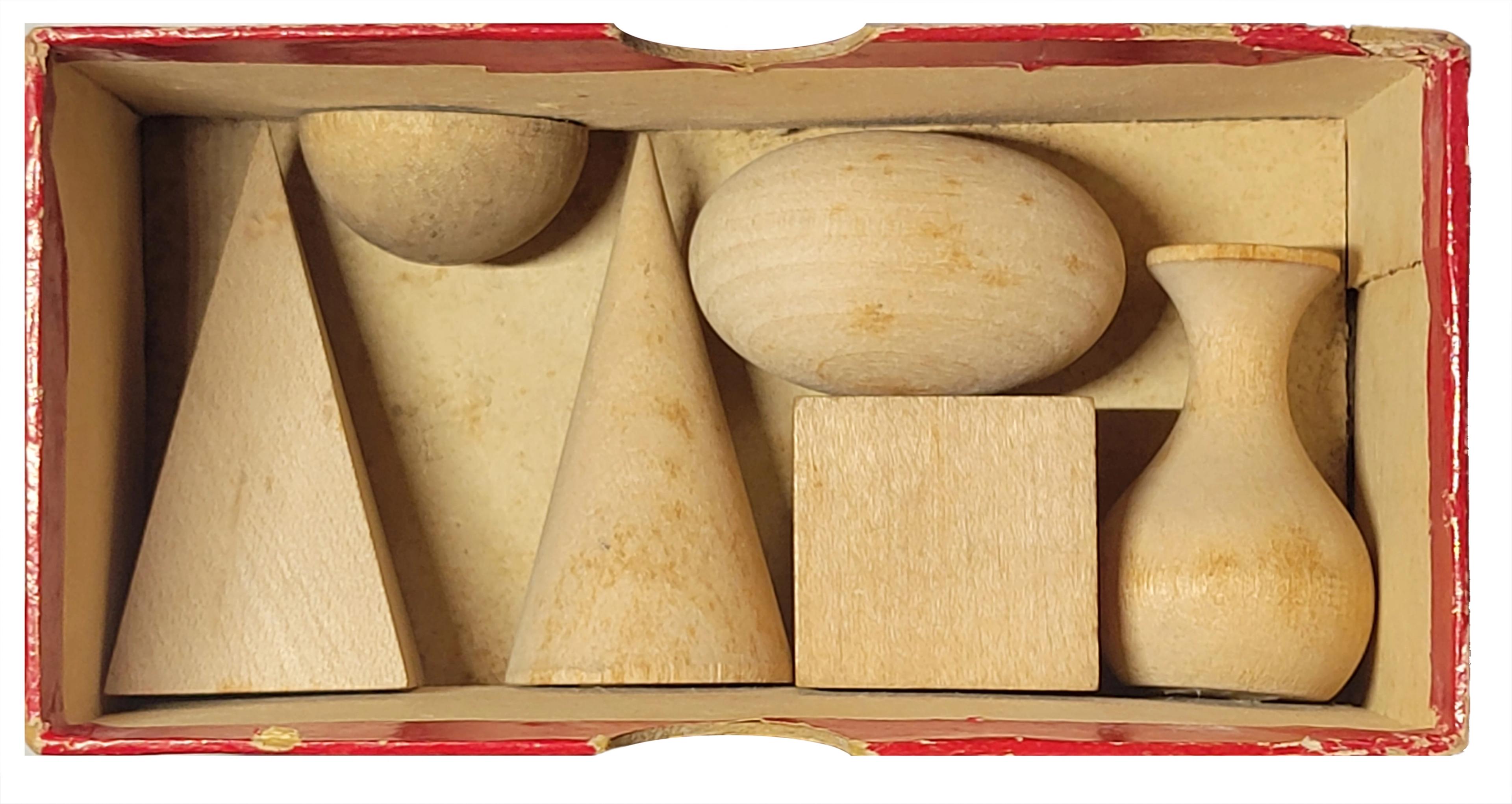
Fig. 1 and above. Prang’s Models for Form Study and Drawing, Set No. 21, ca. 1875–1909. Box of assorted wood geometric forms. Collections of Larry List and Daniel Lawler, New York
What Man Ray had in mind at the time was the first chess set he made (fig. 2), in 1920, whose pieces had not been sculpted in any traditional sense but had been appropriated, for the most part, from the selection of wooden geometric forms available from Prang at the time: spheres, cones, pyramids, cubes, and a curved “vase” shape—the very set of instructional devices on which Man Ray had cut his artistic teeth.[5] And while much has been made of the centrality of the game itself to Man Ray’s biography (the symbolism of the chess pieces, the significance of the strategic movements, the collaboration with Marcel Duchamp), I would argue that something much more fundamental to the artist’s practice took place every time he sat down to play. For what Man Ray saw when his gaze swept the board was a constantly mutating field of abstract forms, laid out on a modernist grid.
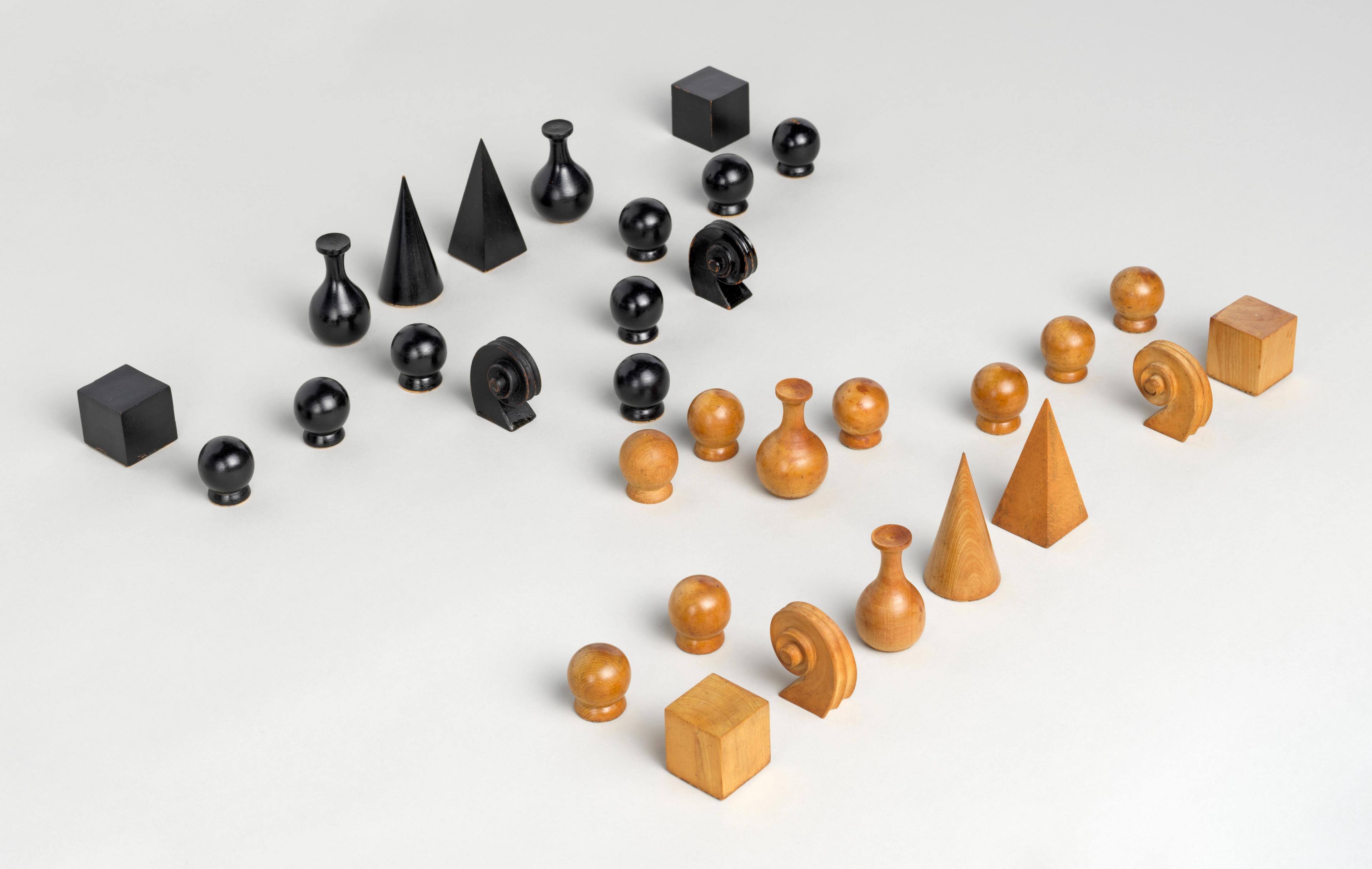
Fig. 2. Man Ray, Chess Set, 1920. Wood, king: 3 1/4 x 1 1/2 x 1 1/2 in. (8.3 x 3.8 x 3.8 cm); queen: 3 3/8 x 1 5/8 x 1 5/8 in. (8.6 x 4.1 x 4.1 cm); bishop: 2 1/2 x 1 5/8 x 1 1/8 in. (6.4 x 4.1 x 2.9 cm); knight: 2 x 1 5/8 x 1 in. (5.1 x 4.1 x 2.5 cm); rook: 1 1/2 x 1 1/2 x 1 1/2 in. (3.8 x 3.8 x 3.8 cm); pawn: 1 3/8 x 1 1/4 x 1/4 in. (3.5 x 3.2 x 0.6 cm). The Metropolitan Museum of Art, New York, Purchase, Gustavus A. Pfeiffer Fund, 1971 (1971.18.1a-p, aa–pp). © Man Ray Trust / 2026 Artists Rights Society (ARS), New York
Chess is a highly regulated game whose element of chance is supplied by the opponent. It is a game that depends on prediction, on seeing into a future that is under constant revision. In a relay not unlike call and response, a player guesses and re-guesses an opponent’s moves, constantly updating the lay of the board and its potential outcomes. The composition of the visual field shifts with every move, each time offering a new organization of forms anchored by the gridded board. In this way, the game automatically produces a series of variations, even when the players’ skills are uneven; but the effect is multiplied exponentially when serious players take up the game, for to win, they must look ahead to all the possible outcomes of every move. Therefore, during the game, Man Ray would have visualized multiple future configurations of the board every time he took a turn, choosing his own reconfiguration of the field based on having imagined the series of outcomes likely to emerge from the next version of the board.
In chess, then, especially when playing with his own set, Man Ray discovered a system for generating a series of abstract compositions, driven conceptually and determined by the intersection of two separate streams of causal events: one produced by him, the other by his opponent. Playing the game would be akin to a form of collaborative conceptual sketching, performed dimensionally, in the realm of experience, with the chessboard’s grid as the stable field that manages the composition and repeatedly gives it meaning in the context of the game. This is not to say that chess was a direct source of abstract compositions for Man Ray; rather, like all critical play, the game was undertaken as an end in itself—a machine that produced nothing, and plenty of it.
Like many of Man Ray’s objects, his first chess set operates according to the fractured logic of a visual pun, its identity flickering between an array of chessmen in play and a literalization of Cézanne’s compositional lesson. But, over the course of a game, that lesson is repeated to the point of inanity, exploded well beyond meaning through sheer permutation, a Dada move that makes this particular chessboard, composed of appropriated geometric forms, much more satisfying than the many that Man Ray would subsequently create “from scratch.” The chessmen in this set challenge the very idea of regulation, setting up an impossible equation between the rules for composition and the vagaries of chance. The visual pun that motivates the geometric forms frees meaning rather than locks it down and, through the ensuing crisis of coherence, opens the chessboard to a form of non-sense that is extraordinarily difficult to achieve but is a hallmark of Dada in New York.
Man Ray’s overdetermined chessboard—comprising references to the instructional rigidity of his early formation as an artist, as well as the mythic emergence of modernist abstraction and its commodification in the American context—conjures a link between the work’s deliberate organization of geometric forms and a variation of Cubism attributed to Cézanne. But, if so, it is Cubism delivered with a Dada smirk, updated via the Readymade. After all, Duchamp, Man Ray’s collaborator and frequent chess partner, notoriously rejected Cubism in favor of the Readymade and, following that, spurned even the Readymade to take up chess. As a Dada work evoking Cézanne by manipulating Prang’s hardwood cones, cubes, and spheres, the chessboard only emphasizes the ultimate codification and commercialization of both Cézanne’s and the Cubists’ projects. This instrumentality of artistic means for commercial purposes was formative for Man Ray’s practice. But rather than understanding this underpinning of misreadings and co-optation as the flawed basis for Man Ray’s project, we should grasp it as pivotal to one of the most important developments of his career. For in the chessboard’s infinite permutations of Readymade forms, we see the first stirrings of his Rayographs, which would soon trace serial assemblages of ordinary objects in a field limited only by the rectilinear frame of the photographic paper on which those objects were placed—in Tristan Tzara’s words, Man Ray’s “game of chess with the sun.”[6]
Notes
The Letters of Paul Cézanne, ed. and trans. Alex Danchev (Getty Publications, 2013), Letter 233, April 15, 1904, 334–36.
Larry List, Permanent Attraction: Man Ray and Chess: Dada and Surrealist Chess Art (Hirmer Verlag, 2025), 2–6, 13, 22–26.
See Theodore Reff, “Painting and Theory in the Final Decade,” in Cézanne: The Late Work, ed. William Rubin (Museum of Modern Art, 1977), 47–48. For the Dada denigration of both Cézanne and Cubism, see Laure-Caroline Semmer, “Le Cézanne d’André Breton,” Histoire de l'art, no. 53 (2003): 59.
Man Ray, "Chessmen," in Arturo Schwarz, Man Ray: The Rigour of Imagination (Rizzoli, 1977), 203.
According to Larry List, the knight is a sawn-off scroll from the neck of a found violin, so technically, it is an assisted Readymade, as are the spherical pawns, whose bottoms have been sawn off, flipped, and reattached to form bases. See List, Permanent Attraction, 25, for an illustrated description.
Tristan Tzara, “La photographie à l'envers,” preface to Man Ray, Champs délicieux: Album de photographies (1922); reprint, Tristan Tzara, “Photography Upside-Down,” in Photography in the Modern Era: European Documents and Critical Writings, 1913–1940, ed. Christopher Phillips (The Metropolitan Museum of Art/Aperture, 1989), 4–6.
