How does the body become incorporated into a display of fashion? If the aesthetic appreciation of fashion is predicated on its status as an embodied artform—as the exhibition Costume Art aims to demonstrate—how do we reconcile the nuances of individual lived experiences within a canon of museum exhibition that emphasizes order and symmetry and precludes any trace of biological corporeality that could potentially harm the works of art on view? While the latter remains a challenge that awaits seemingly supernatural innovations in preventative conservation, the former is addressed in the approach of Costume Art, which endeavors to upend a history of museum mannequin display characterized by “standard,” thin, and non-disabled bodies. Recent attempts at diversifying bodily representation in fashion exhibitions have undoubtedly advanced the language of sartorial display to account for a more personalized, embodied experience of clothing. However, more often than not, approaches toward different body shapes, sizes, and abilities have been based on the scaling of preexisting mannequin prototypes, thus eliminating any gesture toward individualization and corporeal nuance.
For Costume Art, a decision was made from the outset to base a portion of the mannequins on a diverse range of real bodies with real lived experiences that, when dressed in the show’s selected fashion works and juxtaposed with other artworks from The Metropolitan Museum of Art collection, elicit a discernable aesthetic appreciation rooted in life and imbued with truth. The exhibition features 18 mannequins created from the bodies of nine models, activists, artists, and makers, as well as one mannequin based on extant photography of a deceased model, American entertainer and drag queen Goddess Bunny. The group was chosen for their collective range of professional and personal enterprises that address the disruption and upending of standardized representations of bodies, and the nine living models agreed to have their bodies 3D scanned in a process known as photogrammetry, which captures every angle of their body using an apparatus comprising 175 cameras. The resulting data was then digitally sculpted into usable files that were 3D printed, hand sculpted, and hand finished by the mannequin manufacturer.
While ideally every single mannequin in Costume Art would be based on a real body, logistical and budgetary limitations prevented this possibility; the exhibition’s display approach is therefore not a perfect solution, but it is another step in the right direction toward an understanding of fashion-as-art that is inextricably connected to the lived experience of the body. What follows is an oral history of collected reflections of all who participated in the realization of these one-of-a-kind mannequins. May it serve as a record of a moment in time that marks a turning point in both the representation and the appreciation of fashion in the museum and of costume art.
Participants
Ivin Ballen: Founder, NewYorkCapture
Frank Benson: Artist
Andrea Bonaveri: CEO, Bonaveri
Sinéad Burke: Activist, academic, and founder, Tilting the Lens
Joyce Fung: Installation Manager, Exhibitions and Special Projects, The Costume Institute
Aimee Mullins: Athlete, actress, and public speaker
Jade O’Belle: Model
Aariana Rose Philip: Model and musician
Charlie Reynolds: Model
Michaela Stark: Artist and couturier
Antwan Tolliver: Model and founder, FREEDOM IS FLY
Sonia Vera: Model and swimwear designer
Yseult: Model and singer-songwriter
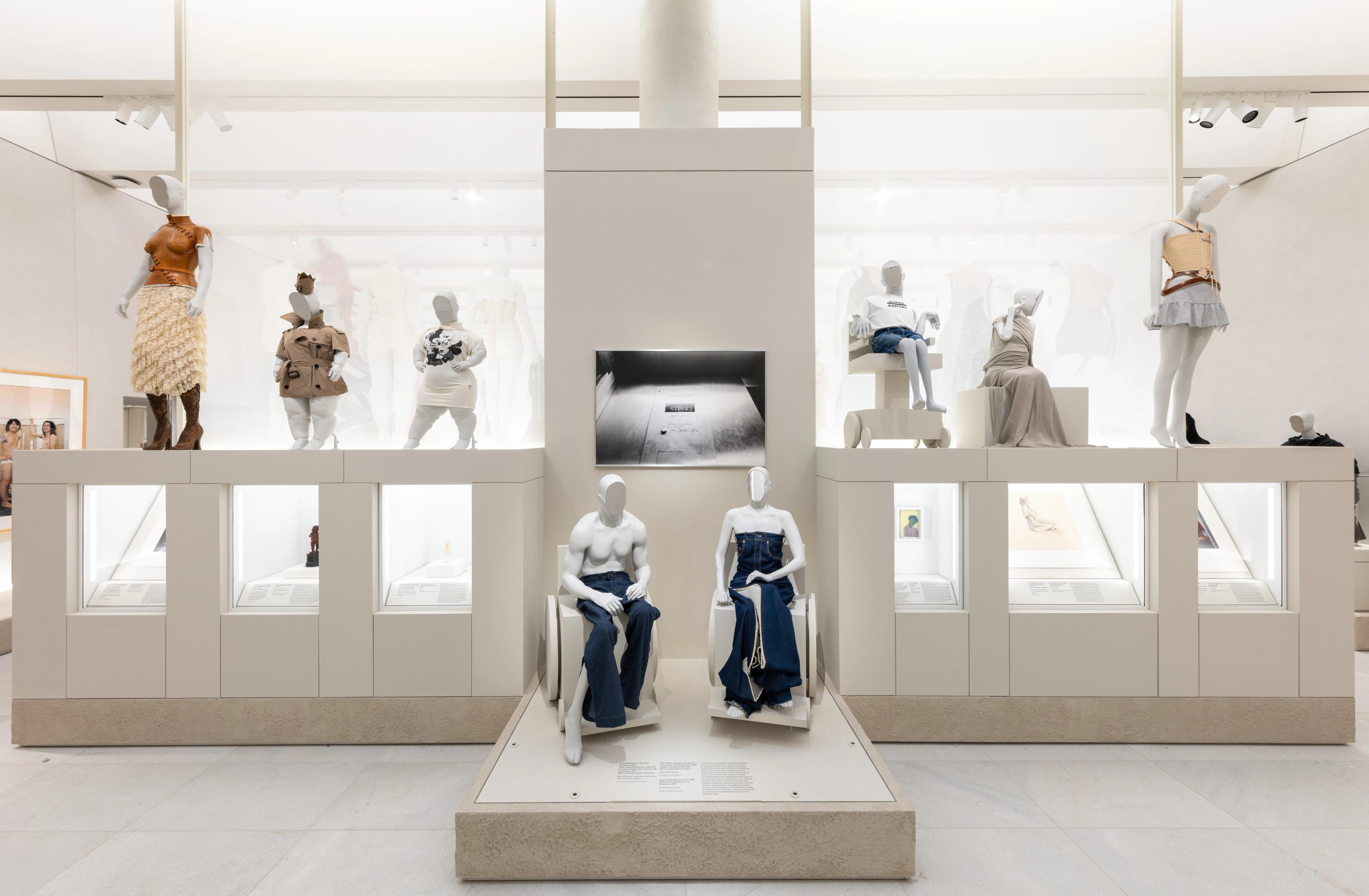
Gallery view of Costume Art featuring the Disabled Body section of the exhibition. Photo by Anna-Marie Kellen
Conceptualization
Joyce Fung:
Representing a real body—a unique body—is more artistic. Most of the mannequins we use are retail mannequins—except for our historical mannequins, which are specialty mannequins. In retail in recent years, plus-size, petite, and disabled bodies have been created. But in this environment, they’re trying to make things equal by designing a generic or prototype body, so it’s still in a way less unique and more standard. The models who we worked with to create the mannequins for this exhibition have unique features, unique proportions. So you’re really going to get a feel for how special each mannequin is.
Charlie Reynolds:
It’s an incredible choice during this time specifically, when we’re seeing such a lack of diversity in bodies, to create this plethora of mannequins to represent fashion and the body. We are seeing fashion happen and admiring the art. And we have to ask ourselves, Are we admiring this because of the person wearing it? Are we admiring this because of the unobtainable beauty standard that fashion has placed on such a high hill for so long? Or are we interested in the reality of what those designs are and the real bodies wearing them? There are so many people with a vision of how fashion is also art, who are going down this path of untraditional beauty standards, and it’s elevating their art to another level.
Michaela Stark:
It is such an amazing moment in time to be showing bodies in the way that Andrew Bolton is showing bodies. And the way that he’s using the exhibition to acquire pieces and acquire mannequins so that the collection can grow in a more inclusive way, especially considering that so many of these conversations revolving around the body are actually bubbling down, or turning into something different, or don’t feel as positive at the moment. So it’s really powerful for such an extraordinary institution to be doing that.
Yseult:
The idea that my body could be part of this sartorial lineage felt like a quiet revolution. It reminded me of Joséphine Baker entering the French Panthéon—when someone who was never “supposed” to belong finally takes up eternal space.
Sonia Vera:
I didn’t really see this as a modeling job; I saw it as an incredible opportunity, something I felt—unlike any other job—really honored, really represented a voice, the chance to represent those who are wheelchair users and those with a disability.
Aariana Rose Philip:
Being first scanned for Women Dressing Women (The Costume Institute’s fall 2023 exhibition) was a completely surreal experience, and it deeply touched the core of my soul. As someone who feels mostly overlooked and unappreciated in the fashion industry as a disabled and Black trans model, to be honored and represented as a mannequin in that way, to be on display as myself in The Met was mind-boggling and very gratifying. It was like a fairytale. I had thought that these kinds of opportunities were once in a lifetime, but to be able to do this again in Costume Art does not even feel real, and I am just so grateful from the very bottom of my heart.
Aimee Mullins:
All of us today have a device in our pocket that allows us to take images of whatever we want whenever we want, and I’m aware that the pictures all tend to stay on our phones. Rarely do we print these out anymore, so we don’t have physical artifacts of what we looked like. The idea that this representation is three dimensional thrills me. Of course, it’s an artifact for myself and my own curiosity, but I’m also excited to see it grouped with all of these other bodies. Maybe it’ll be a subtle reminder to all of us to really savor an experience with something tactile rather than something virtual or screen-based.
Sinéad Burke:
To be in a position where my physicality could provoke questions, conversation, could create belonging, or give some people comfort or a sense of reflection—I was really just overcome and immediately wanted to say yes.
Ivin Ballen:
I’m fortunate to have this photography equipment and business and to be in a position to work with The Met on a project that aligns with an evolution away from conventional ideas of beauty. It really highlights that people are different, and they look different, and they’re shaped differently. And it’s beautiful.
Andrea Bonaveri:
This project is revolutionary in the most subtle and important way: It shifts the axis of perspective. What I appreciate is that it broadens the frame. It does not reject what came before; it adds nuance. For decades, fashion has worked with idealized forms to express aspirational beauty. But now there’s an opportunity to add new voices, new silhouettes, new presences. These figures do not deny the past; they complete the picture. And in doing so, they invite a broader and more inclusive reflection on identity, perception, and beauty itself.
Approach
Ivin Ballen:
We use a process called photogrammetry. It’s basically an array of cameras that are all synchronized to go off at the same time. It’s lit by strobe, giving us an instant capture. The advantage of catching that instant moment is that people, even when they’re standing still, are moving ever so slightly, so if a scan or a capture takes longer than a fraction of a second, there are going to be issues with the data from basic movement like breathing, when your chest is moving and your head is bobbing. So photogrammetry has a great advantage: The models really don’t have to stand still for very long, and they can get into position and be relatively calm throughout the process. It really just feels like getting your picture taken. It’s just 175 cameras that are taking the picture.
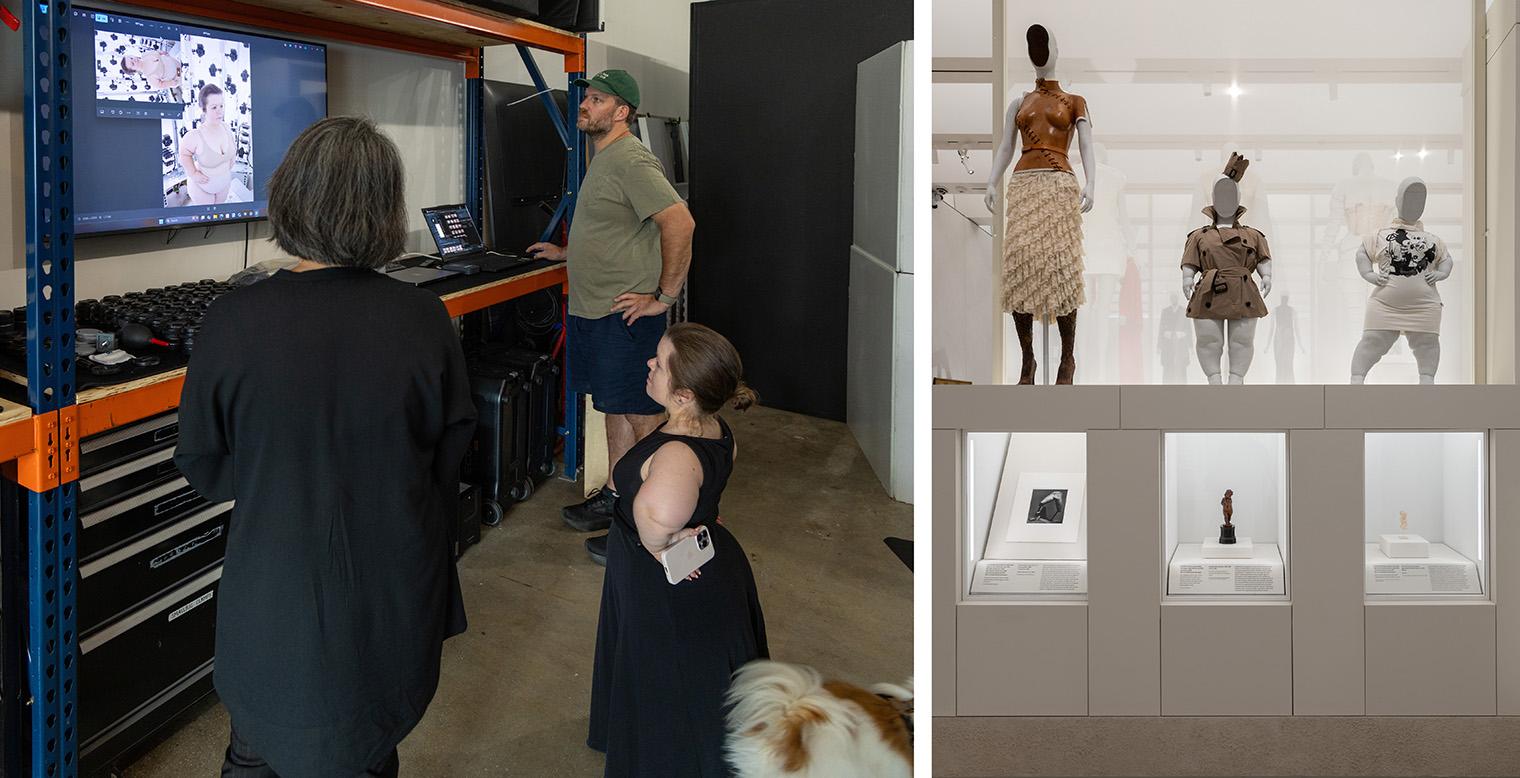
Left: Sinéad Burke reviewing results of photogrammetry capture. Right: Sinéad Burke mannequins (center and right) on view in the Disabled Body section of Costume Art. Photos by Anna-Marie Kellen
Sinéad Burke:
The thing that I was really struck by was that the photo studio in Brooklyn felt like it could have been somebody’s apartment. It almost looked like an elevator bank, in a strange way, that you could just step into, and from that, this 360-degree image could be made of you. In seconds, it became something incredibly physical, like a mannequin in Disabled Body.
Yseult:
It was strangely intimate, almost spiritual. You stand there, motionless, and technology becomes your mirror. It captures everything: the asymmetry, the weight of reality. I thought about artists like Auguste Rodin who sculpted bodies with emotion not perfection. That’s how it felt like being sculpted by light. I wasn’t performing; I wasn’t edited. For once, the gaze wasn’t judgmental; it was archival. That moved me profoundly.
Sonia Vera:
I felt free. I felt really content and almost like I’ve arrived.
Aimee Mullins:
I had a career as an athlete before I was a model, so the idea of my body as a tool in and of itself is very known to me. That’s actually why I think I wasn’t a great editorial model, because there’s so many poses that make clothes look great, but I can’t really do them because I don’t have ankles. So the modeling of clothes almost always was secondary to me in understanding the placement of my body and trying to release the tension that I tend to retain from having to hold my body up. The whole time I was being scanned, I was being shown an image of myself from nearly thirty years ago, which was a freeze-frame of a runway walk. So trying to replicate that position is entirely sculptural and a little bit energetic. After the initial feeling of, “Oh my goodness, this is a lot of cameras, and I’m feeling very naked,” I just got over it and executed the thing I needed to do.
Antwan Tolliver:
I’ve never had so many cameras on me at one time. I was like, wait, this looks like how the video games are created. It was so cool. It just brought me back; I felt like a kid again. Well, I was in my underwear, so…
Yseult:
When you model clothing, you transform, you become someone else’s vision. When you model your own body, you reveal. It’s not about seduction or style; it’s about existence. In fashion, you’re often a projection. Here, I was myself. There’s a political dimension to that. Standing there as I am is a statement: My body matters too.
Sinéad Burke:
I rarely reveal that at the backs of my legs, around my ankles, there’s more muscle than space, so it requires a roll of the skin, which is not something that most people have, so it feels different. Then it feels strange and then feels uncomfortable, even though it’s just natural and a part of me and a part of my body. So the dissonance between wearing clothes and clothes being an invitation to discuss different kinds of bodies, and then the explicit examination of different kinds of bodies without those clothes, without concealment, are a recognition of who I am, this is what I look like. It’s not an exercise in shame. It’s an exercise in pride, an exercise in existence.
Joyce Fung:
For Michaela, there was an expectation that I would help with some of her costumes. Working with a live body is certainly different from working with a mannequin or a dress form. What you discover—which was kind of a surprise but not a surprise—is that the body is warm, and when I’m dressing a mannequin, it doesn’t move. It doesn’t really respond to you.
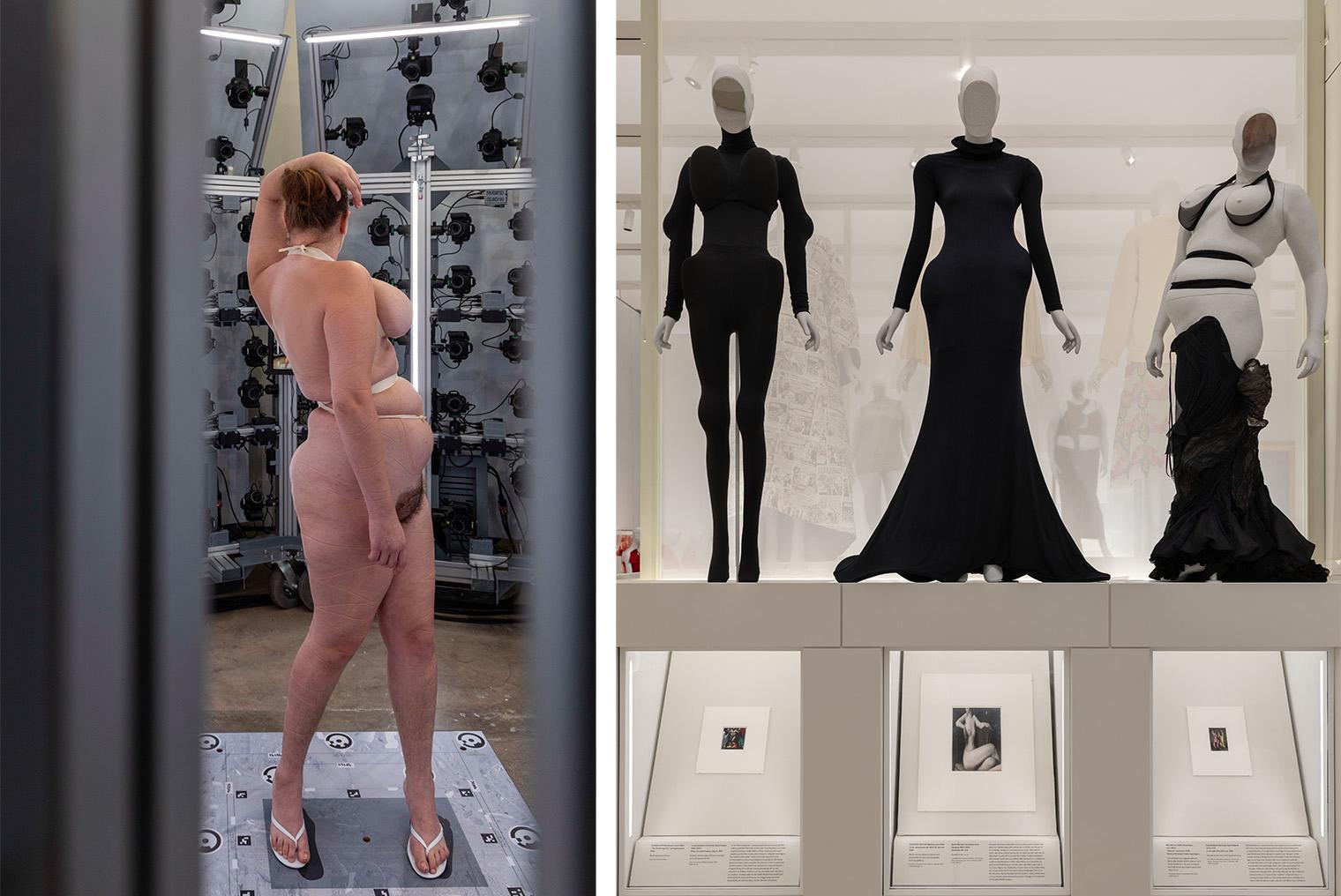
Left: Michaela Stark posing for photogrammetry capture. Photo by Eugenia Tinsley. Right: Michaela Stark mannequin (right) on view in the Reclaimed Body section of Costume Art. Photo by Anna-Marie Kellen
Michaela Stark:
I made some corsets to bring in and wear. I was so creatively free. I put on a corset, and then we wrapped my body in string, and the resulting shapes were translated directly into the mannequins in Corpulent Body and Reclaimed Body. And there was one moment when I couldn’t even walk. It was so fun and free, because that’s how you create the best work: by being limitless.
Yseult:
I wanted to show up as I am, my lived experience. If I had prepared, it would have been a performance. I wanted authenticity, not aesthetics. My body is a living archive of resilience and memory. I wanted the scanner to capture that story.
Ivin Ballen:
And sometimes it’s hard to guess how something’s going to look. There’s a sort of magic that happens when there’s a snap and all that data is captured in that moment. If you haven’t done it, it’s almost hard to believe. It’s really like you’re a facilitator of magic.
Joyce Fung:
During the scanning, my direction to the models was always be a mannequin, do a mannequin pose. A mannequin is something that is static, sort of maybe robotic, maybe like a doll. So standing very straight, standing with limbs symmetrical—that’s where I was trying to go with the live models. Keep them relaxed.
Antwan Tolliver:
Well, the stillness and the poses were very different. Usually I get to be free and flowing, but this one is for a mannequin in Disabled Body. We basically just wanted to use my body. I took the first couple of pictures, and then I started to relax more and get more into it. It’s intimidating at first. I was a little overwhelmed, a little scared, a little nervous, a little bit of everything.
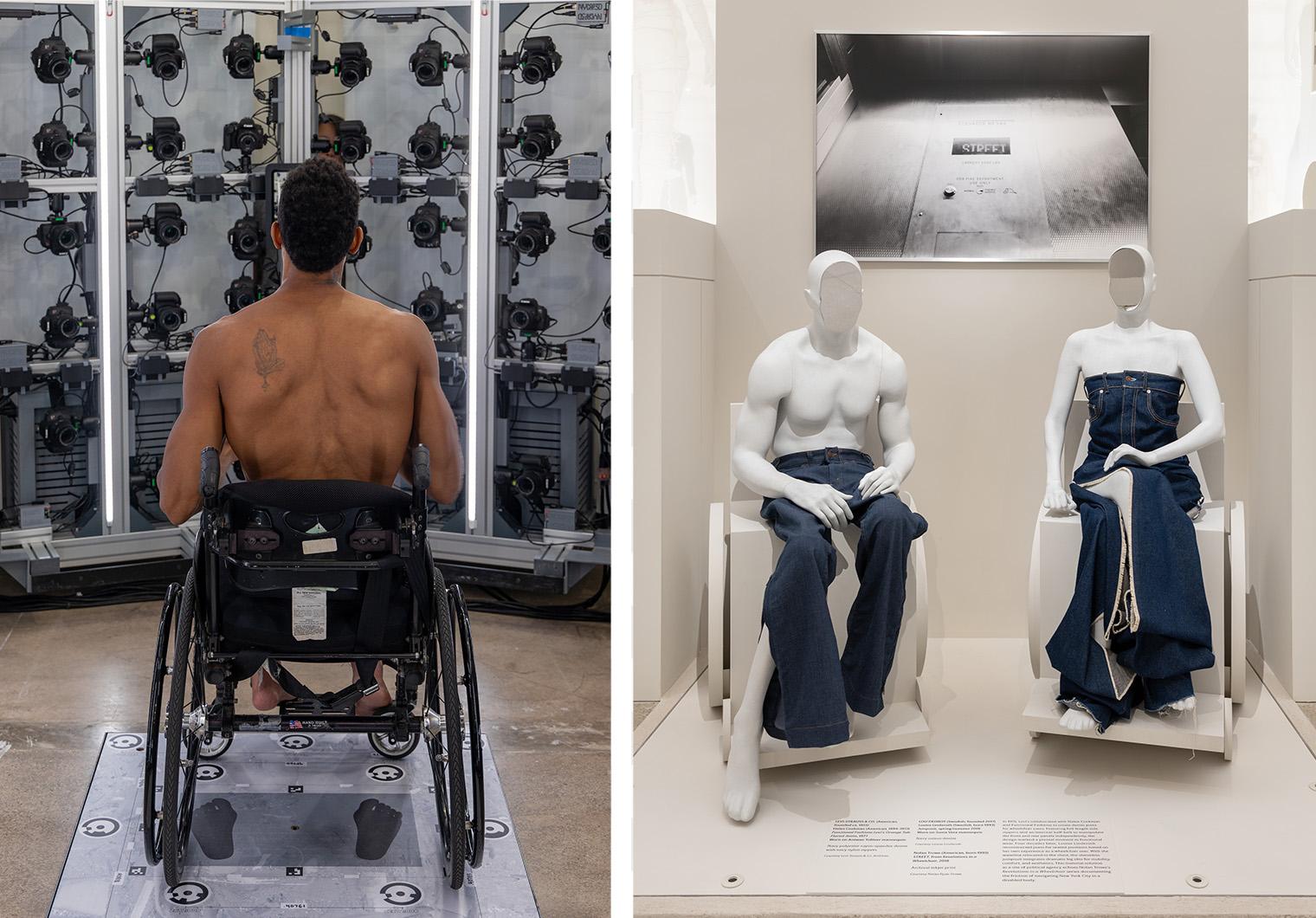
Left: Antwan Tolliver posing for photogrammetry capture. Right: Antwan Tolliver mannequin (left) on view in the ‘Disabled Body section of Costume Art. Photos by Anna-Marie Kellen
Ivin Ballen:
Once we had a dataset, we ran it through photogrammetry software that detected any variations on the skin or clothing in the photo—could be freckles or even tiny pores—and it used all that surface data to construct a 3D mesh. The 3D mesh is very accurate, but it tends to need a lot of cleanup, which is where Frank Benson came in.
Frank Benson:
I received the file from Ivin, and then I basically took that and sculpted it using a program called ZBrush, which is almost like a digital form of clay. I have a palette of tools that I can choose from, and I can move things around and reshape them. A lot of it was smoothing out some of the noise and some of the distracting details that you get when you scan someone. For this project, there was a level of functionality that we had to be aware of, where limbs often needed to be separated in order to allow for the dressing of the figure. And then some of it was removing the clothing so it actually leaves space for the clothing to go back on. All of that was done by moving around a digital form of clay.
Joyce Fung:
This had to be a mannequin that we can dress. So we wanted, for instance, to have the models with their arms slightly away from the body, not touching, because limbs or body parts need to have distinctive spaces in order to put the clothes on.
Antwan Tolliver:
I’d never had this experience before—the mannerisms and some of the poses that I was directed to do.
Frank Benson:
I’ve been working on Antwan most recently. And I just really like the way that one turned out. It’s challenging because the chair hides more of the body than it does in some of the other poses. It’s one of my favorite poses actually. The way that his back is sort of arched forward turned out really well. There’s a lot of beauty in that particular pose.
Joyce Fung:
We did everything in order to make this successful. When dressing the standard mannequin, sometimes if you put multiple layers on, the thickness of the fabric makes it hard to dress, especially between the arms and the body. So, especially in scanning plus-size models, where the limbs are fleshier and where body parts are touching more, we didn’t want to affect the pose and make it unnatural. We wanted it very graceful and elegant, so we asked Frank Benson and the mannequin company Bonaveri to address the areas where maybe the limbs are touching in our scan.
Frank Benson:
It’s been interesting because I tried to prepare the model so the setup could be fairly well interpreted and useful for Bonaveri to take to the next step. In a way, that’s a little bit of a relief for me because there’s somebody else that takes it and gives it that sort of final treatment and preparation for the mannequin fabrication. It relieves me of a little bit of the responsibility so I can focus more on how to treat it aesthetically.
Andrea Bonaveri:
The digital file marks the beginning of our operational work: From that moment, a highly specialized process begins that requires precision, attention, and refined sculptural skills. The most delicate phase involves defining the cuts—the points where the limbs are separated from the body—which are essential for properly dressing the mannequin. These cuts are never standardized but are custom designed for each figure, in close relation to the costume they will wear. It is entirely manual work, carried out by our sculptors with great rigor. Each cut must be precise, invisible once assembled, and functional at the same time.
Realization
Yseult:
The idea that this version of me will live on, motionless, while I keep evolving—it’s a strange duality. But that’s what magic does: It freezes a moment that was once alive. There’s something almost mythological about it—like the marble bodies of the Renaissance—except this time the body is contemporary, imperfect, beautiful.
Jade O’Belle:
To have my body be a reference point in Corpulent Body for histories and memories, taking up space in the world today, and then it be alongside all these artifacts and goddesses from the past that told stories and represented concepts for the people who were in that time… And then for that to be all present together, it’s a dream come true. It’s so affirming.
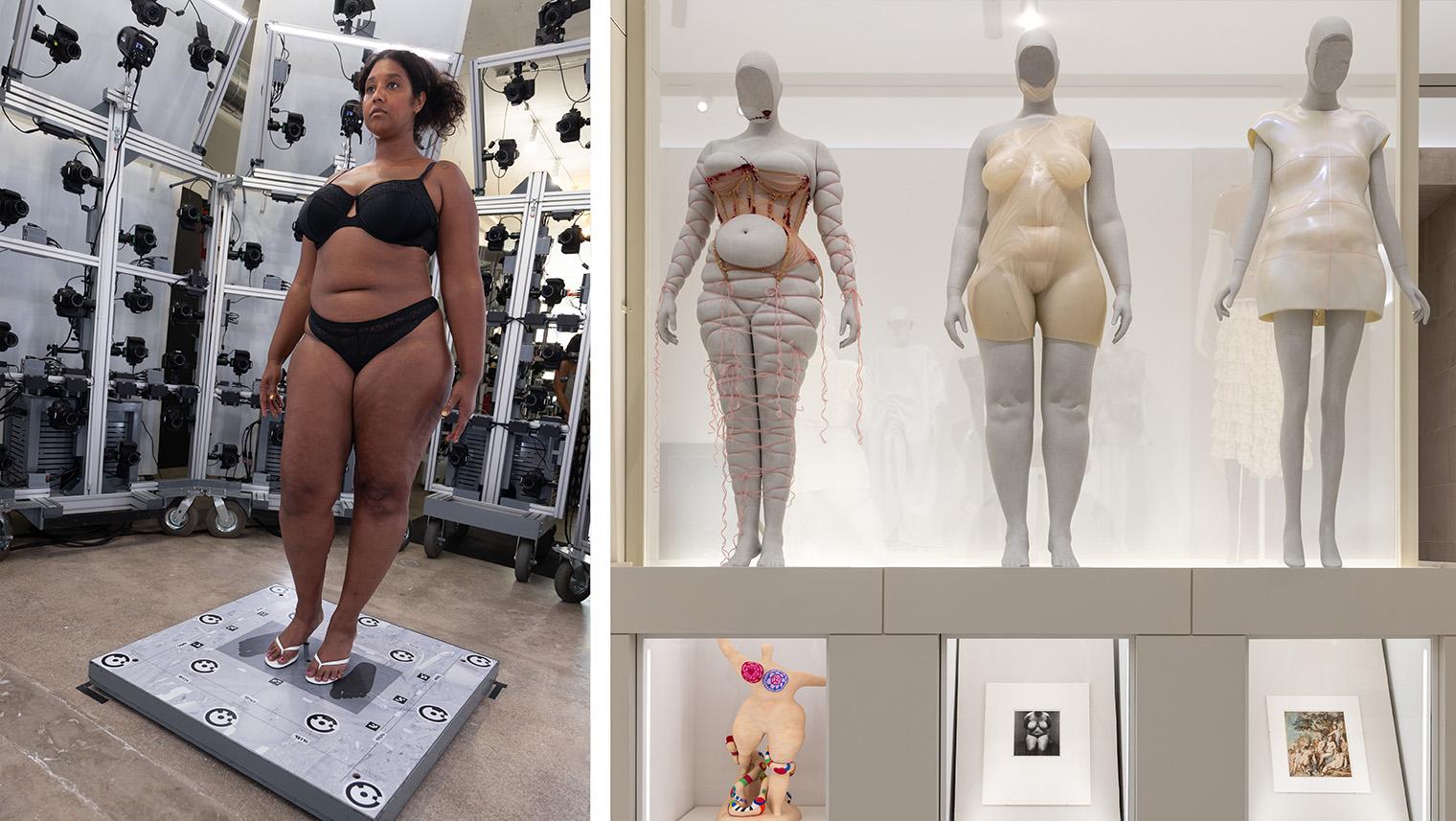
Left: Jade O’Belle posing for photogrammetry capture. Right: Jade O’Belle mannequin (center) on view in the Corpulent Body section of Costume Art. Photos by Anna-Marie Kellen
Sinéad Burke:
In terms of it being frozen in time, having gone through the process twice, I feel a sense of humility in thinking about legacy and legacy memory. And in so many ways, yes, that’s my body, and I have a sense of ownership and agency over it. But I also acknowledge that once the casting process happens, people will reflect on that body with whatever they’re coming to at that moment in that exhibition. So even though it’s me, it’s actually not me in the sense that it then becomes detached from me. It takes on a life and a space and a character within an exhibition. But also other women with dwarfism who may come see the exhibition, or parents, or family, or people with disabilities in general—they will find a different meaning that is absent of me. And I feel that that has great power, because that is what the majority of non-disabled people get to experience in every exhibition, in every retail venue: that sense of… anonymity.
Michaela Stark:
I feel that I’m actually so used to seeing my body as an object at this point that it is for me an emotional way to express myself through my body. But there’s also a disassociation that happens when it’s made into an artwork and it’s no longer me. There’s a disassociation when it becomes about beauty. It sounds horrible, but it’s actually quite nice. It’s no longer me, so I can disassociate and treat it like an artist might treat their painting.
Charlie Reynolds:
It’s even more than an image. It’s me. How insane is that? I feel grateful and very touched that The Met saw in it something so significant. My body, as it is, no changes, no insecurities, a blank canvas, is going to be able to hold pieces of art, pieces of fashion in Corpulent Body. And I hope that the way that it is perceived elevates the beauty that it’s carrying.
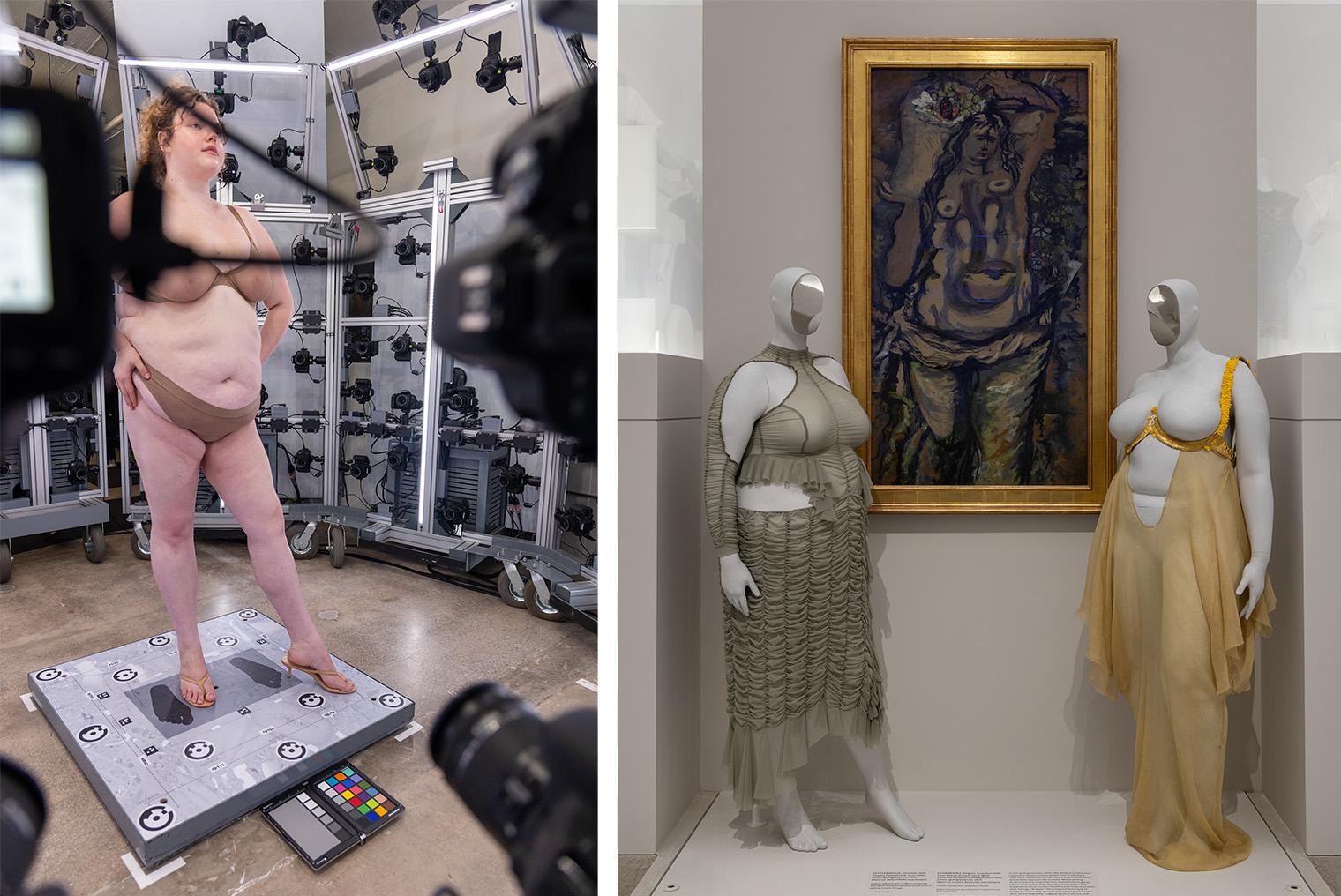
Left: Charlie Reynolds posing for photogrammetry capture. Right: Charlie Reynolds mannequin (left) on view in the Corpulent Body section of Costume Art. Photos by Anna-Marie Kellen
Andrea Bonaveri:
Fit is an invisible art that requires experience, tactile and aesthetic sensitivity, a sense of proportion, and the sculptor’s ability to shape matter. It takes an expert eye, capable of perceiving and working on detail. When a mannequin truly succeeds, no one notices the complexity of the work behind the right tilt of a shoulder, the angle of a wrist, or the nuances of the body’s attitudes. Every mannequin we create must honor both the costume and the story it carries. This means the technical aspect must never overpower the emotional one. The ideal result is a harmonious encounter between figure and fabric.
Charlie Reynolds:
So whether that be the design that it’s wearing, the statue nearby, perhaps a painting, people being able to look at themselves in the mirror and have it reflected back onto them, it is really an amazing touch of self-reflection, of seeing this body in front of you and just accepting it as it is, as a reflection of the human body, the human body as a part of a canvas. This is fashion art.
Joyce Fung:
The mirrored mannequin heads sculpted by Samar Hejazi are something new. We haven’t done a reflective surface before. In general, people like to look in the mirror, although some people don’t like looking at themselves. Interacting with the mannequin’s face might offer something new to the visitor.
Ivin Ballen:
When I heard The Met was taking away the heads, I was like, oh, their heads are attached to their bodies. To me, that’s a part of their body identification. But learning that the heads are mirrors is amazing. It’s almost like all the models, all the talent are donating their bodies to this cause, this awareness. That being said, mannequins are typically without identity anyway. They’re supposed to be neutral. So it’s a great decision and a metaphor: Seeing a mirror on a mannequin face is obviously going to immediately inspire self-perception.
Sonia Vera:
I find it incredibly powerful that our heads are mirror cubes, because it really will be everybody who steps in and sees their face. And in Disabled Body it’s connected to my body. That could be you.
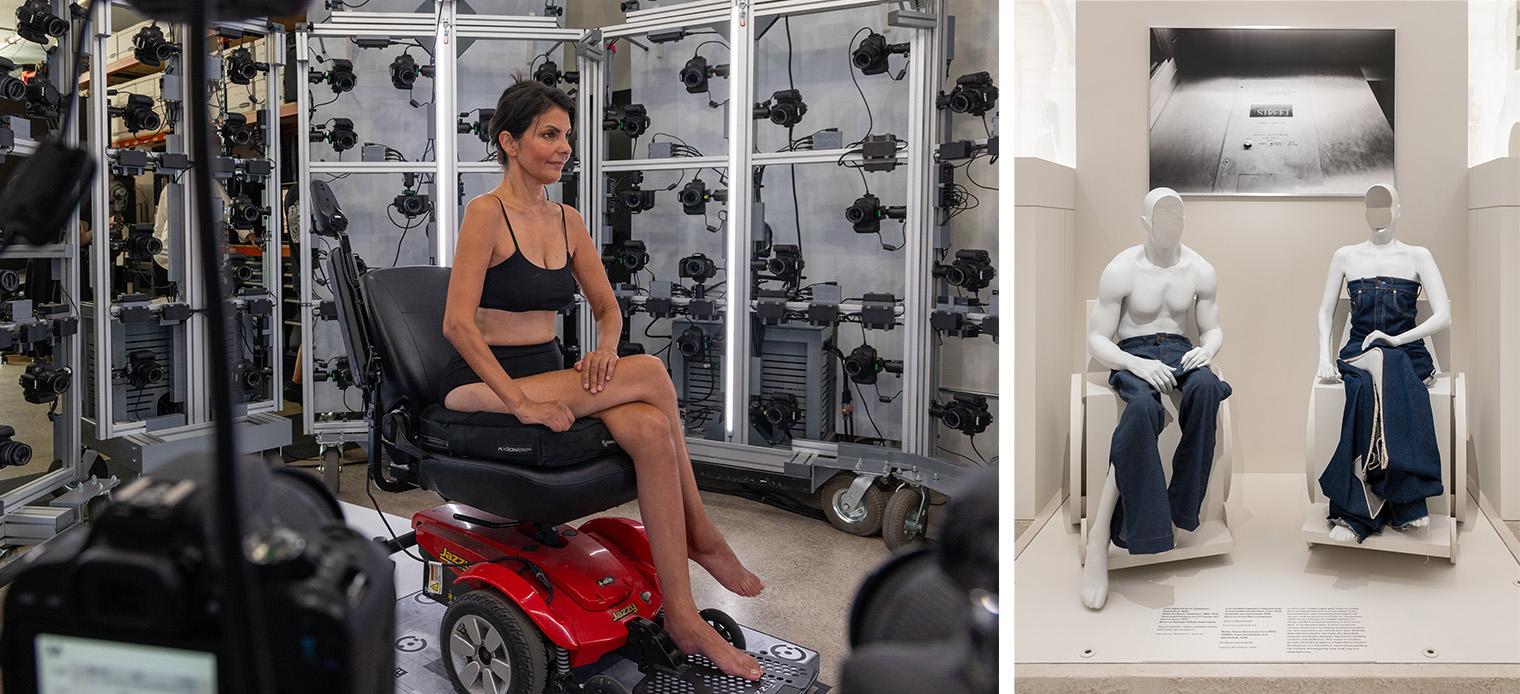
Left: Sonia Vera posing for photogrammetry capture. Right: Sonia Vera mannequin (right) on view in the Disabled Body section of Costume Art. Photos by Anna-Marie Kellen
Reflection
Andrea Bonaveri:
Mannequins are powerful because they exist in a paradox: They are objects, but they can also mirror real bodies and real experiences. It do not speak, but it suggests. In this exhibition, it becomes a silent conversationalist. These bodies, which bear traces of time, trauma, diversity, and desire, remind us that fashion is not a spectacle detached from life. It is life, shaped and staged. When visitors encounter these mannequins, they encounter themselves—in difference, in recognition, in vulnerability. In this exhibition, the mannequins do not just carry costumes; they carry perspective. They are not representations of ideals but reflections of reality, of possibility.
Sinéad Burke:
I hope that this encourages people to visit. To come. To see themselves. To trust that there has been consideration given to them being able to come. And more than anything, what I want visitors to come away with is an expectation that this is not a trend. That this is not a headline. That this is how we curate and represent forevermore, and we can only go further. I hope that they hold us to that expectation.
Antwan Tolliver:
It isn’t optional. It’s necessary for society to thrive. Everyone wants to feel included. I hope that it opens visitors’ minds to see people with disabilities as fashionable.
Aariana Rose Philip:
And to understand that we are of great value to the world and the arts.
Antwan Tolliver:
I go out, and I like to dress. I like to look nice. It builds my confidence, it makes me feel good, right? But I notice the stares that I get as if I'm not supposed to be… I just want people to expand their minds and to not have a stigma about people with disabilities when they see us out, dressed nice. Just because I'm in a wheelchair, because I have a disability, I'm supposed to be down and feeling sorry for myself? No, I feel great. And I want to show that I feel great by the way that I dress.
Aimee Mullins:
My hope would be the same for everyone, which is that they consider how unique their body is. There’s no other body just like yours on the planet, and I think that’s an incredible thing to ponder. How these differences manifest physically in someone’s life—their genetics, their choices—here it all is in this container that walks around, or rolls around, or however it gets around.
Yseult:
I hope they feel something real. I hope they question what beauty and fashion mean when the body itself becomes the story. I want them to see humanity before they see couture. My body in that museum says there is no hierarchy of beauty. If someone walks away feeling seen, even a little, then the mission is complete.
Jade O’Belle:
The vulnerability in showing yourself and allowing someone to see it, and feeling permitted to be free in your body even though maybe this is not conventionally what is allowed to be seen, I see beauty in it and the surroundings. Maybe I can also have that in my body and have permission to also feel beautiful and be seen and take up space in places where maybe I don’t feel like I have permission to.
Aariana Rose Philip:
I felt understood rather than misunderstood, overlooked, or rejected for who I am. Contrary to what others may think when they see me or see my accomplishments, I don’t get to have that experience a lot in my life—of feeling genuinely valued or being treated that way either. It’s very meaningful to me. Disabled folks, especially children, getting to go to The Met and see somebody like me as a statue or mannequin is a big reason why I even proceeded with my modeling career in the first place.
Yseult:
My career has always existed in a tension between celebration and rejection, inclusion and tokenization. People love to call me brave, as if existing in my own skin were an act of courage. It shouldn’t be! When visitors see my form in Corpulent Body and Inscribed Body, I hope they understand that representation is not decoration. Bodies like mine carry stories that have been systematically erased. It’s time to shine now.
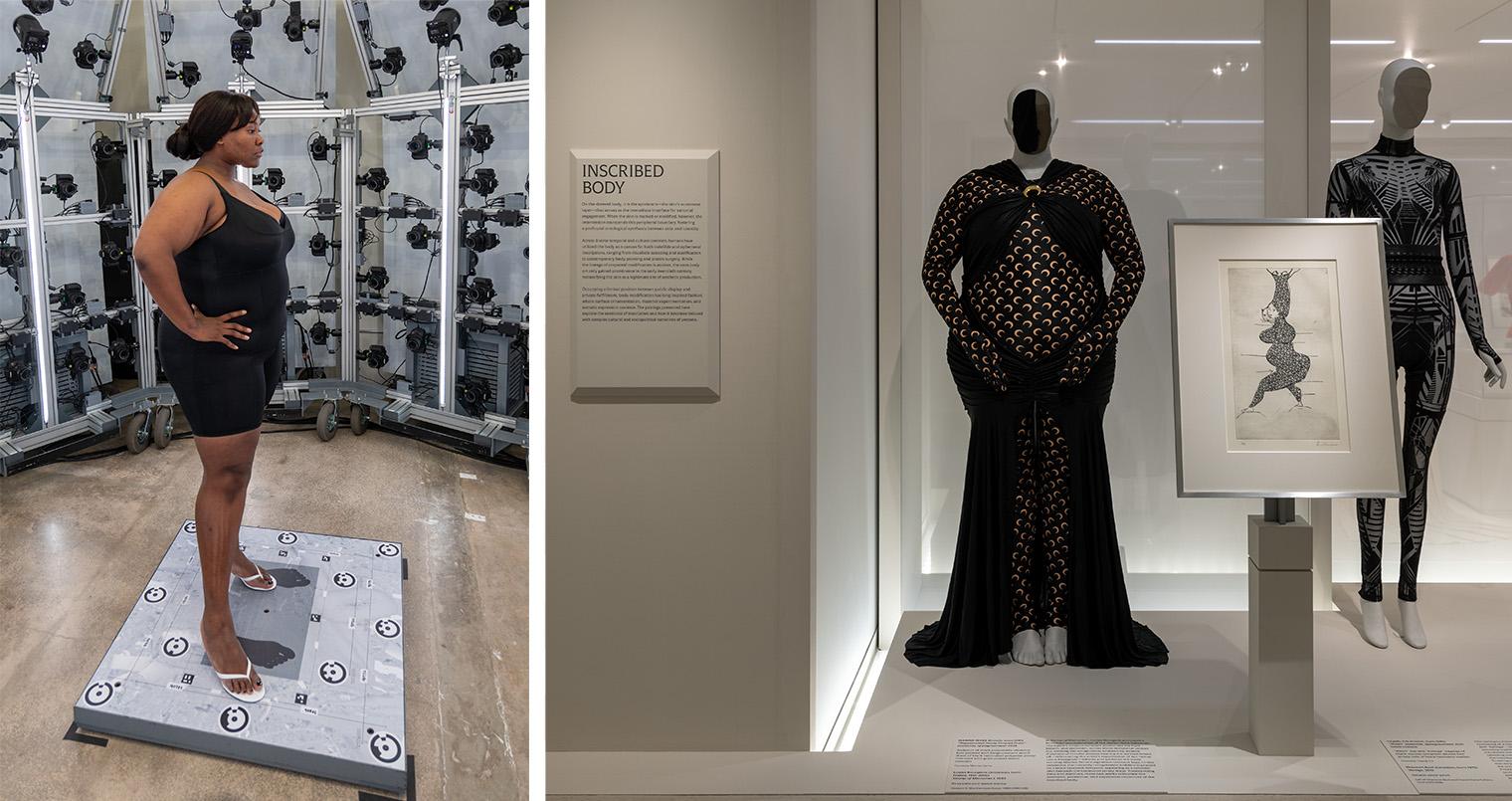
Left: Yseult posing for photogrammetry capture. Right: Yseult mannequin on view in the Inscribed Body section of Costume Art. Photos by Anna-Marie Kellen
Embodiment for me is the act of saying I belong here as I am. Philosophers like Maurice Merleau-Ponty wrote about the body as the primary site of perception, and I feel that deeply. My music, my performance, my voice all come from this body.
Michaela Stark:
If you’re embodying an emotion, you’re embodying something, you’re embodying a movement, you’re feeling that through your bones, and you’re feeling it so fully, and it’s almost an expression of emotion in some kind of way. It’s funny because sometimes I put the corset on, and if there is pain involved, I feel that right before and right after. But then there’s a moment that I’m actually modeling, and I know the camera is on me, and I feel kind of serene. I really tap into that, and I can disassociate from the rest of the room and tap into exactly what’s happening. And that’s a really beautiful moment. Even if I’m being photographed, I don’t look at the lens; I defocus my eyes so I can’t see anything. I don’t know why, but I kind of disassociate in a weird way so I can try to connect with my body.
Sinéad Burke:
An embodiment for me feels like the central axis, having a sense of acknowledgement and comfort of who you are. And also acknowledging that who you are can be shaped, tainted, changed by external factors and external voices. But that embodiment is holding tight to that sense of self, as you move through the storm of that cacophony.
Aariana Rose Philip:
It’s representing something in fullness and to great capacity, if not maximum capacity.
Charlie Reynolds:
Power over oneself, that ownership. Fully holding onto everything that you are. Owning that power. Embodying that kind of truth.
Aimee Mullins:
An energetic inhabitation—that’s what I think is fascinating about a collection of scanned bodies that have been turned into mannequins. The energetic intent will be in that scan.
Sinéad Burke:
In terms of that embodiment, the thing that I’ve really tried to hold onto is that, now more than ever, I exist in a world where people make me feel less than human because of the body that I live in—something that I did not choose, but I would choose again and again if I had the choice because of the destinations in life it has brought me to. And for me, embodiment is about encouraging myself and others not to necessarily ignore that cacophony of voices but to feel encouraged, empowered. And to feel activated to create change in how people see, treat, value, and respect others.
Michaela Stark:
I’m a designer and an artist who creates clothing that morphs the body and transforms and sculpts the body entirely. And that can be to show parts of the body that we’ve been conditioned to hide, or that we’ve been conditioned to see as unattractive or ugly or vulgar. And I love to emphasize those parts of the body, like the tummy or the boobs, uneven boobs, in order to celebrate it and shift the way that we see the human body by literally sculpting it in a new way so that we can maybe appreciate its beauty. And this experience just allowed me to develop a whole new appreciation for my body and the forms that it could create, and it made me realize that the beauty in the human form doesn’t have to be so linear, and it doesn’t have to be in such a small box.
Yseult:
Beauty is not perfection. It’s Frida Kahlo painting herself in pain. It’s Nina Simone singing “Mississippi Goddam” with fire in her throat. It’s a scar, a breath that refuses to be polished. Beauty is what remains when you stop performing for approval. It’s the moment when art becomes human again.
Sonia Vera:
I was a former model for eighteen years. I ran my own business—my own swimwear brand—did Mercedes-Benz Swim Week... my whole image really was about my body, my talent as a designer and being an entertainer. One day I woke up as a disabled person, and I was stripped away from that identity. Beauty to me is somebody’s personality. Somebody’s energy is beautiful to me. How they show up to the world is beauty. It’s like your energy is embodied in the posture, even. What we forget about the body is that it really is this kind of communicator of what’s going on inside.
Antwan Tolliver:
It’s that inner confidence and that glow.
Charlie Reynolds:
So much can be beautiful. It doesn’t always have to do with the way you look but the impact of your presence. We’re looking at somebody through the eyes of someone else and then depicted on a canvas, or on a statue, or on a carving. Going into the detail of that creation, it’s so easy to find beauty in it. It’s so easy to see a rounder, more voluptuous figure and think how beautiful it is that someone painted this with such detail.
Aariana Rose Philip:
Beauty as a concept is quite subjective and limitless. I think that the world’s definitions of mainstream beauty are like a prison and are extremely ignorant and limited. I think that lots of people get disqualified from being realized for their beauty and full potential because of the extremely limited ideas of beauty and desire in this world. I wish that everyone felt and treated each other as though they were beautiful, and worthy of gentleness and compassion.
Michaela Stark:
In any other context away from the human body, we can appreciate beauty for what it is and do not need to compare it to something else. We don’t need to compare beauty within nature. We don’t even need to compare beauty within different fashion garments. We can appreciate the beauty of one thing and then something completely different. But for some reason, within the human body, what we see as beautiful is so limited. And I really think that it’s holding us back within the creative arts and within the fashion world. Such a small, pigeonholed idea of beauty is stopping us from being able to create.
Yseult:
Museums often show idealized bodies, the ones that fit within Western ideas of proportion and control. I exist in the opposite, and this project feels different. It’s a dialogue between what art and fashion history was and what it could become. Seeing my body at The Met is about rewriting a visual language that has excluded so many for so long.
Jade O’Belle:
The pieces around The Met, all the goddess sculptures—you look at their bodies, and you look at paintings, and you see the curve of the stomach, or the back, or the shoulder, or the forearm, and how it looks with the wrist. Everybody’s body is just amazing, especially a female body, a feminine body. It’s just delightful.
Aimee Mullins:
I always think if you really do linger in a museum and look, you’ll find stories of bodies that weren’t the normative standard of what societies consider “able-bodied” to be. One of the most moving experiences I’ve ever had in any museum was in Cairo, when I was standing at the sarcophagus of a woman who they think was Queen Hatshepsut’s nurse. She lived to a great age for that era, and she lost her big toe on one foot. She had had a prosthetic toe made from linen that had been dipped in layers of gold. It was beautiful. When I moved down to the base of the sarcophagus, which was glass, I saw that the bottom of the prosthetic toe was nearly worn through. You could see the linen fibers. And right then and there, I envisioned this woman walking around with her big amazing gold toe, and I just felt like she must have rocked it and been proud of it. I will never forget that experience—having the sense of a shared connection over thousands of years—from just standing in a museum.
Charlie Reynolds:
We’ve changed our standards in such an interesting and drastic way. Reflecting back on Renaissance art, and the way women are depicted in ancient art, in fertility statues, in Greek statues—the bodies were depicted so differently. They were much softer, much gentler, unlike this very sharp imagery that we’re seeing more of today. So it’s such an interesting idea to reflect on these designers who are highlighting different body types in their fashion, in their art, mirroring art that we see of women from times past.
Jade O’Belle:
The way that the industry is going at the moment, where we’re kind of backpedaling away from accessibility and inclusivity… An institution such as The Met is still putting their foot down and saying no, this has space. This is actually what’s happening within fashion—the real conversations about society through fashion.
Sinéad Burke:
Pieces from my wardrobe that are very important parts of my visual language and my visual life are now in the permanent collection of The Costume Institute. I think about how that might be used for research, how that might be used for learning. But I also think about how important it is that the exhibition is more representative not only because of mannequins but also because of the collection that’s evolving and developing over time.
Yseult:
Behind that mannequin stands a little girl from France who dreamt of being seen. She, who once felt invisible, now stands in The Met not as an object but as an inspiration. It’s a moment where personal becomes universal. Where history reflects the world we live in… all of it.
This essay is adapted in part from the catalogue for Costume Art. The exhibition is on view through January 10, 2027.