In 1880, six leaders of the Apsáalooke/Crow Nation traveled two thousand miles over two months from Montana to Washington, D.C. to negotiate land rights with President Rutherford B. Hayes. During their five-week sojourn in the nation’s capital, the six men sat for individual portraits and one group portrait in the studio of photographer Charles Milton Bell; an earlier delegation in 1873 was similarly photographed. These sittings continued a centuries-old tradition rooted in European colonization that employed portraiture for diplomatic purposes. In the agreement following the 1880 negotiations, the Apsáalooke were forced to cede approximately twenty percent of their land to the U.S. government for the expansion of the Northern Pacific Railroad. One of the six delegates, Déaxitchish/Pretty Eagle, recalled his experience: “The whites got together and talked until it made my heart feel dead.”
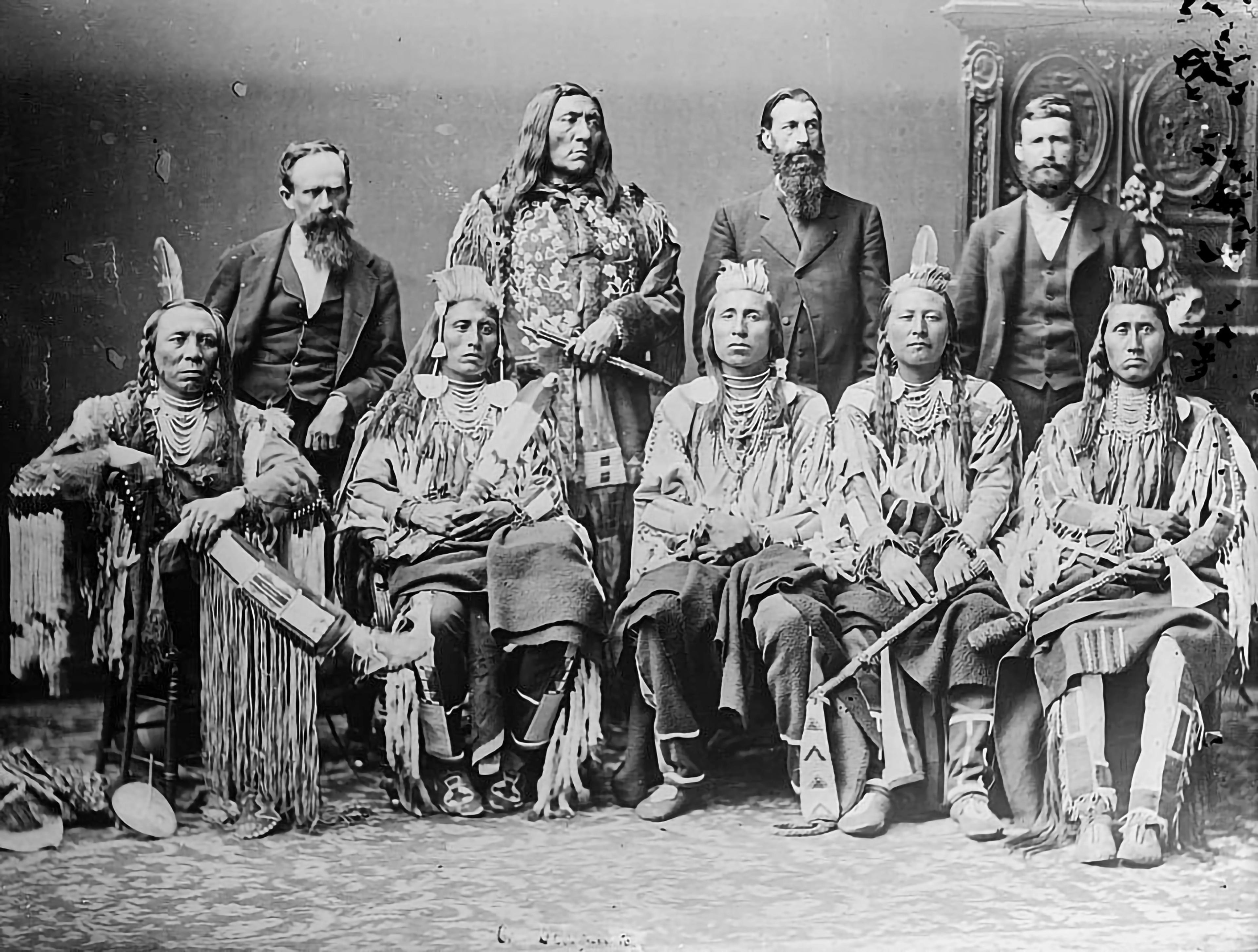
Back row (standing) from left to right: A. M. Quivey (interpreter); Bia Eélisaash (Two Belly); Augustus R. Keller (agent); and Tom Stewart (interpreter). Front row (seated) from left to right: Peelatchixaaliash (Old Crow [Raven]); Peelatchiwaaxpáash (Medicine Crow [Raven]); Iichiilachkash (Long Elk); Alaxchiiaahush (Plenty Coups); and Déaxitchish (Pretty Eagle). Charles Milton Bell (American, ca. 1849–1893). Delegation to Washington, 1880. National Anthropological Archives, Washington, D.C. (NAA INV 06576000). Courtesy Smithsonian Institution
Bell’s delegation photographs are formulaic studio portraits that were intended as ethnographic records of what was then thought to be a vanishing race. It is not known if his subjects received copies of their portraits. The negatives were subsequently relegated to the archives of the now-defunct Bureau of American Ethnology. Within a decade, the sitters’ likenesses were co-opted for commercial purposes, appearing on trade cards (the forerunner of the baseball card) and in advertisements as generic representations of Native Americans. Over time, the identities of the Apsáalooke/Crow leaders were either lost or ignored, and individuals were reduced to types. In 2008, Bell’s portrait of Peelatchiwaaxpáash (Medicine Crow [Raven]) on the label of a bottle of iced tea in a Los Angeles supermarket caught the attention of artist Wendy Red Star, herself Apsáalooke.
This moment of discovery served as the catalyst for Red Star’s research into the identities of Bell’s subjects, which resulted in her 2014 series, 1880 Crow Peace Delegation. As she explained in a 2014 interview, “I wanted people to realize that the images of Medicine Crow were of a human being, a reservation-era chief with important ties to the forming of the Crow Indian Reservation, the loss of Crow lands, the changing of a people, and the resilience of a culture.”
Portraits from Wendy Red Star’s 2014 1880 Crow Peace Delegation series (clockwise from top left): Alaxchiiaahush/Many War Achievements/Plenty Coups (2019.332); Bia Eélisaash/Large Stomach Woman (Pregnant Woman)/Two Belly (2019.331); Peelatchixaaliash/Old Crow (Raven) (2019.328); Peelatchiwaaxpáash / Medicine Crow (Raven) (2019.336). All Inkjet print of artist-manipulated digitally reproduced photograph, 24 × 16 1/2 in. (61 × 41.8 cm). The Metropolitan Museum of Art, New York, Purchase, Nancy Dunn Revocable Trust Gift and John B. Turner Fund, in memory of Loren G. Lipson M.D., 2019 © Artist, Wendy Red Star
By manipulating digital reproductions of ten of Bell’s original photographs, Red Star transformed them into powerful expressions of Apsáalooke/Crow identity. She outlined in red ink elements of the formal attire that signal the sitters’ high status in Native society; she also individualized their portraits with handwritten annotations, drawing from archival biographical research as well as from her own experience growing up on a Crow reservation in Montana. She likened her artistic interventions to “marking on history.” Art historian Nadiah Rivera Fellah has suggested that Red Star’s selective outlining alludes to the colonizing practice of “redrawing” territorial boundaries.
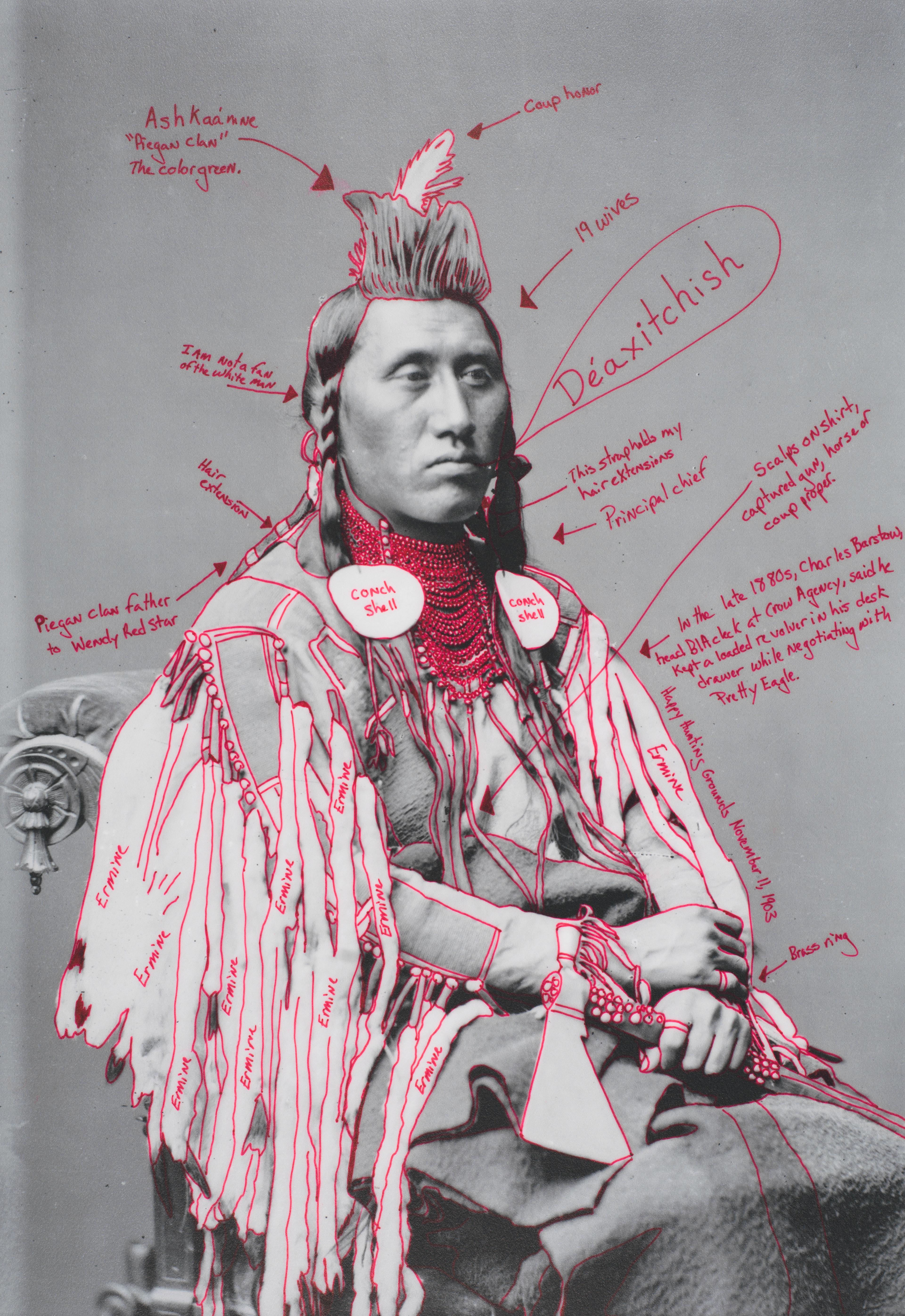
Wendy Red Star (Apsáalooke/Crow, b. 1981). Déaxitchish / Pretty Eagle from 1880 Crow Peace Delegation, 2014. Inkjet print of artist-manipulated digitally reproduced photograph, 24 × 16 1/2 in. (61 × 41.8 cm). The Metropolitan Museum of Art, New York, Purchase, Nancy Dunn Revocable Trust Gift and John B. Turner Fund, in memory of Loren G. Lipson M.D., 2019 (2019.337 and 2019.335) © Artist, Wendy Red Star
In this portrait of Déaxitchish/Pretty Eagle, the sitter’s Apsáalooke/Crow name appears within a bubble, as if he were speaking to us. By the simple yet radical act of naming him, Red Star reclaimed his identity as an individual. Beneath his name, Red Star added “Principal chief” and highlighted the symbols of his power—from the feather worn as a headdress to the ermine fringes hanging from his shirtsleeves, each one outlined and labeled “ermine.” Red Star’s research revealed that these attributes marked the acts, or coups, necessary for an Apsáalooke to attain the status of bacheeítuuk, or chief: a red arrow points to the feather, which the artist notes is a “coup honor,” while the ermine signals multiple coups, including that Pretty Eagle stole a weapon, captured a horse from an enemy camp, and was the first to touch an enemy in combat. A long red arrow designates the scalps worn on his shirt as other coup symbols.
In the process of reclaiming the identities of Bell’s sitters in this work, Red Star asserts her own identity as a twenty-first-century Apsáalooke woman through subjective commentary (such as “I am not a fan of the white man,” in which the artist assumes the voice of Pretty Eagle) and by referencing her own biography, as when she notes her father’s name, Piegan Claw, on the portrait. The merging of identities in 1880 Crow Peace Delegation through Red Star’s markings on history humanizes the Apsáalooke/Crow leaders and affirms the continuity of their culture and history through Red Star herself.
This essay is adapted from Points of View: 100 Connections to Art, a book that brings together voices from across The Met to consider how art inspires us to connect to the world and to each other.