(New York, September 10, 2026)—The period from the eighth to the early fifth century BCE was a time of intense cultural interchange, when the Greeks left their homeland for distant places across the Mediterranean Sea and beyond. The dynamic interactions between Greek traders, craftsmen, settlers, and mercenaries and their Mediterranean neighbors had a profound effect on Greek art as well as on the peoples they encountered. Opening December 20, 2026, at The Metropolitan Museum of Art, the exhibition Across Wine-Dark Seas: Art and Identity beyond Ancient Greece will explore the extraordinary skill and creativity of ancient Greek and Mediterranean artists through a panorama of exceptional works they produced during this time of close interaction with diverse cultures. The art on view will include major international loans from institutions throughout Austria, Bulgaria, France, Germany, Greece, Italy, Serbia, Spain, Tunisia, the United Kingdom, and Vatican City.
The exhibition is made possible by The John A. Moran Charitable Trust.
Additional support is provided by The Jaharis Family Foundation, Dorothy and Lewis B. Cullman, the Malcolm Hewitt Wiener Foundation, Renée and Robert A. Belfer, and The International Council of The Metropolitan Museum of Art.
Max Hollein, The Met’s Marina Kellen French Director and CEO, remarked: “Across Wine-Dark Seas is a remarkable and revelatory examination of the interconnectedness of the ancient world and the dynamic artistic exchanges that connected diverse Mediterranean cultures. Bringing together extraordinary works from more than two dozen collections from around the globe, this exhibition will illuminate just how deeply interconnected the ancient world truly was and how that interchange of ideas, materials, and artistry gave rise to some of the most innovative art of the era. We are immensely grateful to our lenders for making this ambitious international collaboration possible.”
Dr. Lina Mendoni, Minister of Culture of the Hellenic Republic, stated: “The forthcoming exhibition “Across Wine-Dark Seas: Art and Identity beyond Ancient Greece”, at The Metropolitan Museum of Art in New York, offers a compelling new perspective on ancient Greek art, illuminating how encounters among the peoples of the Mediterranean and beyond fostered artistic innovation and contributed to the shaping of identities. For the ancient Greeks, the sea was not a void separating peoples and lands, but a dynamic space of connection, communication, exchange, discovery, and creativity. It was one of the great forces that brought the societies of the ancient Mediterranean into contact and enabled the continuous circulation of people, ideas, artistic forms, and techniques. Ancient civilizations, therefore, cannot be fully understood in isolation, but as parts of a wider Mediterranean world shaped by movement, encounter, exchange, and mutual influence.
Greece is particularly pleased to contribute important works from its archaeological collections to this major exhibition, offering an international audience the opportunity to appreciate both the exceptional achievements of Greek artists and the profound interconnectedness of the ancient Mediterranean world. The presentation of the griffin protome from Olympia, following its return to Greece in 2025 as a result of collaborative research between the Hellenic Republic and The Metropolitan Museum of Art, also testifies to the value of sustained scholarly cooperation and mutual trust.
We warmly welcome this ambitious exhibition and congratulate The Metropolitan Museum of Art on bringing this rich and enduring chapter in the history of the Mediterranean world vividly to life.”
Seán Hemingway, John A. and Carole O. Moran Curator in Charge of the Department of Greek and Roman Art, said: “For many people, the Parthenon represents the pinnacle of ancient Greek art, but the pre-Classical age was a time of dynamic cultural interchange that also produced outstanding works of art. Beginning in the eighth century, Greek artists responded to the remarkably diverse cultures they encountered across the Mediterranean world and beyond—encounters that ultimately reshaped the nature of Greek identity. This exhibition brings together the works of art that tell that story.”
The eighth century BCE was a transformative time in ancient Greece: it saw the advent of the city-state; the foundation of Panhellenic sanctuaries and festivals, including the Olympic Games; the first use of the Greek alphabet (borrowed from the Phoenicians); and the compilation of the Homeric epics, the Iliad and the Odyssey. These innovations corresponded with the revival of maritime trade routes between Greece and all parts of the Mediterranean, resulting in increased contact between the Greeks and numerous other cultures that reached as far as the Pillars of Herakles at the westernmost point of the Mediterranean and beyond the coasts of the Black Sea to the northeast.
Featuring over 180 objects, including loans from 29 international lenders, Across Wine-Dark Seas: Art and Identity beyond Ancient Greece brings together works from different regions that reflect the nature of Greek interactions with local cultures—whether for trade, colonization, warfare, or immigration—and the mutual influence of artistic styles, techniques, and traditions. By focusing on the period when the ancient Greeks left the Greek mainland and settled abroad, it sheds new light on the Mediterranean world and Greek art as a reflection of cultural contact and artistic innovation.
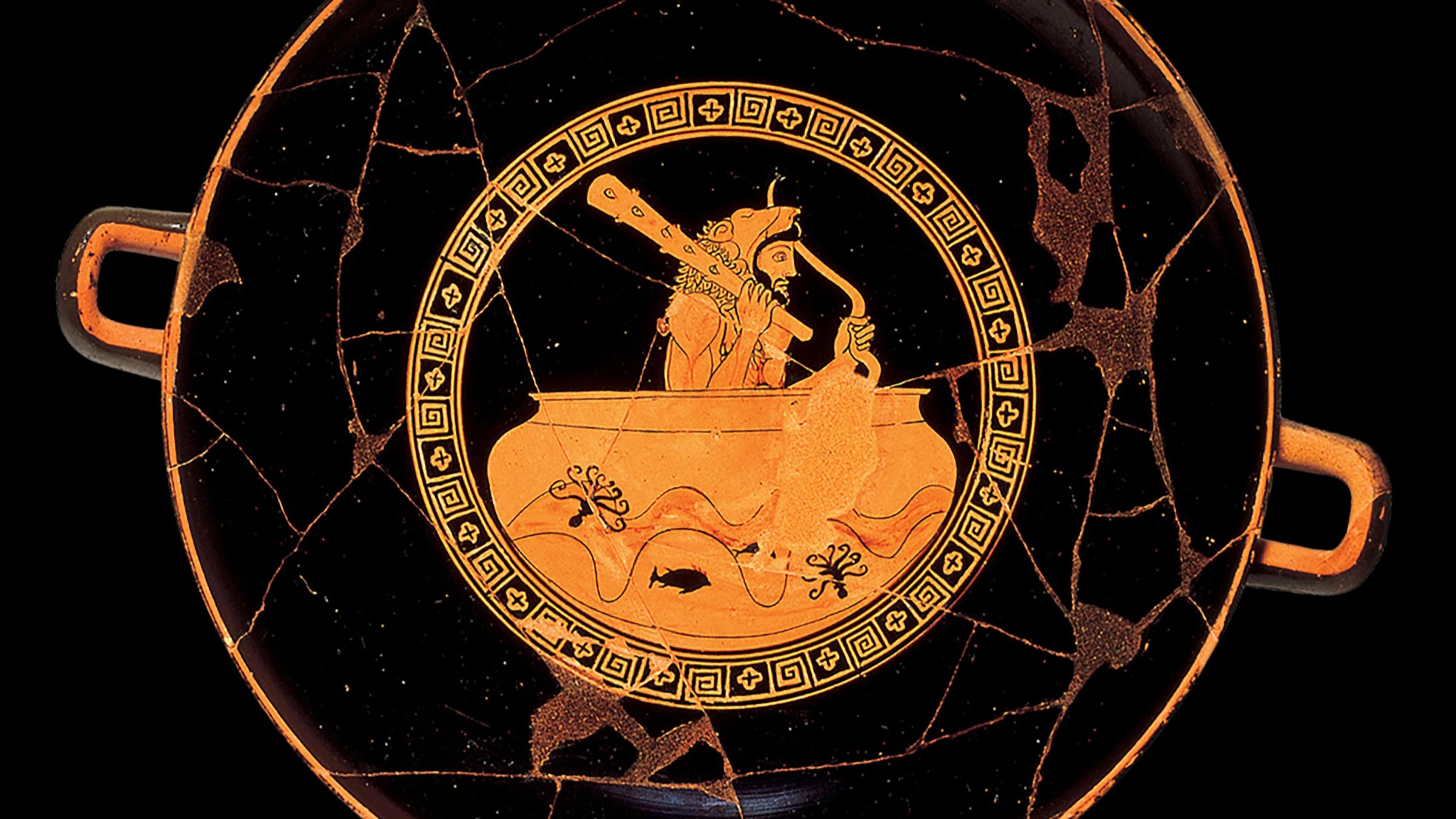
Important international loans presented in the exhibition include, from Museo Gregoriano Etrusco, Musei Vaticani, a remarkable cup depicting the Greek hero Herakles crossing the sea in the cauldron of the sun-god Helios. Works gathered primarily from archaeological sites outside mainland Greece illuminate the diverse forms of intercultural exchange that defined this era. These works range from Iberian sculptures of a sphinx and lion lent by the Museo de Albacete and Museo Arqueológico de Córdoba to an enormous Greek bronze weight found on the Achaemenid acropolis of Susa from the Musée du Louvre. Funerary discoveries further enrich this picture through finds from a princely tomb at Trebenischte, lent by the National Museum of Serbia, which reveals a community at the crossroads of Illyrian, Thracian, and Greek culture, while ceramic vessels from tombs at Sardis in The Met collection blend Lydian, Greek, and Phrygian traditions, and objects on loan from the Republic of Tunisia reflect Phoenician art and endeavors in the western Mediterranean.
Greek bronzes in particular were dispersed across the ancient world, offering a compelling testament to these networks of exchange. Featured in the exhibition is a bronze statue of Zeus from Ugento, most likely the product of Tarentine bronzesmiths and a testament to the reach of Archaic Greek craftsmanship into Italic sanctuaries. It is a signature work of the Archaeological Museum of Taranto and will be exhibited in the United States for the first time. Among the objects on view will be a Griffin Protome from a Cauldron, lent by the Archaeological Museum of Olympia following its return to Greece in 2025 after collaborative research between The Met and the Hellenic Republic.
The exhibition will be organized geographically into six sections, consisting of an introduction and five geographic regions: Eastern Mediterranean and West Asia; Egypt and North Africa; Italy, Sicily and Sardinia; Western Mediterranean and Europe; and the Balkans and the Black Sea. Each section will introduce a region through works and myths that explore how the Greeks perceived and represented the various cultures they encountered. Moreover, as a way of exploring and comparing Greek perception of different cultures, the exhibition will include works of Greek art that depict the peoples associated with each of these regions.
Alexis Belis, Associate Curator in the Department of Greek and Roman Art, said: “The exhibition reminds us of the diversity of the ancient world, and that Greece was part of a much larger network of intercultural exchanges. It also explores how the Greeks perceived this interconnected world—through visual representations and historical accounts as well as through their myths, such as the adventures of the Greek hero Herakles, who traveled to lands beyond the realm of the known world.”
Delphine Tonglet, Assistant Curator in the Department of Greek and Roman Art, said: “We hope this exhibition will offer a broader view of the ancient world as a heterogeneous, interconnected, and incredibly diverse place. The exhibition plays with the poetic idea that the ancient Mediterranean Sea was a continent made of water, a place of interaction with the land merely forming the outlines.”
Credits and Related Content
Across Wine-Dark Seas: Art and Identity beyond Ancient Greece is curated by Seán Hemingway, John A. and Carole O. Moran Curator in Charge; Alexis Belis, Associate Curator; and Delphine Tonglet, Assistant Curator, from The Met’s Department of Greek and Roman Art.
The exhibition will be accompanied by a fully illustrated catalogue, with contributions from over 70 authors featuring an international group of distinguished scholars presenting multiple points of view and the latest research on this fascinating and complex subject.
The catalogue is made possible by Dorothy and Lewis B. Cullman and Patricia and Marietta Fried.
Additional support is provided by Barbara G. Fleischman, Lady Gibbons, Andrés A. Mata, John J. Medveckis, Kathleen Olsen, and Felecia and Jeffrey Weiss.
The Met will host a variety of exhibition-related educational and public programs, to be announced at a later date.
###
September 10, 2026
Image credit: Red-figure kylix with Herakles in the cauldron of Helios (detail), Greek, Attic, 480 BCE. Terracottta, 2 3/16 × 14 3/16 × 11 5/8 in., 1.5 lb. (5.5 × 36 × 29.5 cm, 0.7 kg). Museo Gregoriano Etrusco, Musei Vaticani, No. 16563.
The Metropolitan Museum of Art to Present Major Exhibition on Cross-Cultural Roots of Ancient Greek Art
Exploring a transformative time in ancient Greece, the exhibition sheds new light on the cultural interactions between Greeks and diverse cultures from West Asia and the Balkans to North Africa and Europe, and the artistic innovations that shaped Greek art
The exhibition features major international loans from 11 countries including Bulgaria, France, Greece, Italy, Serbia, and Tunisia
Contact: Stella Kim
Communications@metmuseum.org