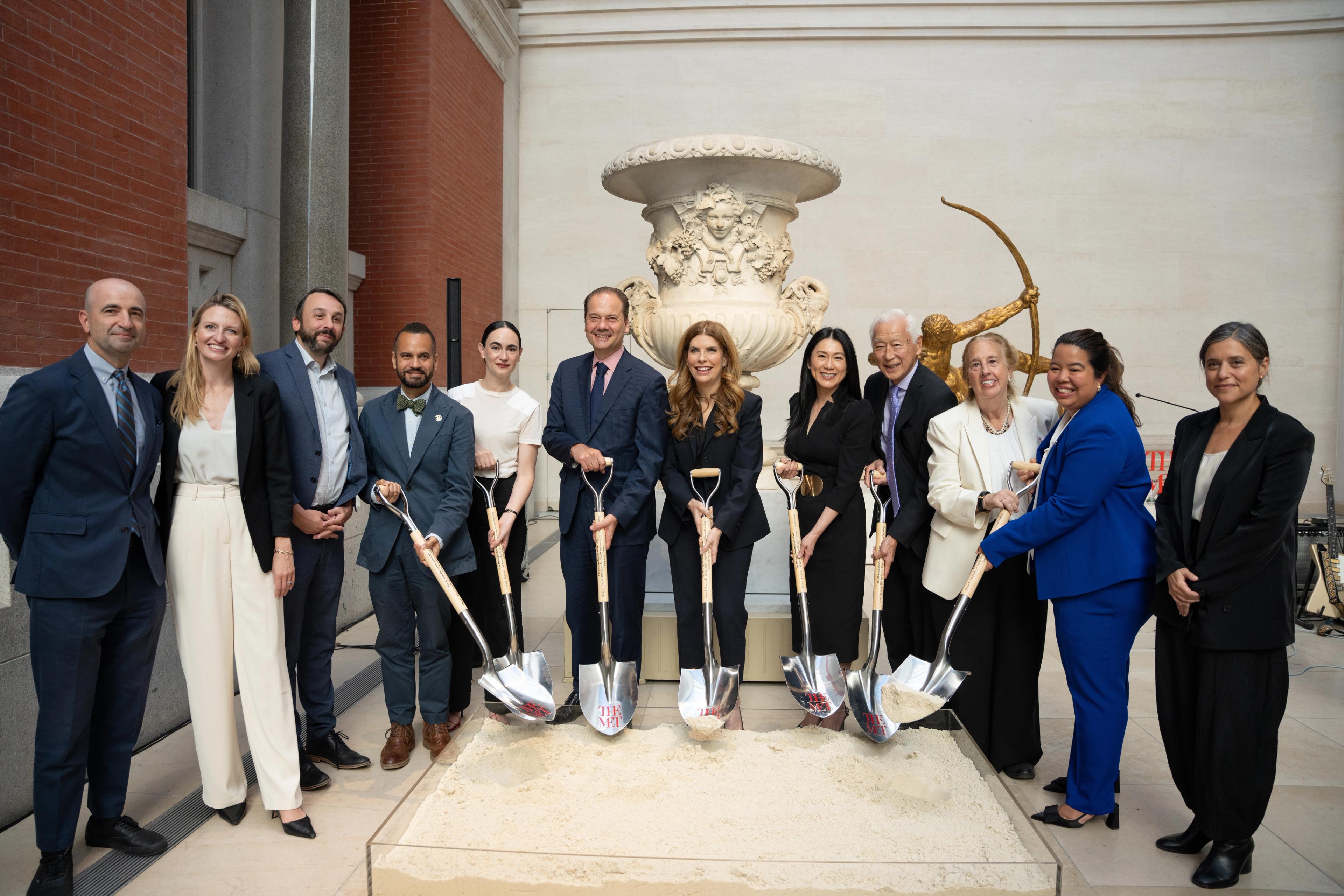
Image (L-R): David Breslin, Council Member Virginia Maloney, Assemblymember Keith Powers, State Senator Jose Serrano, Frida Escobedo, Max Hollein, City Council Speaker Julie Menin, Agnes Hsu-Tang, Oscar L. Tang, Council Member Gale Brewer, New York City Parks Commissioner Tricia Shimamura, and Brett Gaillard. Photo by Brian Rodriguez.
(New York, September 15, 2026)—The Metropolitan Museum of Art formally broke ground today on the Oscar L. Tang and H.M. Agnes Hsu-Tang Wing. Designed by Frida Escobedo, the first woman to design a wing in the Museum’s 156-year history, the project will create a dynamic new home for The Met’s distinguished collection of modern and contemporary art. The Tang Wing will include 69,500 square feet of exhibition space, a nearly 50 percent increase from the Museum’s current wing. Remaining within the existing building’s footprint, the 126,000-square-foot redesigned wing will also include critical advances in accessibility, infrastructure, and sustainability and foster seamless connections with the rest of the Museum’s art holdings. The Tang Wing is expected to open in 2030.
"Today's groundbreaking marks a major milestone for The Met and for New York City," commented The Met's Board of Trustees Co-Chairs Candace K. Beinecke and Hamilton ("Tony") E. James. "This new wing will be a spectacular setting for our visitors to explore modern and contemporary art in fresh and exciting ways, ensuring that the Museum remains an important resource for our millions of visitors from across the five boroughs and around the world. We're deeply grateful to the many Trustees, donors, elected officials, and civic partners for their steadfast and enthusiastic support that has made this extraordinary endeavor possible."
"The Met’s new wing will transform how we present 20th- and 21st-century art, expanding our galleries and connecting our modern and contemporary art collection more closely to the thousands of years of art housed within the Museum,” said Max Hollein, The Met’s Marina Kellen French Director and Chief Executive Officer. “Importantly, the new wing will also serve as a welcoming new space for Museum goers and for all of New York City. Working with Frida Escobedo on her visionary design has been an enormous privilege, and together with our trustees and donors we are excited to celebrate this important milestone as we begin the work that will turn that vision into a reality.”
"The design for the Tang Wing weaves together the many architectural styles that make up The Met’s campus, honoring each building’s own history while creating a space that is distinctly of our time," said Frida Escobedo, Founder and Principal of Frida Escobedo Studio. "The wing speaks to that layered history while also drawing inspiration from the visitors who walk through the Museum’s doors each year. Thank you to our partners at The Met for trusting this vision and to my team for helping bring it to life."
Oscar L. Tang and H.M. Agnes Hsu-Tang remarked, “The Met brings together art from across time and place to create vital opportunities for discovery, learning, connection and inspiration. Frida’s exceptional design for the new wing thoughtfully captures the spirit of the Museum’s important mission and will be a dynamic addition that is both timely and enduring to The Met and to New York City. We are delighted by the overwhelming enthusiasm from the public, the board, and private donors, who have joined us in supporting this significant and meaningful undertaking.”
The groundbreaking was celebrated with remarks from elected officials including City Council Speaker Julie Menin, Manhattan Borough President Brad Hoylman-Sigal, Parks Commissioner Tricia Shimamura, and State Senator Jose Serrano.
As of today, The Met has raised $670 million to fund the full cost of construction as well as a significant portion of the newly established endowment for operating the new wing, demonstrating extraordinary local, national, and international support for the project from both new and longtime Trustees and donors.
The design and engineering team consists of lead design architect Frida Escobedo Studio, executive architect Beyer Blinder Belle Architects & Planners LLP, and engineering firms Kohler Ronan and Thornton Tomasetti.
Project Description
Drawing inspiration from The Met’s varied architectural styles, diverse art holdings, and setting within Central Park, Escobedo’s design artfully blends a contemporary approach with the Museum’s 156 years of architectural history. The reimagined five-story wing will be no higher than the original height of the 1880 wing at the center of the Museum complex and will be lower than the Fifth Avenue facade. Comprising a three-story base with a recessed fourth floor and a further setback fifth floor, the scaled facade is defined by a limestone celosía—an architectural screen that references a universal architectural language spanning multiple cultures and centuries. Its mineral texture and stone lattice create a diaphanous surface designed to subtly respond to the movement of sunlight throughout the day. Inside, rhythmic gallery spaces with varying ceiling heights ranging from 11 to 22 feet will flow into one another to allow for the display of large-scale installations in dialogue with more intimate spaces. In addition, the fifth floor will include a 1,000-square-foot cafe where visitors can pause to enjoy refreshments before continuing their exploration of the modern and contemporary art galleries.
The seasonal rooftop views admired by New Yorkers and visitors alike will be visible year-round from indoor and outdoor spaces. Large, south-facing windows in the fourth- and fifth-floor galleries will bring the majestic views of Central Park and the Manhattan skyline inside, where they can be enjoyed in all seasons. Both floors will also offer direct connections to the park and the city beyond, adding a total of approximately 18,500 square feet of outdoor space spread across the fourth- and fifth-floor terraces. The Iris and B. Gerald Cantor Roof Garden, previously located on the fifth floor, will move to an expanded 10,000-square-foot space on the fourth-floor terrace, where visitors will once again be able to experience artworks set against the backdrop of Central Park and the city skyline. The outdoor landscaped area on the fifth floor will offer visitors a space for respite where they can reconnect with the natural world and city beyond.
Accessibility, Sustainability, and Landscape
The configuration of the new wing and its infrastructure will critically improve accessibility for all staff and visitors. The Tang Wing will include two elevator cores, ramps, improved entry points from adjacent wings, and clear circulation routes for visitors. The new building will also utilize cutting-edge design practices to significantly reduce energy consumption in that part of the Museum. At least a quarter of the galleries in the existing wing have southern or western exposures with light conditions that render the spaces inappropriate for the long-term display of art and require significant energy to maintain appropriate temperature and humidity levels. The articulated facade and thoughtful placement of windows in the new wing, along with a below-ground mechanical space, will reduce solar gain while also maximizing the use of natural light in galleries, contributing to The Met’s overall sustainability goals.
Landscape restorations and improvements—designed by the Central Park Conservancy, in coordination with the New York City Department of Parks & Recreation and The Met—will bring the green spaces immediately around the building up to Central Park’s impeccable standards. Enhancements include accessible paths, new lighting, new lawns, new canopy and multistem trees, a variety of low shrubs and ground cover, and other perennial plantings.
###
About Frida Escobedo
Architect Frida Escobedo’s design for the Tang Wing will transform The Met experience for millions of annual visitors. Originally from Mexico City where her studio is headquartered, Escobedo has completed numerous competition-winning projects in her native country, including the expansion of the cultural center La Tallera Siqueiros (2012). Escobedo received global acclaim in 2018, when she won the prestigious commission to design the annual Serpentine Pavilion in London, becoming the youngest architect at the time to undertake the project. Following her appointment as the Lead Designer for the Tang Wing, in 2022 Escobedo opened a studio in New York City, where she has completed projects including Ray Harlem (2025, with Handel Architects), whose mixed-use design incorporates residences, commercial spaces, and housing for the new National Black Theatre. In 2024, she was selected as a co-designer alongside lead architects Moreau Kusunoki for the Centre Pompidou 2030 renovation.
About Beyer Blinder Belle
Founded in 1968, Beyer Blinder Belle Architects & Planners LLP (BBB) has long been recognized for the design and revitalization of nationally celebrated buildings and urban sites, including The Met and other cultural institutions such as the Smithsonian Institution, the New York Public Library, Lincoln Center, The Kennedy Center, The Frick Collection, and the Morgan Library & Museum. In addition to award-winning architecture, planning, historic preservation, interior design, and graphic design, BBB specializes in adapting existing structures for new uses and in sensitively integrating contemporary building systems within historic contexts.
About The Met
The Metropolitan Museum of Art was founded in 1870 by a group of American citizens—businessmen and financiers as well as leading artists and thinkers of the day—who wanted to create a museum to bring art and art education to the American people. Today, The Met displays tens of thousands of objects covering thousands of years of art from around the world for everyone to experience and enjoy. The Museum lives in two iconic sites in New York City—The Met Fifth Avenue and The Met Cloisters. Millions of people also take part in The Met experience online. Since its founding, The Met has always aspired to be more than a treasury of rare and beautiful objects. Every day, art comes alive in the Museum’s galleries and through its exhibitions and events, revealing both new ideas and unexpected connections across time and across cultures.
Originally planned in 1871, The Met’s campus in Central Park has evolved into one of the most iconic and important New York landmarks over the last 156 years. The location of the Museum within Central Park was part of the park’s early design by its famed architects Frederic Law Olmsted and Calvert Vaux and reflects their complementary missions to provide a source of respite and inspiration for all New Yorkers and visitors within the larger city. Over the years, the Museum has continued to renovate within its designated footprint, allowing a wide array of architects and architectural styles to work in harmony to house one of the most prominent and expansive art collections in the world. Today, it consists of 21 structures that operate as a single building within Central Park, spanning five floors in addition to mezzanines and basements.
About The Met’s Modern and Contemporary Art Collection
The Met holds one of the world’s leading collections of 20th- and 21st- century art, spanning painting, sculpture, design, installation, and time-based media. Anchored by key holdings including the Leonard A. Lauder Cubist Collection and the Alfred Stieglitz Collection, the department has exceptional holdings in Abstract Expressionism, American Modernism with a renewed focus on the Harlem Renaissance, and global contemporary art from 2000 to the present. You can find iconic paintings by Pablo Picasso, Georgia O’Keeffe, Aaron Douglas, Jackson Pollock, Georg Baselitz, Ibrahim El-Salahi, Carmen Herrera, Philip Guston, Nicole Eisenman, and Kerry James Marshall; sculptures by Alberto Giacometti, Isamu Noguchi, Mrinalini Mukherjee, Charles Ray, and Wangechi Mutu; works on paper by Paul Klee, Zarina, and Julio Le Parc; design and decorative art objects from Art Nouveau to the Memphis Group; installations and videos by Arthur Jafa, William Kentridge, Nalini Malani, and Pipilotti Rist, and much more. The Tang Wing presents a unique opportunity to newly contextualize modern and contemporary art historical movements at an institution that holds centuries of art and believes in the power of cross-cultural exchange.
While the Tang Wing is under construction, visitors can continue to experience highlights of the modern and contemporary art collection throughout the Museum. Select works remain on view in The Face of Life: Modern Portraits at The Met, on view through 2029, and rotating installations of modern and contemporary art will appear across the Museum, including Krasner and Pollock: Past Continuous, on view October 4, 2026, through January 31, 2027; There Are No Words: Si Lewen's Parade, October 1, 2026 through January 5, 2027; David Hartt: Peripheries, September 25, 2026, through February 7, 2027; and The Genesis Facade Commission: Liu Wei, Speculation, September 17, 2026, through June 8, 2027. The Met will also continue to present modern and contemporary art programming through Met Live Arts and special exhibitions throughout the construction period.
###
September 15, 2026