Vermeer's Masterpiece: The Milkmaid
September 10–November 29, 2009
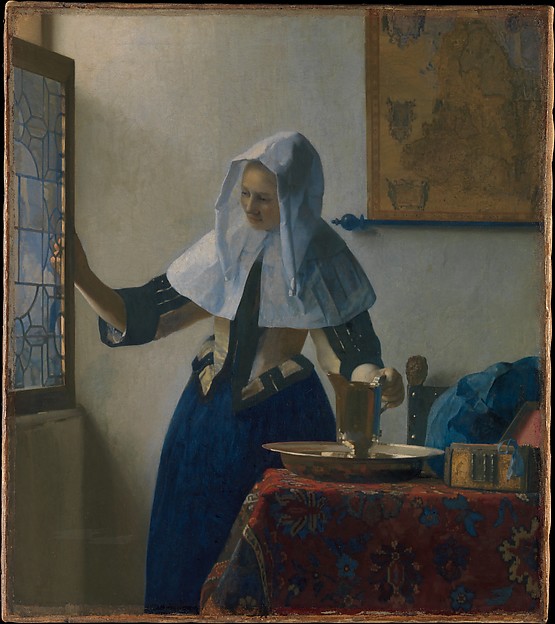
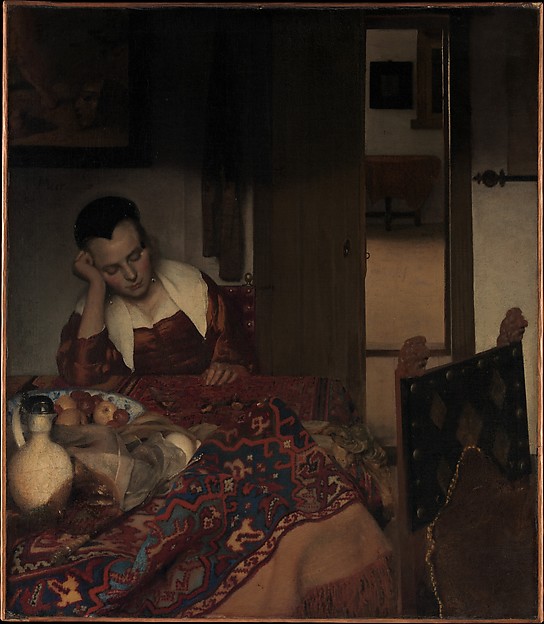
On the occasion of the four hundredth anniversary of Henry Hudson's historic voyage to Manhattan from Amsterdam, that city's Rijksmuseum has sent The Milkmaid, perhaps the most admired painting by Johannes Vermeer (1632–1675), to the Metropolitan Museum. To celebrate this extraordinary loan, the Metropolitan Museum presents Vermeer's Masterpiece The Milkmaid, a special exhibition that brings together all five paintings by Vermeer from its collection, along with a select group of works by other Dutch artists, placing Vermeer's superb picture in its historical context. Along with The Milkmaid, important works by Pieter de Hooch, Gabriël Metsu, Nicolaes Maes, Emanuel de Witte, and Gerard ter Borch are on view. All were masters who, like Vermeer, were active during the remarkable period of exploration, trade, and artistic flowering that occurred during the Dutch Golden Age in the seventeenth century. Vermeer's Masterpiece The Milkmaid marks the first time that the painting has traveled to the United States since it was exhibited at the 1939 World's Fair.
The Milkmaid was painted by Johannes Vermeer in about 1657–58. It may be considered one of the last works of the artist's early, formative years, during which he adopted various subjects and styles from other painters and at the same time introduced effects based on direct observation and an unusually refined artistic sensibility. Influenced by the detailed realism of Gerrit Dou (1613–1675) and his followers in Leiden, Vermeer created his most illusionistic image in The Milkmaid. To modern viewers the picture may resemble a photograph. However, the composition is exquisitely designed, as is evident from several revisions made in the course of execution and from subtle relationships of light and shadow, color, contours, and shapes. A low vantage point and a pyramidal buildup of forms from the left foreground to the woman's head lend the figure monumentality and perhaps a sense of dignity. And yet, like milkmaids and kitchen maids in earlier Netherlandish art, and like other young women in Vermeer's oeuvre, this figure was meant to attract the male viewer and to have her own thoughts of romance.
The Milkmaid's Provenance
The painting was probably purchased from the artist by his Delft patron Pieter Claesz van Ruijven (1624–1674), who at his death appears to have owned twenty-one works by Vermeer. When these pictures were sold from the estate of Van Ruijven's son-in-law Jacob Dissius, in 1696, The Milkmaid was described as "exceptionally good" and brought the second-highest price in the sale. [Vermeer's celebrated cityscape A View of Delft (The Hague, Royal Picture Gallery Mauritshuis) was slightly more expensive.] "The famous milkmaid, by Vermeer of Delft, artful," was auctioned in 1719 and then went through at least five Amsterdam collections to one of the great collectors of Dutch art, Lucretia Johanna van Winter (1785–1845). In 1822 she married into the Six family of collectors and it was from the heirs of Lucretia's two sons that the Rijksmuseum, in 1908, purchased The Milkmaid, with support from the Dutch government and the Rembrandt Society.
The "Milkmaid" Theme
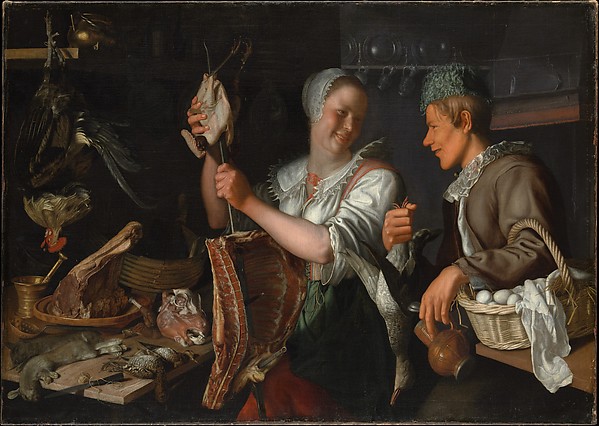
For at least two centuries before Vermeer's time, milkmaids and kitchen maids had (or were assigned) a reputation for amorous predispositions. Netherlandish artists adopted this theme in works ranging in tone from coarsely erotic to slyly suggestive. The most frankly sexual interpretations include some of the kitchen and market scenes by the Antwerp painters Joachim Beuckelaer (ca. 1535–1575) and Frans Snyders (1579–1657), and by Dutch emulators such as Joachim Wtewael (1566–1638) and his son Peter Wtewael (1596–1660). In the younger Wtewael's Kitchen Scene, of the 1620s, an eager farmhand offers his wares and services to a receptive cook. The dangling bird and the chicken jammed onto a spit refer to male and female anatomy, signs made more explicit by the encounter of the youth's extended finger with an open jug. Later painters, in particular the Leiden artist Gerrit Dou, depended upon their viewers' familiarity with kitchen scenes like Wtewael's when they depicted comely maids with inconspicuously symbolic objects such as jugs and various forms of game and produce. In The Milkmaid, Vermeer characteristically goes further in the direction of understatement. The image of Cupid on a Delft tile next to the foot warmer—which can imply arousal of the fairer sex—would appear to intimate that the woman has feelings as well as obligations.
The exhibition is made possible by the William Randolph Hearst Foundation, Daphne Recanati Kaplan and Thomas S. Kaplan, and Bernard and Louise Palitz.