女跪像
Artwork Details
- 标题: 女跪像
- 创作日期: 十五至十六世纪早期
- 地域: 墨西哥
- 文化: 阿兹特克
- 材料: 石头
- 尺寸: 高211⁄2 英寸(54.6厘米)
- 来源信息: 大都会博物馆购买,1900年
- 藏品编号: 00.5.16
- Curatorial Department: The Michael C. Rockefeller Wing
Audio
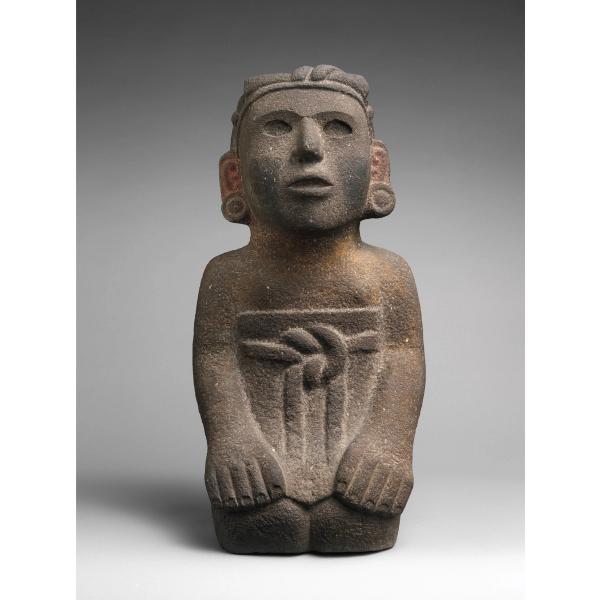
1643. Kneeling female figure, Mexica artist(s)
Diana Magaloni
DIANA MAGALONI: This is a posture of composure. This is an elegant, feminine position. Femininity… it's a social construct and the social construct of the feminine in Aztec times, it's very different from ours.
JOSÉ MARÍA YAZPIK (NARRATOR): Diana Magaloni, Los Angeles County Museum of Art.
DIANA MAGALONI: Women are often shown kneeling. A lot of women's work is made in this posture.
JOSÉ MARÍA YAZPIK: This female figure wears a traditional wrap covering, secured with a cord tied in a decorative knot. You’ll see her feet are tucked beneath her. They are beautifully, symmetrically rendered, echoing the shapes of her hands.
DIANA MAGALONI: Women work with making the dough from maize, the nixtamalization of the maize, grinding them… this is a posture for that.
JOSÉ MARÍA YAZPIK: Maize is a central, life-giving substance of Mesoamerican cultures, so a kneeling woman might be associated with fertility, with the generative power of the earth. A sculpture such as this might be kept in a small local temple or household shrine and used in ceremonies honoring earth or water goddesses.
DIANA MAGALONI: But women can also be drawn and shown as powerful warriors and beings. Warriors that are super powerful that are shown standing up. Women are shown in the art as powerful beings related to the Earth goddess giving birth. They have their own realm of social important activities. They have their own realm in terms of religion… and earth goddesses were very powerful and omnipresent. Women could be also brave warriors in themselves. Could be leaders, could be painters.
JOSÉ MARÍA YAZPIK: But, after the Spanish conquest, the male-dominated Catholic church restricted women’s roles in society.
DIANA MAGALONI: I think we lose a lot of the depth and complexity of a woman's role in a society where duality is so important, where both forces need to be complementary and always together to create the world.
More Artwork
Press the down key to skip to the last item.
Related Content
 Free to download
Research Resources
The Met provides unparalleled resources for research and welcomes an international community of students and scholars. The Met's Open Access API is where creators and researchers can connect to the The Met collection. Open Access data and public domain images are available for unrestricted commercial and noncommercial use without permission or fee.
To request images under copyright and other restrictions, please use this Image Request form.
Feedback
We continue to research and examine historical and cultural context for objects in The Met collection. If you have comments or questions about this object record, please contact us using the form below. The Museum looks forward to receiving your comments.