Mosaic Fragment
Artwork Details
- Title: Mosaic Fragment
- Maker: Tiffany Studios (1902–32)
- Date: ca. 1905
- Culture: American
- Medium: Favrile glass on concrete
- Dimensions: 21 1/2 x 73 1/2 x 2 3/4 in. (54.6 x 186.7 x 7 cm)
- Credit Line: Purchase, Mr. and Mrs. Richard L. Chilton Jr. and Arlie Sulka Gifts, 2010
- Object Number: 2010.124.1
- Curatorial Department: The American Wing
Audio
4542. Mosaic Fragment
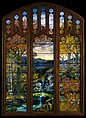
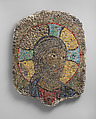
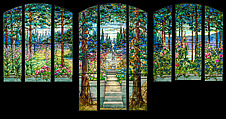
ALICE COONEY FRELINGHUYSEN: My name is Alice Cooney Frelinghuysen and I'm the Anthony W. and Lulu C. Wong Curator of American Decorative Arts. These are two mosaic fragments that were originally part of the decorations of the façade of the Tiffany Studios Showroom that was located on Madison Avenue, Midtown, New York. So it said Tiffany Studios, and then it also had the address, 347-355 Madison Avenue. And if you look closely, it's just extraordinary glass--wonderful, kind of, mottled and marbleized glass looking like precious stones, precious figured marbles. Particularly the background glass for the lettering, very deep, almost black glass, veined with white and blue and . . . the whole was incorporated into a Renaissance-type design called Cosmati design: you see the interlaced borders and the central decorative element in the middle there. Louis Comfort Tiffany was the son of Charles Tiffany, who was the founder of Tiffany and Company, the jewelry, and silver, and luxury goods store that was founded in 1835, and it's still carrying on today, on Fifth Avenue. But Louis was a true artist; his father supported him in his artistic work, and he, in the late 1870's, moved into decorative work. Glass would be his true métier, whether it was in leaded glass windows, lampshades, mosaic, wonderful glass vessels. I think it's most appropriate that these mosaic fragments that were announcing Tiffany's showrooms would be installed here, and would be one of the first things that a visitor sees when they walk into the courtyard, because our courtyard is really full of extraordinary important, fantastic examples of large-scale architectural work by Tiffany. There four leaded-glass windows, for example. There is the wonderful garden mosaic and fountain, and the entrance to Louis Tiffany's country estate on Long Island, Laurelton Hall.
More Artwork
Press the down key to skip to the last item.
Research Resources
The Met provides unparalleled resources for research and welcomes an international community of students and scholars. The Met's Open Access API is where creators and researchers can connect to the The Met collection. Open Access data and public domain images are available for unrestricted commercial and noncommercial use without permission or fee.
To request images under copyright and other restrictions, please use this Image Request form.
Feedback
We continue to research and examine historical and cultural context for objects in The Met collection. If you have comments or questions about this object record, please contact us using the form below. The Museum looks forward to receiving your comments.
Content Notice
The Metropolitan Museum of Art presents over 5,000 years of art from around the world, and our online collection reflects ongoing work conducted over the course of our more than 150-year history. You may encounter objects or images that may be inappropriate for some viewers or information that may be outdated.