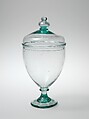
Glass cinerary urn with lid
Broad, horizontal rim, with rounded tubular edge made by folding out, down, and in; short, concave neck; ovoid body; deep concave bottom.
Intact; some bubbles, a few very large; dulling, limy encrustation, faint iridescence, and patchy brown weathering on exterior, slight dulling on interior.
Lid: Translucent blue green.
Thickened horizontal rim, with slight downward and inverted lip and beveled outer edge; horizontal side with concentric ridge near rim and broad concave band within on upper surface; hollow stem, tapering upwards to slightly flattened circular knob; small, tooled indent on top and tiny hole in center of knob.
Intact, except for small chip in rim; many bubbles, some very large; slight dulling, iridescence, and creamy brown weathering.
The lid is slightly smaller than the rim of the urn but sits evenly on inner edge of rim and mouth.
In addition to handled vessels, large plain jars were often used as cremation urns, which may explain why they are more commonly found in Italy and the western provinces than in the Greek East.
Artwork Details
- Title: Glass cinerary urn with lid
- Period: Imperial
- Date: mid-1st–2nd century CE
- Culture: Roman
- Medium: Glass; blown
- Dimensions: H.: 11 1/8 in. (28.3 cm)
- Classification: Glass
- Credit Line: Gift of Henry G. Marquand, 1881
- Object Number: 81.10.4a, b
- Curatorial Department: Greek and Roman Art
More Artwork


Research Resources
The Met provides unparalleled resources for research and welcomes an international community of students and scholars. The Met's Open Access API is where creators and researchers can connect to the The Met collection. Open Access data and public domain images are available for unrestricted commercial and noncommercial use without permission or fee.
To request images under copyright and other restrictions, please use this Image Request form.
Feedback
We continue to research and examine historical and cultural context for objects in The Met collection. If you have comments or questions about this object record, please contact us using the form below. The Museum looks forward to receiving your comments.
Content Notice
The Metropolitan Museum of Art presents over 5,000 years of art from around the world, and our online collection reflects ongoing work conducted over the course of our more than 150-year history. You may encounter objects or images that may be inappropriate for some viewers or information that may be outdated.