Cubiculum (bedroom) from the Villa of P. Fannius Synistor at Boscoreale
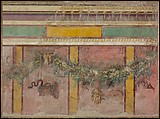
The rear wall shows rocky terrain with balustrades and an arbor above, a small cave or grotto sheltering a fountain, and a small figure of Hekate below. In the center of the wall, between two columns, a parapet embellished with a yellow monochrome landscape supports a glass bowl filled with fruit.
The side walls of the room are symmetrical. Each wall is subdivided into four sections by a pilaster that defines the area of the couch and by two ornate columns. The paintings depict enclosed courtyards in which we glimpse the tops of statuary, rotundas, and pylons as well as vegetation. These precincts alternate with townscapes combining colonnaded buildings and projecting terraces.
The Villa of P. Fannius Synistor at Boscoreale: A Virtual Tour
Artwork Details
- Title: Cubiculum (bedroom) from the Villa of P. Fannius Synistor at Boscoreale
- Period: Late Republic
- Date: ca. 50–40 BCE
- Culture: Roman
- Medium: Fresco
- Dimensions: 8 ft. 8 1/2 in. × 10 ft. 11 1/2 in. × 19 ft. 1 7/8 in. (265.4 × 334 × 583.9 cm)
- Classification: Miscellaneous-Paintings
- Credit Line: Rogers Fund, 1903
- Object Number: 03.14.13a–g
- Curatorial Department: Greek and Roman Art
Audio
1250. Wall Paintings from the Villa of P. Fannius Synistor at Boscoreale
All of the wall paintings in this gallery come from a Roman villa at Boscoreale, as do those in the cubiculum opposite the entrance at the left. Located just north of Pompeii, the villa was buried during the volcanic eruption of Mount Vesuvius in 79 A.D. You can appreciate how close the villa was to the volcano on the map nearby. In 1900, archaeologists uncovered the villa and its frescoes that had survived for nearly two thousand years.
The villa was constructed about 50 B.C., when Roman aristocrats were building lavish retreats in the countryside, and around the Bay of Naples. As you look around the gallery, you’ll see a number of frescoes that evoke the splendor of Hellenistic palaces recently fallen under Roman control.
To hear how these wall paintings were originally installed in the villa, look at the plan next to the map, and press the PLAY button.
Listen to more about this artwork
More Artwork
Related Content

Research Resources
The Met provides unparalleled resources for research and welcomes an international community of students and scholars. The Met's Open Access API is where creators and researchers can connect to the The Met collection. Open Access data and public domain images are available for unrestricted commercial and noncommercial use without permission or fee.
To request images under copyright and other restrictions, please use this Image Request form.
Feedback
We continue to research and examine historical and cultural context for objects in The Met collection. If you have comments or questions about this object record, please contact us using the form below. The Museum looks forward to receiving your comments.
Content Notice
The Metropolitan Museum of Art presents over 5,000 years of art from around the world, and our online collection reflects ongoing work conducted over the course of our more than 150-year history. You may encounter objects or images that may be inappropriate for some viewers or information that may be outdated.