Glass beaker
Translucent pale blue-green.
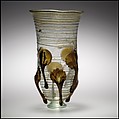
Unworked, knocked-off rim with slight bulge below; truncated funnel-shaped body; flat bottom. Three vertical mold seams run down sides from bulge to edge of bottom, with a separate shallow disk-shaped base section.
On body, faint wheel-abraded horizontal line on bulge below rim and five rows of buds, decreasing in size, down side, some smooth, some tiered on surface; on bottom, two fine concentric circles surrounding a central concave depression containing a raised circle and dot.
Intact; many pinprick bubbles; some severe pitting, most of surfaces covered with thick creamy weathering and brilliant iridescence.
Truncated conical beakers have been found on numerous military sites, for example, in the canabae legionis (civilian settlement attached to the legionary fortress) at Noviomagus (modern Nijmegen, Holland), at forts in Wales and northern England, and at Masada in Israel. Soldiers may have helped popularize Roman tastes and customs, which are now reflected in the pottery and glassware found on archaeological sites throughout the Roman Empire.
Unworked, knocked-off rim with slight bulge below; truncated funnel-shaped body; flat bottom. Three vertical mold seams run down sides from bulge to edge of bottom, with a separate shallow disk-shaped base section.
On body, faint wheel-abraded horizontal line on bulge below rim and five rows of buds, decreasing in size, down side, some smooth, some tiered on surface; on bottom, two fine concentric circles surrounding a central concave depression containing a raised circle and dot.
Intact; many pinprick bubbles; some severe pitting, most of surfaces covered with thick creamy weathering and brilliant iridescence.
Truncated conical beakers have been found on numerous military sites, for example, in the canabae legionis (civilian settlement attached to the legionary fortress) at Noviomagus (modern Nijmegen, Holland), at forts in Wales and northern England, and at Masada in Israel. Soldiers may have helped popularize Roman tastes and customs, which are now reflected in the pottery and glassware found on archaeological sites throughout the Roman Empire.
Artwork Details
- Title: Glass beaker
- Period: Early Imperial
- Date: ca. 40–100 CE
- Culture: Roman
- Medium: Glass; blown in a four-part mold and cut
- Dimensions: H.: 5 in. (12.7 cm)
Diam.: 2 1/2 in. (6.4 cm) - Classification: Glass
- Credit Line: Bequest of Mary Anna Palmer Draper, 1915
- Object Number: 15.43.207
- Curatorial Department: Greek and Roman Art
More Artwork
A slider containing 5 items.
Press the down key to skip to the last item.
Press the down key to skip to the last item.
Frankish
5th–6th century
Roman
mid–1st century CE
British
1760–65
Roman
1st half of 1st century CE

Roman
4th century CE
Research Resources
The Met provides unparalleled resources for research and welcomes an international community of students and scholars. The Met's Open Access API is where creators and researchers can connect to the The Met collection. Open Access data and public domain images are available for unrestricted commercial and noncommercial use without permission or fee.
To request images under copyright and other restrictions, please use this Image Request form.
Feedback
We continue to research and examine historical and cultural context for objects in The Met collection. If you have comments or questions about this object record, please contact us using the form below. The Museum looks forward to receiving your comments.