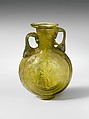
Glass two-handled bottle (amphora)
Rounded rim; shallow funnel-shaped mouth; cylindrical neck; sloping shoulder, with rounded edge that very slightly overhangs side; cylindrical body with vertical side, then funnel-shaped and tapering to solid, pointed, knob base; two four-ribbed strap handles applied to shoulder, drawn up vertically, then turned in, and trailed onto underside of mouth and top of neck under trail decoration, with excess glass drawn up to rim on one handle.
Single trail wound once around underside of mouth; on cylindrical side of body, wheel-abraded decoration, carelessly executed, comprising three horizontal registers, with a pair of lines above each register: at top, band of eight vertical oval facets alternating with eight motifs that have three parallel vertical lines flanked at top and bottom with a single long line; in middle, band of 23 vertical oval facets; and at bottom, same as top band but more compressed.
Complete, except for weathered chip in rim above one handle; pinprick bubbles, with black impurities in handles; slight weathering on exterior, soil encrustation and iridescent weathering on interior.
Made in imitation of larger terracotta storage jars used to transport wine and olive oil, this amphora may be seen as the eastern equivalent of the cylindrical, barrel-shaped glass bottles that are found in the northwest provinces. It was probably made in Syria, although similar vessels are also known from Egypt.
Artwork Details
- Title: Glass two-handled bottle (amphora)
- Period: Late Imperial
- Date: 4th century CE
- Culture: Roman
- Medium: Glass; body blown in a mold, trailed, and cut
- Dimensions: H.: 7 7/8 in. (20 cm)
- Classification: Glass
- Credit Line: Gift of J. Pierpont Morgan, 1917
- Object Number: 17.194.326
- Curatorial Department: Greek and Roman Art
More Artwork
Research Resources
The Met provides unparalleled resources for research and welcomes an international community of students and scholars. The Met's Open Access API is where creators and researchers can connect to the The Met collection. Open Access data and public domain images are available for unrestricted commercial and noncommercial use without permission or fee.
To request images under copyright and other restrictions, please use this Image Request form.
Feedback
We continue to research and examine historical and cultural context for objects in The Met collection. If you have comments or questions about this object record, please contact us using the form below. The Museum looks forward to receiving your comments.
Content Notice
The Metropolitan Museum of Art presents over 5,000 years of art from around the world, and our online collection reflects ongoing work conducted over the course of our more than 150-year history. You may encounter objects or images that may be inappropriate for some viewers or information that may be outdated.