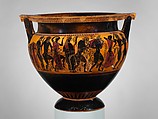
Terracotta column-krater (bowl for mixing wine and water)
Reverse, Athena with deities
Representations of artists at work are exceedingly rare. This vase illustrates a craft for which virtually no evidence survives, that of applying pigment to stone sculpture using the technique of encaustic. The column and phiale (libation bowl) at the far left indicate an interior space, probably a sanctuary. In the foreground stands a statue of Herakles with his club, bow, and lion-skin. The painter, characterized by his cap and his garment worn to leave his upper body bare, applies a mixture of pigment and wax with a spatula to Herakles’ lion-skin. To the left, a Black African youth tends the brazier
on which rods are heating that will spread the tinted wax. Above, Zeus, ruler of the gods, and Nike, personification of victory, preside as Herakles himself ambles in from the right to survey his image.
The reverse, in an outdoor setting, shows Herakles’ staunch protectress, Athena, seated in conversation with one of the Dioskouroi. To the left, Hermes, the messenger god, turns away from Pan, his son, while Eros plays with a bird below. Surely complementary, the pictures may refer to the apotheosis of Herakles. Rather than driving to Mount Olympos in a chariot, Herakles sees himself monumentalized in stone, while Athena, her task accomplished, takes her ease between divine travelers.
Artwork Details
- Title: Terracotta column-krater (bowl for mixing wine and water)
- Artist: Attributed to the Group of Boston 00.348
- Period: Late Classical
- Date: ca. 360–350 BCE
- Culture: Greek, South Italian, Apulian
- Medium: Terracotta; red-figure
- Dimensions: H. 20 1/4 in. (51.5 cm)
- Classification: Vases
- Credit Line: Rogers Fund, 1950
- Object Number: 50.11.4
- Curatorial Department: Greek and Roman Art
Audio
1224. Terracotta column-krater (bowl for mixing wine and water)
This vase depicts the exceptional subject of an artist painting a statue of the Greek hero, Herakles. The technique being used to apply the paint is known as encaustic. Molten wax, resin, and mineral-based pigments are heated together and then applied with hot implements. Here, the artist holds a pot containing the molten mixture, and uses a spatula to apply it to the stone sculpture. His cap and garment, which allows for maximum coolness and freedom of movement, are characteristic of a workman. To the left, an African youth tends the charcoal brazier that heats the wax mixture and tools. The column and libation bowl behind him suggest an interior space, most likely a sanctuary. Above, Zeus – ruler of the gods – and Nike – personification of victory – preside over the scene. And, Herakles himself, entering at right, inspects his stone likeness. The scene may refer to the apotheosis of Herakles – when he was transformed into a deity after his death. Here, he sees himself monumentalized in stone. Most Greek and Roman sculpture and architecture were painted. However, one of the most serious losses in ancient art is evidence for that painting. Statues that survive today appear white, or at most retain only faint traces of their original pigments. Just imagine how brightly colored they would have been in antiquity!
Listen to more about this artwork
More Artwork
Related Content

Research Resources
The Met provides unparalleled resources for research and welcomes an international community of students and scholars. The Met's Open Access API is where creators and researchers can connect to the The Met collection. Open Access data and public domain images are available for unrestricted commercial and noncommercial use without permission or fee.
To request images under copyright and other restrictions, please use this Image Request form.
Feedback
We continue to research and examine historical and cultural context for objects in The Met collection. If you have comments or questions about this object record, please contact us using the form below. The Museum looks forward to receiving your comments.
Content Notice
The Metropolitan Museum of Art presents over 5,000 years of art from around the world, and our online collection reflects ongoing work conducted over the course of our more than 150-year history. You may encounter objects or images that may be inappropriate for some viewers or information that may be outdated.