Bronze cuirass (body armor)
Artwork Details
- Title: Bronze cuirass (body armor)
- Period: Classical
- Date: 4th century BCE
- Culture: Greek, Apulian
- Medium: Bronze
- Dimensions: H. (front): 19 5/8 in. (49.8 cm)
H. (back): 20 1/16 in. (51 cm) - Classification: Bronzes
- Credit Line: Gift of Estée Lauder Inc., 1992
- Object Number: 1992.180.3a, b
- Curatorial Department: Greek and Roman Art
Audio
1057. Bronze cuirass (body armor)
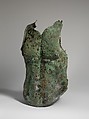
This armor of South Italian type may come from a burial of the fourth century B.C. It is a remarkably complete set made for a horseman. The cuirass shows all the muscles of the chest and back, developed and idealized to heroic proportions. The front and back are hinged at the sides, and the rings at the shoulders were laced and tied with leather.
The pieces are ornamented with delicately incised patterns. On the helmet, behind the opening for the ear, there are half palmettes and other floral shapes. Whinnying horses appear on the cheek pieces. The horse also wore armor. You can see the shaffron that guarded its face in this case. Guards for the lower legs are called greaves. This pair would've looked old fashioned by the time this cuirass was made. Perhaps they were handed down through several generations or made according to a conservative pattern.
The man in armor and the man on horseback must have been awesome to behold in life, both with favorite themes throughout the history of Greek art.
More Artwork
Related Content


Research Resources
The Met provides unparalleled resources for research and welcomes an international community of students and scholars. The Met's Open Access API is where creators and researchers can connect to the The Met collection. Open Access data and public domain images are available for unrestricted commercial and noncommercial use without permission or fee.
To request images under copyright and other restrictions, please use this Image Request form.
Feedback
We continue to research and examine historical and cultural context for objects in The Met collection. If you have comments or questions about this object record, please contact us using the form below. The Museum looks forward to receiving your comments.
Content Notice
The Metropolitan Museum of Art presents over 5,000 years of art from around the world, and our online collection reflects ongoing work conducted over the course of our more than 150-year history. You may encounter objects or images that may be inappropriate for some viewers or information that may be outdated.