Double-crocodile pendant
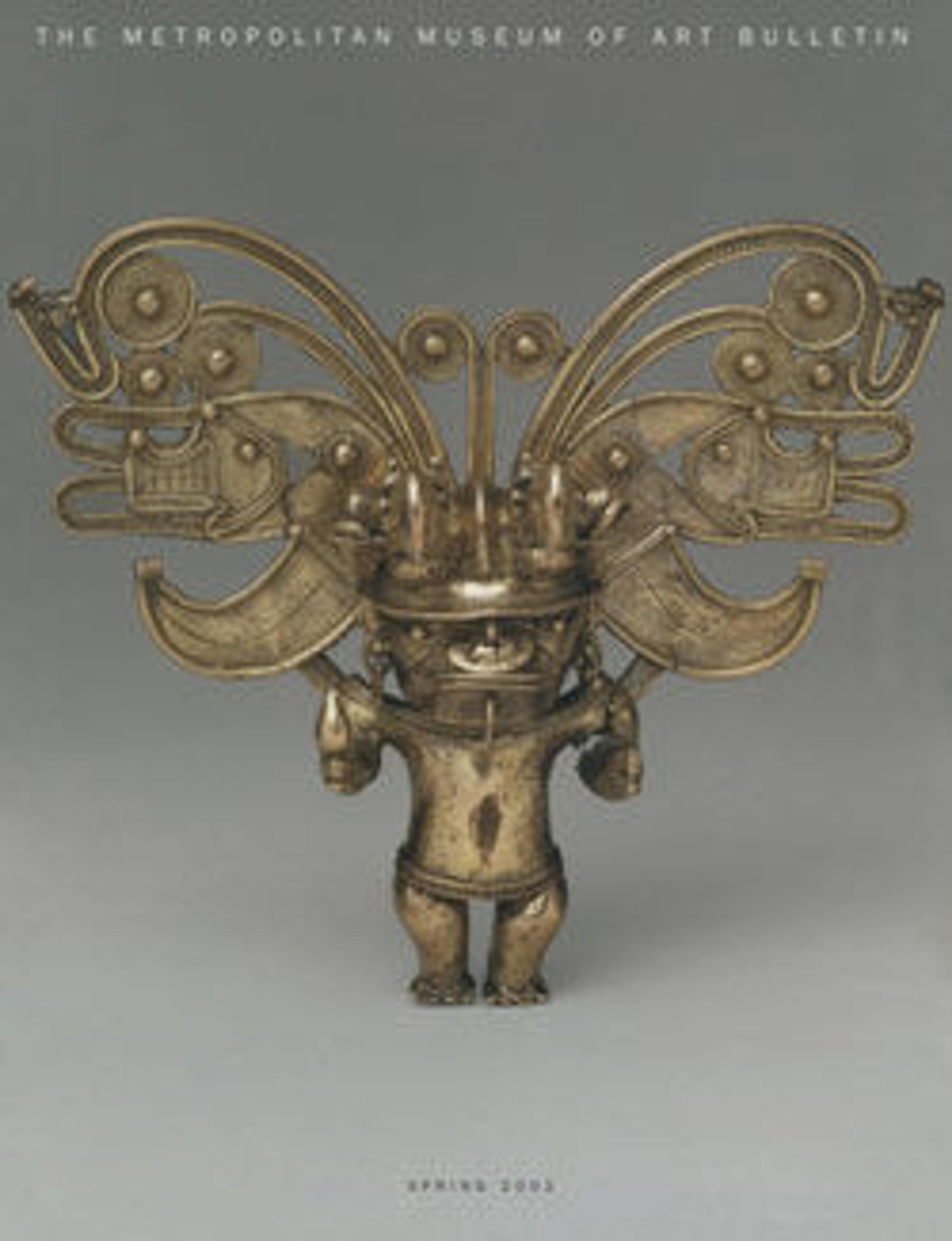
Goldworking in the Americas was first practiced in the Andes, spreading north to Panama by 200 CE. Gold objects reflected the brilliance of the sun both literally and metaphorically, and were highly coveted by many people in the ancient Americas. This pendant depicts a saurian head with minuscule spherical eyeballs. The ornament was made using the lost wax method, in which an artist expertly modeled tiny details in wax before enclosing the wax in a clay investment. When heated, the wax would melt, leaving a void into which molten metal could be poured and left to harden. The clay was then broken open, revealing the detailed gold pendant within.
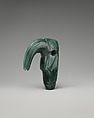
Two upcurved greenstones depict the long body of the crocodilian creature. A lapidary artist carved the hard stone through a labor-intensive process, spending hours shaping the stone into a smooth elliptic. Like gold, greenstone was also considered a precious material for ancient Central Americans, who associated it with water, fertility, and vegetation. Some greenstones, like serpentinite, could be found locally, but others, like jade, were exotic materials acquired from the Motagua Valley in Guatemala.
The gold and the greenstone were attached together with a waxy substance. Scientific analyses of similar composite gold objects from the site of El Caño indicate that a mixture of beeswax derivatives (hymenaea, burseraceae) and cerumen were used to connect these precious materials (Kaal et al. 2020). The complex chemical signature of the wax material suggests it was not simply an adhesive, but was a distinctive raw material.
Together, the gold and greenstone manifest the relationships between Coclé people and communities to the north and south. As Quilter (2003:8-9) notes, gold and greenstone are opposite in many ways. They relate to opposing directions, as gold working was first associated with South America while greenstone was obtained through long-distance exchange from Mesoamerica. They also differ in availability: gold may be found locally in many parts of the Americas, but greenstone sources are geographically limited. Production of these materials also required different skills: gold working requires knowledge of specialized production, while greenstone working is laborious but technically straightforward. The gold head and greenstone body thus unify the straightforward production of an exotic material and the complex production of a more accessible material.
Figures with crocodilian and saurian attributes are common in the iconography of ancient Panama. Gold pendants, such as this one, often take a saurian form, while crocodile-headed dancing figures appear commonly in ceramics from this period. Some scholars identify these images as iguanas, rather than crocodiles, linking the iguana to expressions of rulership and power in ancient Panama. The repetition of the heads emphasizes the concept of dualism, an important cosmological principle often expressed through paired figures. The repeated animal heads, and the juxtaposition of the gold and greenstone, reinforce the ideal of complementary and opposing forces. Duality remains an important element of art made by indigenous Panamanians today, particularly in mola textiles woven by Guna artists.
Pendants like these were worn by important members of Coclé society. The two minuscule circular loops on the top of the gold pendant would have allowed it to be suspended from the neck, perhaps part of a larger assemblage of ornaments. Similar pendants have been recovered from Sitio Conte and El Caño, extensive elite cemeteries dating to 750 - 950 CE (Lothrop 1937, 1942; Mayo 2025). Burials at these sites feature luxurious graves that contain large quantities of gold pendants, earrings, necklaces, and plaques alongside other objects, like pottery and stone pendants.
Caitlin Reddington Davis
Sylvan C. Coleman and Pam Coleman Memorial Fund Fellow
December 1, 2025
References
Cooke, Richard G. "Observations on the Religious Content of the Animal Imagery of the ‘Gran Coclé’ Semiotic Tradition of Pre-Columbian Panama." In Behaviour behind Bones: The Zooarchaeology of Ritual, Religion, Status and Identity, Sharyn Jones O’Day, Wim Van Neer, and Anton Ervynck, eds., 114–27. Liverpool: Oxbow Books, 2004.
Helms, Mary W. The Curassow's Crest: Myths and Symbols in the Ceramics of Ancient Panama. Gainesville: University Press of Florida, 2000.
Kaal, Joeri, Maria Martin Seijo, Cesar Oliveira, Ewa Wagner-Wysiecka, Victoria E. McCoy, Monica M. Solorzano Kraemer, Alexander Kerner, Philip Wenig, Carlos Mayo, Julia Mayo. "Golden artefacts, resin figurines, body adhesives and tomb sediments from the pre-Columbian burial site El Caño (Gran Coclé, Panamá): Tracing organic contents using molecular archaeometry." Journal of Archaeological Science 113, 2020.
Lothrop, Samuel Kirkland. Coclé: An Archaeological Study of Central Panama, Part I: Historical Background, Excavations at the Sitio Conte, Artifacts and Ornaments. Cambridge: Peabody Museum Press, 1937.
Lothrop, Samuel Kirkland. Coclé: An Archaeological Study of Central Panama, Part II: Pottery of the Sitio Conte and Other Archaeological Sites. Cambridge: Peabody Museum Press, 1942.
Mayo, Julia. El último vuelo del chamán. Panama City: Fundación El Caño, 2025.
Pillsbury, Joanne, Timothy Potts, and Kim N. Richter, eds. Golden Kingdoms: Luxury Arts in the Ancient Americas. Los Angeles: Getty Publications, 2017.
Quilter, Jeffrey. "The Golden Bridge of the Darien." In Gold and Power in Ancient Costa Rica, Panama, and Colombia (Jeffrey Quilter and John W. Hoopes, eds.): 1-14. Washington D.C.: Dumbarton Oaks Research Library and Collection, 2003.
Artwork Details
- Title: Double-crocodile pendant
- Artist: Coclé (Macaracas) artist
- Date: 950–1100 CE
- Geography: Panama, Cocle Province, Rio Parita
- Culture: Coclé (Macaracas)
- Medium: Gold (cast), greenstone
- Dimensions: H. 1 × W. 7/8 × D. 5/8 in. (2.5 × 2.2 × 1.6 cm)
- Classification: Metal-Ornaments
- Credit Line: Bequest of Alice K. Bache, 1977
- Object Number: 1977.187.20
- Curatorial Department: The Michael C. Rockefeller Wing
More Artwork
Related Content
 Free to download
Research Resources
The Met provides unparalleled resources for research and welcomes an international community of students and scholars. The Met's Open Access API is where creators and researchers can connect to the The Met collection. Open Access data and public domain images are available for unrestricted commercial and noncommercial use without permission or fee.
To request images under copyright and other restrictions, please use this Image Request form.
Feedback
We continue to research and examine historical and cultural context for objects in The Met collection. If you have comments or questions about this object record, please contact us using the form below. The Museum looks forward to receiving your comments.
Content Notice
The Metropolitan Museum of Art presents over 5,000 years of art from around the world, and our online collection reflects ongoing work conducted over the course of our more than 150-year history. You may encounter objects or images that may be inappropriate for some viewers or information that may be outdated.