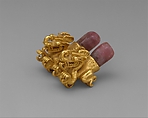
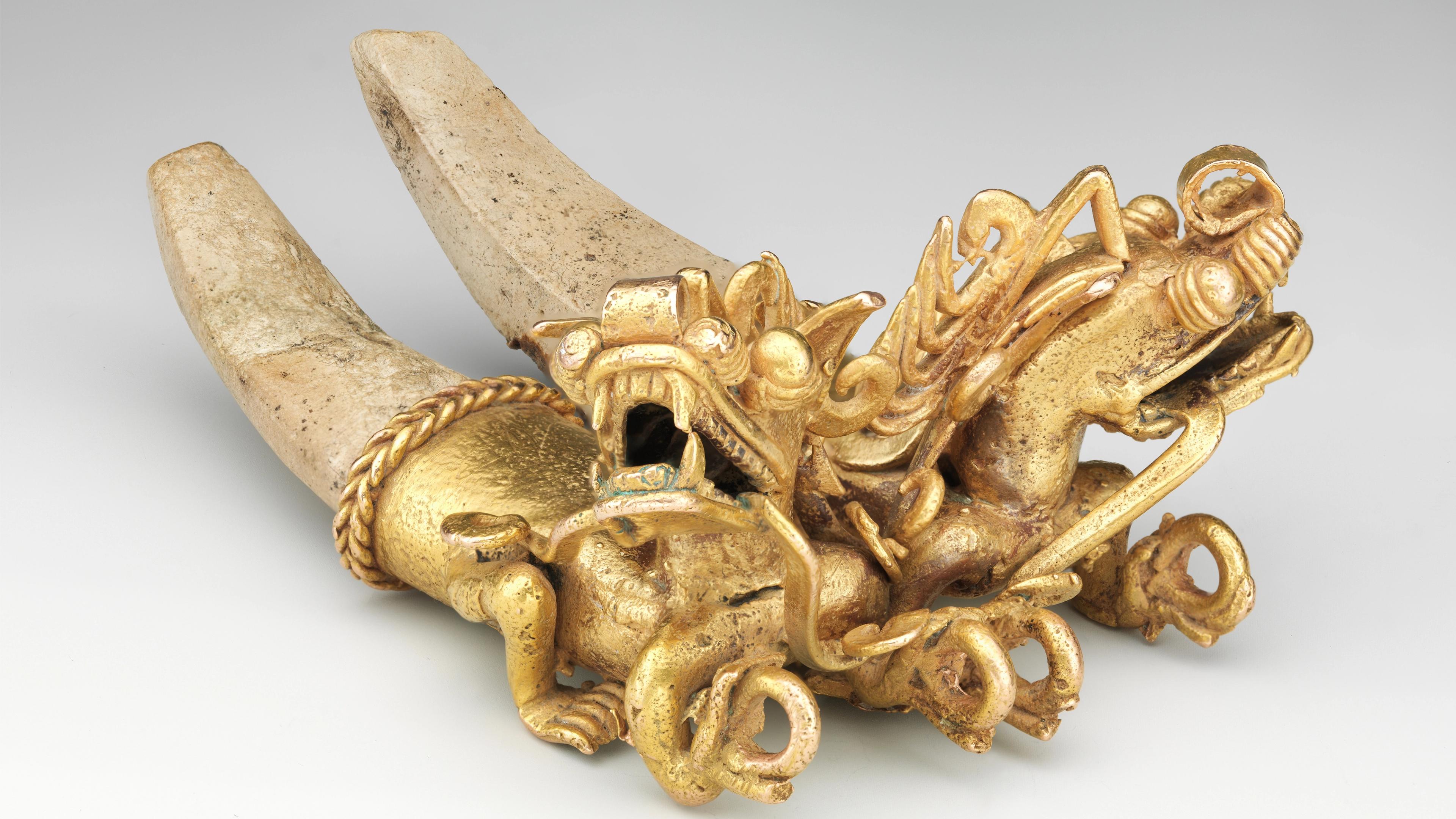
Double crocodile pendant
Similar objects have been excavated from elaborate burials at the archaeological sites of El Caño and Sitio Conte in the Coclé Province of Panama. Deceased chiefs were covered in fine gold ornaments, including decorated plaques, pendants, ear rods, embossed cuffs for wrists and ankles, and many strands of gold beads. Some of these gold ornaments included other precious materials, including greenstone, emerald, and sperm whale tooth. As many as twenty-five individuals would have accompanied the principal occupant of the tomb into the afterlife.
Goldworking technologies—including hammering, alloying, annealing, gilding, and casting—are believed to have come to Central America from the Andean region of South America around 700 CE. The majority of works from the area of the Isthmus of Panama were cast, and the most frequent form was the effigy pendant. These were produced in various animal and human forms, or combinations thereof, and were worn suspended from the neck by a thong or cord. In this example, the cord would have been strung through small gold loops located under the creatures’ front feet, so when worn they would be facing up in the direction of the wearer’s head.
Further Reading
Cooke, Richard G., et al., eds., To Capture the Sun: Gold of Ancient Panama (Tulsa, OK: Gilcrease Museum, 2011).
Jones, Julie. The Art of Precolumbian Gold: The Jan Mitchell Collection (New York: The Metropolitan Museum of Art, 1985).
Mayo, Julia and Juan Carles, eds., Guerreros de oro: Los señores de Río Grande en Panamá = Golden Warriors: The Lords of Río Grande in Panama (Panamá: Editora del Caribe, Fundación El Caño, 2015).
Pillsbury, Joanne, Timothy Potts, and Kim N. Richter, eds., Golden Kingdoms: Luxury Arts in the Ancient Americas (Los Angeles: The J. Paul Getty Museum, 2017).
Quilter, Jeffrey, and John W. Hoopes, eds., Gold and Power in Ancient Costa Rica, Panama and Colombia: A Symposium at Dumbarton Oaks, 9 and 10 October 1999 (Washington, D.C.: Dumbarton Oaks Research Library and Collections, 2003).
Artwork Details
- Title: Double crocodile pendant
- Artist: Coclé (Macaracas) artist
- Date: 950–1100 CE
- Geography: Panama, Cocle Province, Rio Parita region
- Culture: Coclé (Macaracas)
- Medium: Gold, shell
- Dimensions: H. 3 3/4 × W. 3 × D. 1 1/2 in. (9.5 × 7.6 × 3.8 cm)
- Classification: Metal-Ornaments
- Credit Line: Jan Mitchell and Sons Collection, Gift of Jan Mitchell, 1991
- Object Number: 1991.419.17
- Curatorial Department: The Michael C. Rockefeller Wing
More Artwork
Related Content

 Free to download
Research Resources
The Met provides unparalleled resources for research and welcomes an international community of students and scholars. The Met's Open Access API is where creators and researchers can connect to the The Met collection. Open Access data and public domain images are available for unrestricted commercial and noncommercial use without permission or fee.
To request images under copyright and other restrictions, please use this Image Request form.
Feedback
We continue to research and examine historical and cultural context for objects in The Met collection. If you have comments or questions about this object record, please contact us using the form below. The Museum looks forward to receiving your comments.
Content Notice
The Metropolitan Museum of Art presents over 5,000 years of art from around the world, and our online collection reflects ongoing work conducted over the course of our more than 150-year history. You may encounter objects or images that may be inappropriate for some viewers or information that may be outdated.