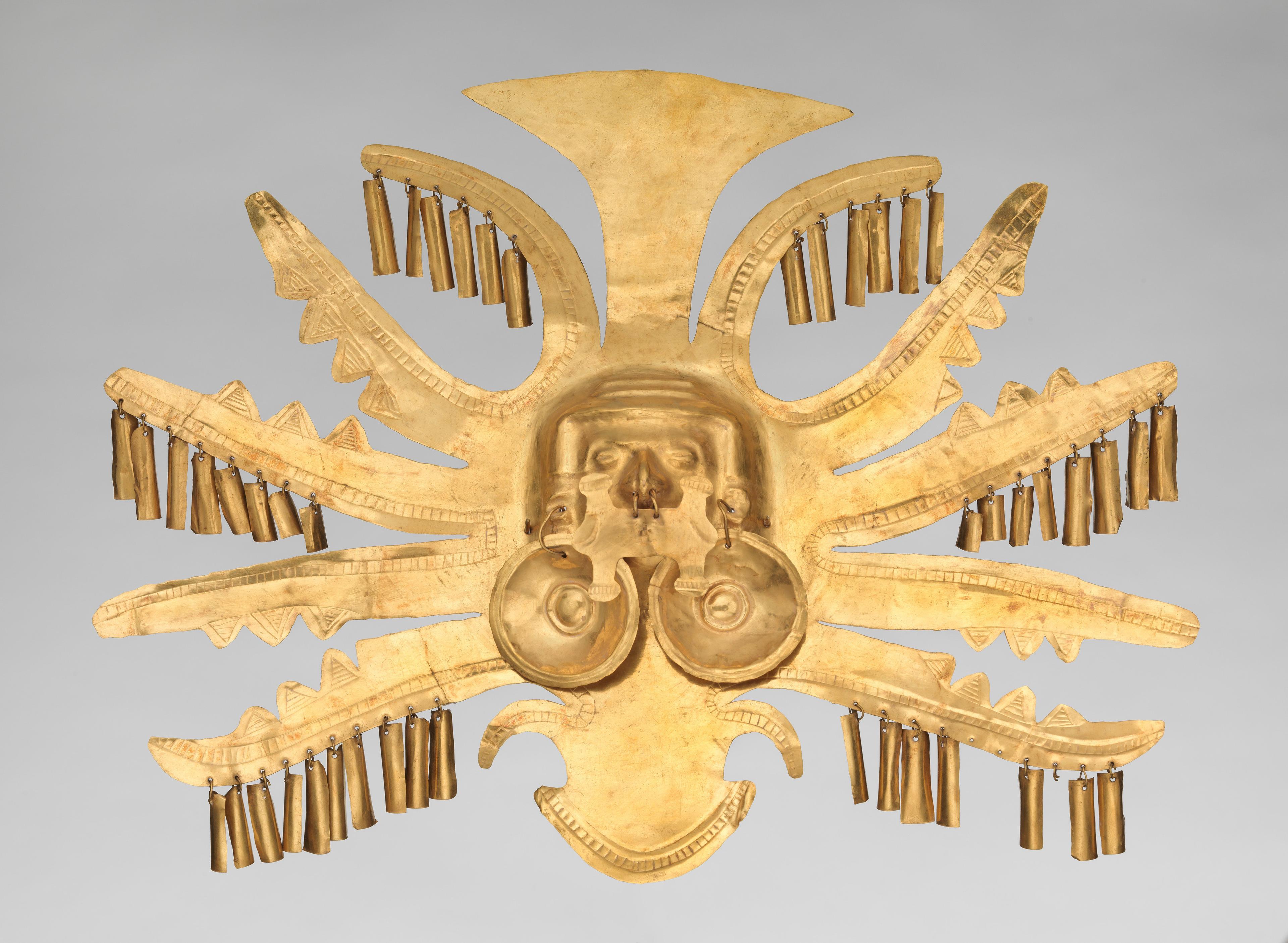
Headdress ornament, 100 BCE–700 CE. Calima (Yotoco) artist, Columbia. Gold,
8 1/2 × 11 1/2 × 1 1/4 in. (21.6 × 29.2 × 3.2 cm). The Metropolitan Museum of Art, New York, Gift and Bequest of Alice K. Bache, 1966, 1977 (66.196.24)
My name is Teresita Fernandez.
I make large-scale sculptural works that deal with the connection between the subterranean and the cosmos. I’m fascinated by that human narrative that attaches earthly metals to heavenly counterparts, what’s below corresponding to what’s above. Gold is the ultimate example of that.
Gold has always been associated universally with the sun and gold objects are literally parts of places, extracted from riverbeds and earth.
This gallery at The Met of pre-Columbian gold to me always feels like a well kept secret hiding in plain sight.
It’s radiant. I know that an important part of them would have been the sun bouncing off of them and creating all kinds of shimmering light. That element of movement of natural light animating these objects is something that we’re not witnessing when we see them as objects in a case.
The abstraction on some of these is so sophisticated. You’ll see the naturalistic representation of something dissolving before your very eyes and becoming a completely graphic, geometric, minimal shape. There are images within images. I think that’s what abstraction is about, it’s about how one thing can suggest something else.
In the United States we often forget that America is part of the Americas. These objects are part of an often overlooked or entirely invisible history. There’s no way to trace gold’s provenance. When you melt it down it’s just itself.
Most pre-Columbian gold was systematically loaded onto Spanish galleons already melted as ingots.
When I see gold in the European collections I can’t help but know it was once in the shape of pectorals or twin crocodiles or flattened feline whiskers.
It’s as though every image in a gold object has a ghost image of what it was before. These objects retain the memory of every form they’ve ever been. They’re not defined by physical edges.
Throughout history there have been attempts to erase other people’s histories. In this particular case it’s just poignant, because there was so much of it. We know that this represents greatness, and yet we only have a handful of examples to point to it. For me, this gallery is like looking at the tip of an iceberg, where one is seeing only a tiny glimpse of what we can only imagine.