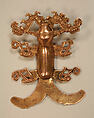
Double animal-head bell
Goldworking in the Americas was first practiced in the Andes, spreading north to Costa Rica by 200 CE (Pillsbury et al. 2017). Gold objects, reflecting the sun's brilliance both literally and metaphorically, were highly coveted by many people in the ancient Americas. The ornament was made using the lost-wax method, in which an artist expertly modeled tiny details in wax before enclosing the wax in a clay investment. When heated, the wax would melt, leaving a void into which molten metal could be poured and left to harden. The clay was then broken open, revealing the detailed gold pendant within.
The animals depicted in this pendant resemble deer, although the single horns suggest the animals are composite zoomorphs that draw on deer and other animals. White-tailed deer (Odocoileus virgianianus) were widely available in the Chiriquí area. Deer were multipurpose: the meat was used for food, while the antlers were used for tool, instrument, and ornament making. Deer skin can also be used for clothing and musical instruments, such as drums.
As one of the largest land mammals in Central America, deer held a wealth of symbolic associations. The Greater Coclé region celebrated white-tailed deer as spiritually powerful, consuming large quantities of deer in feasting events and using tubes made of deer bones to smoke hallucinogenic herbs(Martínez-Polanco and Cooke 2019). At Joya de Ceren, a 6th century town buried under a volcanic eruption in El Salvador, a deer-skull headdress and butchered deer bones indicate deer were incorporated into rituals related to agricultural fertility and the generative capacity of nature (Sheets 2013:29).
Deer-like animals are a favored subject in Chiriquí art. One pendant from the Met collection shows a composite being with the head of a deer and the body of a human, possibly representing a ritual specialist in transformation (MMA 1991.419.3). Ancient Chiriquí instruments were often crafted in the shape of animals, such as a bell in the shape of a jaguar (MMA 1979.206.916). Sound was an essential component of ritual in ancient Costa Rica, where drums, rattles, armadillo shells, and pan flutes were among the instruments used to make music. A lively gold figurine depicting a flute player presents a vibrant example of music-making (MMA 1974.271.26). Gold objects similar to the present example, such as this pendant shaped like a sea mammal (MMA 59.96.7) have been recovered from the Great Cenote at Chichén Itzá, demonstrating the long distances such highly valued objects could be carried (Coggins 1992).
Caitlin Reddington Davis
Sylvan C. Coleman and Pam Coleman Memorial Fund Fellow
January 2026
References
Coggins, Clemency Chase, ed. Artifacts from the Cenote of Sacrifice, Chichén Itzá, Yucatan. In Memoirs of the Peabody Museum of Archaeology and Ethnology Harvard University 10, no. 3. Cambridge, MA: Harvard University Press, 1992.
Dennett, Carrie, and Katrina C. Kosyk. "The Archaeology of Music in Greater Nicoya." Mi Museo y Vos 7(25): 4-11, 2013.
Fernández Esquivel, Patricia, Oro de Costa Rica: Metalurgía y orfebrería en la época precolombina. Costa Rica: Fundación Museo del Banco Central de Costa Rica, 2015.
Jones, Julie, ed. The Art of Precolumbian Gold: The Jan Mitchell Collection. New York: The Metropolitan Museum of Art, 1985.
Martínez-Polanco, María Fernanda and Richard G. Cooke, "Zooarchaeological and Taphonomical Study of the White-tailed Deer (Cervidae: Odocoileus virginianus Zimmerman 1780) at Sitio Sierra, a Pre-Columbian Village in Pacific Coclé Province, Panama, with an Evaluation of its Role in Feasts." Archaeological and Anthropological Sciences 11, 5405-5422, 2019.
Moore, J. Kenneth, Jayson Kerr Dobney, and E. Bradley Strauchen-Scherer
Musical Instruments: Highlights of the Metropolitan Museum of Art. New Haven: Yale University Press, 2015.
Pillsbury, Joanne, Timothy Potts, and Kim N. Richter, eds. Golden Kingdoms: Luxury Arts in the Ancient Americas. Los Angeles: J. Paul Getty Museum and Getty Research Institute, 2017.
Quilter, Jeffrey, and John W. Hoopes, eds. Gold and Power in Ancient Costa Rica, Panama, and Colombia. Washington D.C.: Dumbarton Oaks Research Library and Collection, 2003.
Sheets, Payson, "Dwelling in the Ancestral Joya de Ceren Village." In Revealing Ancestral Central America, edited by Rosemary Joyce, pp. 23-32. Washington, D.C.: Smithsonian Latino Center and the National Museum of the American Indian, 2013.
Steinbrenner, Larry, Alexander Geurds, Geoffrey G. McCafferty, and Silvia Salgado, eds., The Archaeology of Greater Nicoya: Two Decades of Research in Nicaragua and Costa Rica. Louisville: University Press of Colorado, 2021.
Artwork Details
- Title: Double animal-head bell
- Artist: Chiriquí artist(s)
- Date: 1000 - 1600 CE
- Geography: Costa Rica
- Culture: Chiriquí
- Medium: Gold
- Dimensions: H. 1 3/4 × W. 1 3/8 × D. 3/4 in. (4.4 × 3.5 × 1.9 cm)
- Classification: Metal-Musical Instruments
- Credit Line: Jan Mitchell and Sons Collection, Gift of Jan Mitchell, 1991
- Object Number: 1991.419.2
- Curatorial Department: The Michael C. Rockefeller Wing
More Artwork
Related Content
Research Resources
The Met provides unparalleled resources for research and welcomes an international community of students and scholars. The Met's Open Access API is where creators and researchers can connect to the The Met collection. Open Access data and public domain images are available for unrestricted commercial and noncommercial use without permission or fee.
To request images under copyright and other restrictions, please use this Image Request form.
Feedback
We continue to research and examine historical and cultural context for objects in The Met collection. If you have comments or questions about this object record, please contact us using the form below. The Museum looks forward to receiving your comments.
Content Notice
The Metropolitan Museum of Art presents over 5,000 years of art from around the world, and our online collection reflects ongoing work conducted over the course of our more than 150-year history. You may encounter objects or images that may be inappropriate for some viewers or information that may be outdated.