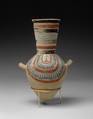
Jar
Compositional analyses have demonstrated that, despite their strong association with Teotihuacan, these vessels were not produced in the city. Instead, Thin Orange wares were made by potters in Tepexi de Rodríguez in southern Puebla (Rattray 1990). This area, located along a tributary of the River Carnero, produced a fine clay capable of constructing thin yet strong vessel walls. Elites at Teotihuacan exerted strong political and economic control over the production and distribution of these vessels. They also controlled the distribution of other luxury goods, like green obsidian from the Sierra de Pachuca volcanic range. Teotihuacan was a center for trade, attracting Maya, Zapotec, and other communities, who formed their own ethnic enclaves within the city. This expansive trade network facilitated the movement of Thin Orange bowls across Mesoamerica. Vessels were often produced in stackable forms to facilitate this long-distance exchange (see MMA 1978.412.45, 1983.497.14, 1994.35.54).
People used Thin Orange vessels for both domestic and ritual purposes. Some show signs of grinding on the interior, hinting at practical use as serving or drinking vessels. Others, such as dog-shaped pots and pots molded with complex iconography (see MMA1983.497.17), suggest a more intricate social function. People at Teotihuacan and other parts of Mesoamerica chose to be buried with Thin Orange vessels. The presence of these vessels in burials at faraway cities like Kaminaljuyu (Guatemala) and Copan (Honduras) is evidence of the widespread exchange network for Thin Orange pottery.
Caitlin Reddington Davis, Sylvan C. Coleman and Pam Coleman Memorial Fund Fellow, December 2025
Published References:
Kolb, Charles C. Thin Orange Pottery at Teotihuacan. Occasional Papers in Anthropology 8. University Park: Penn State University, 1973.
Gazzola, Julie. "La cerámica de Teotihuacán en fases tempranas, 100-200 d. C." Mexico City: Instituto Nacional de Antropología e Historia, 2024.
Rattray, Evelyn. "New Findings on the Origins of Thin Orange Ceramics." Ancient Mesoamerica,(2):181-195, 1990.
Robb, Matthew, et al. Teotihuacan: City of Water, City of Fire. Berkeley: University of California Press, 2017.
Seler, Eduard "Die Teotihuacan-Kultur des Hochlands von Mexico". Gesammelte Abhandlungen zur amerikanischen Sprach- und Alterthumskunde 5: 405-585, 1915.
Spence, Michael W. "Personal Art in Teotihuacan: Thin Orange Graffiti." Ancient Mesoamerica 26(2):295-311, 2015.
Artwork Details
- Title: Jar
- Artist: Teotihuacan artist(s)
- Date: 350–550 CE
- Geography: Mexico, Mesoamerica
- Culture: Teotihuacan
- Medium: Ceramic
- Dimensions: H. 7 3/8 x Diam. 6 in. (18.7 x 15.2 cm)
- Classification: Ceramics-Containers
- Credit Line: Bequest of Arthur M. Bullowa, 1993
- Object Number: 1994.35.50
- Curatorial Department: The Michael C. Rockefeller Wing
More Artwork
Research Resources
The Met provides unparalleled resources for research and welcomes an international community of students and scholars. The Met's Open Access API is where creators and researchers can connect to the The Met collection. Open Access data and public domain images are available for unrestricted commercial and noncommercial use without permission or fee.
To request images under copyright and other restrictions, please use this Image Request form.
Feedback
We continue to research and examine historical and cultural context for objects in The Met collection. If you have comments or questions about this object record, please contact us using the form below. The Museum looks forward to receiving your comments.
Content Notice
The Metropolitan Museum of Art presents over 5,000 years of art from around the world, and our online collection reflects ongoing work conducted over the course of our more than 150-year history. You may encounter objects or images that may be inappropriate for some viewers or information that may be outdated.