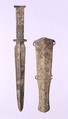
Reproduction of a Scythian sword sheath
This modern electrotype is a copy of a gold sheath in the Hermitage Museum, St Petersburg. The original, known as the Melgunov scabbard, was found with its iron sword in the first kurgan excavated in the Dniepr region in 1763 by General Alexey Melgunov (1722-1788). The rich burial, dated to the late seventh to early sixth century B.C., notably yielded objects showing influence from Urartu, such as the decoration of fantastic creatures on the sheath. At the time of the excavations the Scythians were unknown to scholars and therefore the significance of the discoveries was not recognized.
In the nineteenth century, many museums collected copies of ancient and historical works of art with the aim of presenting outstanding works to a broader public and to serve as inspiration for artists and manufacturers. The Metropolitan Museum of Art, founded in 1870, began to acquire electrotypes in its first decade. In 1883, Henry Marquand, a collector and early patron of the Museum, funded a large purchase from Elkington & Co. of nearly three hundred pieces. Today, these works are part of many departments in the Museum and along with plaster casts reflect the history of collecting and the role of the museum as a locus for the teaching of art history.
Artwork Details
- Title: Reproduction of a Scythian sword sheath
- Date: 19th century, after 7th century BCE original
- Medium: Electrotype
- Dimensions: 1 7/16 × 14 × 1 in. (3.7 × 35.6 × 2.6 cm)
- Credit Line: Gift of Henry G. Marquand, 1883
- Object Number: 83.18.122
- Curatorial Department: Ancient West Asian Art
More Artwork
Research Resources
The Met provides unparalleled resources for research and welcomes an international community of students and scholars. The Met's Open Access API is where creators and researchers can connect to the The Met collection. Open Access data and public domain images are available for unrestricted commercial and noncommercial use without permission or fee.
To request images under copyright and other restrictions, please use this Image Request form.
Feedback
We continue to research and examine historical and cultural context for objects in The Met collection. If you have comments or questions about this object record, please contact us using the form below. The Museum looks forward to receiving your comments.
Content Notice
The Metropolitan Museum of Art presents over 5,000 years of art from around the world, and our online collection reflects ongoing work conducted over the course of our more than 150-year history. You may encounter objects or images that may be inappropriate for some viewers or information that may be outdated.