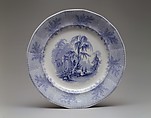
Dish
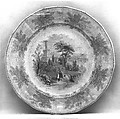
This blue and white transfer-printed earthenware dish made by the Staffordshire firm of William Ridgway, Son & Co. features a view of Fairmount Gardens and the Schuylkill Bridge at the Fairmount Water Works in Philadelphia, Pennsylvania. It belongs to a series of approximately twenty-six American views with moss-decorated borders titled "Catskill Moss" registered on December 16, 1844. The letters “C.C." printed on the back of the dish signify "common crockery" and were registered as a trademark when the firm operated at the Cobden Works from about 1841 to 1846. Built in the Neoclassical style from 1812 to 1824 after designs by Philadelphia engineer Frederick Graff (1774–1847), the Fairmount Water Works were among the first hydraulic-powered systems in the United States. The facility included a dam that backed up the Schuylkill River for nearly six miles to create the power necessary to pump millions of gallons of water into the reservoir situated at the top of "Faire Mount." Providing a scenic setting for the Water Works, Fairmount Gardens, also known as Fairmount Park, was among the nation's first parks. The Gardens and Water Works quickly became popular tourist attractions admired for their architectural and scenic beauty and innovative technology. Views of the site by other potters appear on a plate, 16.83.7, by Henshall, Williamson & Co (ca. 1802–1828), a plate, 10.57.15, by Joseph Stubbs (ca. 1822–1836) and a plate, 14.102.290, by Enoch Wood & Sons (1818–1846). Ridgway's view of the Gardens was based on a drawing by English artist William Henry Bartlett (1809–1854) engraved by English engraver James Giles (active 1840) and reproduced as “Fairmount Gardens, with the Schuylkill Bridge, Philadelphia" in Nathaniel Parker Willis' "American Scenery" (London, 1840). Bartlett was among the finest topographical draftsmen of the nineteenth century. Over one hundred of his drawings were published in "American Scenery," which established the route for the so-called "American Grand Tour" and became one of the most influential travel books of the period. The Museum's collection contains additional pieces by Ridgway, as well as original works by Bartlett and various editions of “American Scenery." Bartlett's American views also inspired decoration on export wares by other firms, including scenes on several pieces, 14.102.65, 14.102.265 and 14.102.327, from the "American Scenery” series by an affiliated firm, William Ridgway & Co. (ca. 1834–1854). Refer to the Dictionary for a definition of the term "transfer printing" and for information about the above-mentioned firms.
Artwork Details
- Title: Dish
- Maker: William Ridgway, Son & Co. (active ca. 1836–48)
- Date: ca. 1844–ca. 1846
- Geography: Made in Staffordshire, England
- Culture: British (American market)
- Medium: Earthenware, transfer-printed
- Dimensions: Diam. 9 5/8 in. (24.4 cm)
- Credit Line: Bequest of Mary Mandeville Johnston, from the collection of Mr. and Mrs. Edward W. S. Johnston, 1914
- Object Number: 14.102.220
- Curatorial Department: The American Wing
More Artwork
Research Resources
The Met provides unparalleled resources for research and welcomes an international community of students and scholars. The Met's Open Access API is where creators and researchers can connect to the The Met collection. Open Access data and public domain images are available for unrestricted commercial and noncommercial use without permission or fee.
To request images under copyright and other restrictions, please use this Image Request form.
Feedback
We continue to research and examine historical and cultural context for objects in The Met collection. If you have comments or questions about this object record, please contact us using the form below. The Museum looks forward to receiving your comments.