Ewer and Plateau
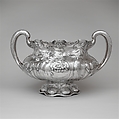
"Martelé" was a term applied to a line of art silver introduced in 1900 by Gorham. It was considered the finest expression of the Art Nouveau style in America. The ewer and plateau, hand-hammered into undulating forms and decorated in repoussé with swirling waves, plants, and female figures, are particularly successful examples of Martelé silver.
Artwork Details
- Title: Ewer and Plateau
- Maker: Gorham Manufacturing Company (American, Providence, Rhode Island, 1831–present)
- Retailer: Spaulding and Company
- Date: 1901
- Geography: Made in Providence, Rhode Island, United States
- Culture: American
- Medium: Silver
- Dimensions: Overall: 19 1/16 x 8 3/4 x 6 3/8 in. (48.4 x 22.2 x 16.2 cm); 64 oz. 9 dwt. (2005.6 g)
Plateau: 2 5/16 x 17 1/4 in. (5.9 x 43.8 cm); 67 oz. 2 dwt. (2086.5 g) - Credit Line: Gift of Mr. and Mrs. Hugh J. Grant, 1974
- Object Number: 1974.214.26a, b
- Curatorial Department: The American Wing
Audio
4528. Ewer and Plateau
MORRISON HECKSCHER: With its undulating waves and swirling plants, this magnificent ewer and stand embodies the Art Nouveau style. Forming the handle is a sensuous female form that also recalls seventeenth-century Mannerist silver. It was made by Gorham, one of America’s oldest silver manufactories, based in Providence, Rhode Island. American Decorative Arts Curator, Beth Wees.
BETH WEES: And the interesting thing to me about this is that Gorham started out in an attempt to make silver for everyone so that the average householder could own silver. But towards the end of the nineteenth century, when the Arts & Crafts movement began to cherish the handmade look, the managers of Gorham decided that it would be nice to have a line of handcrafted silver.
MORRISON HECKSCHER: So Gorham developed Martelé, from the French word for “hammering.” This was basically a technique for chasing, or sculpting the silver with hammers to form these swirling relief motifs.
BETH WEES: Most American silver is of the sterling standard, which is 92.5% silver. And during the period of the manufacture of Martelé, the silver was actually 95% pure silver.
MORRISON HECKSCHER: This, of course, translated into a higher price tag. But the metal was also heavier and softer. And befitting the Arts & Crafts credo, its surface texture actually reveals the marks left in the metal as it was hammered by hand.
More Artwork
Related Content
 Free to download
Research Resources
The Met provides unparalleled resources for research and welcomes an international community of students and scholars. The Met's Open Access API is where creators and researchers can connect to the The Met collection. Open Access data and public domain images are available for unrestricted commercial and noncommercial use without permission or fee.
To request images under copyright and other restrictions, please use this Image Request form.
Feedback
We continue to research and examine historical and cultural context for objects in The Met collection. If you have comments or questions about this object record, please contact us using the form below. The Museum looks forward to receiving your comments.
Content Notice
The Metropolitan Museum of Art presents over 5,000 years of art from around the world, and our online collection reflects ongoing work conducted over the course of our more than 150-year history. You may encounter objects or images that may be inappropriate for some viewers or information that may be outdated.