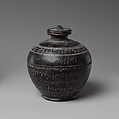
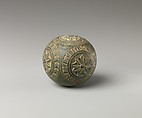
The Ramaka Casket; Inscribed Reliquary, Donated by Ramaka
Artwork Details
- Title: The Ramaka Casket; Inscribed Reliquary, Donated by Ramaka
- Date: 1st century CE
- Culture: Pakistan (ancient region of Gandhara, Bajaur)
- Medium: Schist
- Dimensions: H. 2 15/16 in. (7.5 cm); Diam. 2 1/8 in. (5.4 cm)
- Classification: Sculpture
- Credit Line: Samuel Eilenberg Collection, Gift of Samuel Eilenberg, 1987
- Object Number: 1987.142.71a, b
- Curatorial Department: Asian Art
Audio
7924. The Ramaka Casket; Inscribed Reliquary, Donated by Ramaka, Part 1
[MUSIC PLAYS]
The inscription on this black stone casket tells us that it originally contained relics of the Buddha’s. It may also have contained the kinds of shimmering objects you see nearby—glass beads, crystal, and gold. The Buddha’s enlightened physical remains were associated with light, so donors offered glistening materials to be enshrined with his relics. Relics were central to early Buddhist worship. According to religious texts, the Buddha’s cremated remains were placed into eight reliquaries, which were buried beneath dome-shaped mounds of earth, called stupas. Worshippers circled around the stupas to experience the Buddha’s enlightened presence.
In the third century B.C., King Ashoka, a great proponent of Buddhism, sought to bring the religion to his people. He opened the eight original stupas and divided the Buddha’s remains into 84,000 parts, which he had enshrined in stupas across his empire in Northern India. Later kings emulated Ashoka, opening stupas and further dividing the Buddha’s relics.
According to the inscription on this casket, it was donated by a prince named Indravarman. It tells us of the great merit generated, positive karma that would lead to a rebirth in heaven for Indravarman and his family. The creation of a new sacred area would have also helped to establish his political legitimacy. All of the reliquaries in this case were donated by such faithful Buddhists. To hear more about the earliest forms of Buddhist worship as you look at the other objects in this case, press play.
Listen to more about this artwork
More Artwork
Related Content
Research Resources
The Met provides unparalleled resources for research and welcomes an international community of students and scholars. The Met's Open Access API is where creators and researchers can connect to the The Met collection. Open Access data and public domain images are available for unrestricted commercial and noncommercial use without permission or fee.
To request images under copyright and other restrictions, please use this Image Request form.
Feedback
We continue to research and examine historical and cultural context for objects in The Met collection. If you have comments or questions about this object record, please contact us using the form below. The Museum looks forward to receiving your comments.
Content Notice
The Metropolitan Museum of Art presents over 5,000 years of art from around the world, and our online collection reflects ongoing work conducted over the course of our more than 150-year history. You may encounter objects or images that may be inappropriate for some viewers or information that may be outdated.