Bear figure and spill holder
Artwork Details
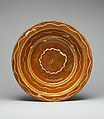
- Title: Bear figure and spill holder
- Maker: Possibly Parker Pottery
- Date: ca. 1850–75
- Geography: Made in Montour County, Pennsylvania, United States
- Culture: American
- Medium: Earthenware; Redware with slip decoration
- Dimensions: H. 6 in. (15.2 cm)
- Credit Line: Friends of the American Wing Fund, 1980
- Object Number: 1980.357
- Curatorial Department: The American Wing
Audio
4520. Overview: Pennsylvania Redware
MORRISON HECKSCHER: Among the most decorative early American earthenware was Pennsylvania German Redware, on display here. Decorative Arts curator Alice Cooney Frelinghuysen.
ALICE COONEY FRELINGHUYSEN: Pennsylvania was a very agricultural area with iron-rich clays that were well-suited to the making of low-fired red earthenware.
MORRISON HECKSCHER: Much of the redware was simple and utilitarian. But what you’re seeing here are pieces that were family treasures. Talented redware potters used two basic decorative techniques. One was drawing with a quill using slip, or liquid clay, on unfired pieces. The other technique was called “sgraffito.” In this method, the potter carved a design through an applied layer of slip to reveal the base of red clay.
ALICE COONEY FRELINGHUYSEN: And you see the motifs are very much those of the origin of the potters themselves, which was from the European low countries. . . The tulip, the horse and rider, the stylized birds are all motifs that you would find in folk pottery in Switzerland and in Germany, as well.
MORRISON HECKSCHER: The plates often have German inscriptions around them. Many refer to birthdays or weddings. Others have names and dates.
ALICE COONEY FRELINGHUYSEN: But some do evince a marvelous sense of humor. One, for example, says something to the effect, "There is the meat and sauerkraut, for our maid is now a bride." Or another one, . . . . says something again to the effect, "In the dish, on the table, merry is he who is unmarried and able."
More Artwork
Research Resources
The Met provides unparalleled resources for research and welcomes an international community of students and scholars. The Met's Open Access API is where creators and researchers can connect to the The Met collection. Open Access data and public domain images are available for unrestricted commercial and noncommercial use without permission or fee.
To request images under copyright and other restrictions, please use this Image Request form.
Feedback
We continue to research and examine historical and cultural context for objects in The Met collection. If you have comments or questions about this object record, please contact us using the form below. The Museum looks forward to receiving your comments.
Content Notice
The Metropolitan Museum of Art presents over 5,000 years of art from around the world, and our online collection reflects ongoing work conducted over the course of our more than 150-year history. You may encounter objects or images that may be inappropriate for some viewers or information that may be outdated.