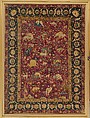
Silk Kashan Carpet
Artwork Details
- Title: Silk Kashan Carpet
- Date: 16th century
- Geography: Made in Iran, probably Kashan
- Medium: Silk (warp, weft and pile); asymmetrically knotted pile
- Dimensions: Rug: L. 96 in. (243.8 cm)
W. 65 in. (165.1 cm)
Mount: L. 101 3/4 in. (258.4 cm)
W. 72 1/2 in. (184.2 cm)
D. 3 in. (7.6 cm)
Estimated weight: 200 lbs. - Classification: Textiles-Rugs
- Credit Line: Bequest of Benjamin Altman, 1913
- Object Number: 14.40.724
- Curatorial Department: Islamic Art
Audio
6640. Overview: Kashan Silk Carpets
NARRATOR: In this case are examples of so-called “Kashan” carpets. They’re made entirely from silk.
WALTER DENNY: The names we use for Persian carpets are, in some ways, a little bit arbitrary because we're not 100% sure of the provenance of most of them. But there's general agreement that these small silk carpets were probably woven in the city of Kashan. These are the luxury objects, par excellence.
NARRATOR: Here, and elsewhere in these galleries, Walter Denny is joined by the Head of the Islamic Department, Sheila Canby:
SHEILA CANBY: There's this whole tactile quality. If you imagine the silk pile of one of these carpets…
WALTER DENNY: Absolutely – which is one of the reasons we keep these carpets behind Plexiglas, because they're almost irresistible to the sense of touch.
SHEILA CANBY: And….the visual vocabulary in the ones with the animal combats is absolutely the same as what one finds in the borders of manuscripts, what you find on book bindings.
WALTER DENNY: And if you were to move through the Islamic Galleries to Gallery 13 you'd find… miniature paintings where you see exactly the same animals in the same poses… which shows that there's a common origin for all of these arts in the royal design atelier at the Safavid Court in the first half of the 16th Century.
SHEILA CANBY: That's absolutely right, I mean, that there really is a unity at the very high end of the arts in the period we're talking about, in the 16th Century.
WALTER DENNY– Right. And high-ends don't get much higher than this.
SHEILA CANBY: No, that's for sure.
More Artwork
Related Content
 Free to download
Research Resources
The Met provides unparalleled resources for research and welcomes an international community of students and scholars. The Met's Open Access API is where creators and researchers can connect to the The Met collection. Open Access data and public domain images are available for unrestricted commercial and noncommercial use without permission or fee.
To request images under copyright and other restrictions, please use this Image Request form.
Feedback
We continue to research and examine historical and cultural context for objects in The Met collection. If you have comments or questions about this object record, please contact us using the form below. The Museum looks forward to receiving your comments.
Content Notice
The Metropolitan Museum of Art presents over 5,000 years of art from around the world, and our online collection reflects ongoing work conducted over the course of our more than 150-year history. You may encounter objects or images that may be inappropriate for some viewers or information that may be outdated.