Saint Barbara
Artwork Details
- Title: Saint Barbara
- Date: ca. 1510
- Culture: German
- Medium: Limewood
- Dimensions: Overall: 24 1/8 x 8 13/16 x 5 3/16 in. (61.2 x 22.4 x 13.2 cm)
- Classification: Sculpture-Wood
- Credit Line: Bequest of George Blumenthal, 1941
- Object Number: 41.190.95
- Curatorial Department: Medieval Art and The Cloisters
Audio
3055. Saint Barbara
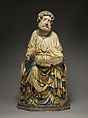
JULIEN CHAPUIS: This sculpture is characterized by an overall great refinement in the treatment of surfaces.
NARRATOR: Curator Julien Chapuis on this sculpture, thought to be of Saint Barbara.
JULIEN CHAPUIS: Look for instance at the hairnet, with all the pearls, and beads, and other ornaments. Or for instance, look at the hem of her dress. You will see that they are punched with a multitude of little circle marks, forming each time this sort of flower. Another wonderful detail is the two clasps that hold the Saint’s mantel together. The one on the left represents a figure, a naked figure with a bow and arrow. The figure on the other medallion appears to be a centaur and in all likelihood this was a depiction of the labors of Hercules This sculpture is also remarkable for the drapery, pulling most of the mantel toward the center and giving the sculpture a great dynamic and sense of life.
This sculpture in a sense marks the end of the Medieval collection, the end of Medieval art, and it is at the threshold of the Renaissance. The sculpture was made in Augsburg around 1510. Augsburg was the first city in Germany to adopt the ideals of the Italian Renaissance.
More Artwork
Related Content
 Free to download
Research Resources
The Met provides unparalleled resources for research and welcomes an international community of students and scholars. The Met's Open Access API is where creators and researchers can connect to the The Met collection. Open Access data and public domain images are available for unrestricted commercial and noncommercial use without permission or fee.
To request images under copyright and other restrictions, please use this Image Request form.
Feedback
We continue to research and examine historical and cultural context for objects in The Met collection. If you have comments or questions about this object record, please contact us using the form below. The Museum looks forward to receiving your comments.
Content Notice
The Metropolitan Museum of Art presents over 5,000 years of art from around the world, and our online collection reflects ongoing work conducted over the course of our more than 150-year history. You may encounter objects or images that may be inappropriate for some viewers or information that may be outdated.