English
DonateMembershipTickets

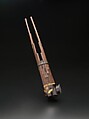
Incense Burner in Form of a Praying Mantis

second half 19th century
On view at The Met Fifth Avenue in Gallery 226
Since ancient times, Japanese artists have depicted a wide variety of living creatures. Everyday insects and animals were imbued with meanings derived from their appearance, behaviors, and even their names, and were used as motifs representing the changing seasons and wishes for an auspicious life and future. The praying mantis has long been regarded in Japan as a beneficial creature because it preys on insects that damage crops. Its image even appears on Yayoi-period (300 BCE–300 CE) bronze bells, used in agricultural rituals for safe and plentiful rice harvests. The mantis also features prominently in Chinese classical anecdotes, in which it sometimes symbolizes the weak who, unaware of their own limitations, boldly confront a stronger adversary. Through these layered associations, the mantis became an enduring subject in Japanese decorative arts.

Artwork Details

Object Information
  • 蟷螂形香炉
  • Title: Incense Burner in Form of a Praying Mantis
  • Period: Meiji period (1868–1912)
  • Date: second half 19th century
  • Culture: Japan
  • Medium: Iron, gold, silver lining
  • Dimensions: H. 3 1/3 in. (8.9 cm); L. 6 in. (15.2 cm)
  • Classification: Metalwork
  • Credit Line: The Howard Mansfield Collection, Gift of Howard Mansfield, 1936
  • Object Number: 36.120.669a, b
  • Curatorial Department: Asian Art
More Artwork
Armor (<i>Gusoku</i>), Saotome Ietada  Japanese, Iron, lacquer, silk, gilt copper, Japanese
Armorer Helmet bowl signed Saotome Ietada
Armorer Breastplate inscribed inside, Myōchin Munesuke
16th and 18th centuries
Incense Burner in Shape of Quail, Iron with gold and silver inlay, Japan
Japan
19th century
Flowers and Grasses of the Four Seasons, Kano Mitsunobu  Japanese, Pair of six-panel folding screens; ink, color, gold paint, and gold leaf on paper, Japan
Circle of Kano Mitsunobu
late 16th century
Shō, Bamboo wood, metal, Japanese
Japanese
19th century
Perfume Burner Surmounted by a Satyr, Desiderio da Firenze  Italian, The cover and body are binary bronze (copper and tin, with traces of zinc, iron, nickel, silver, and antimony); the foot is cast in brass (copperzinc alloy with very minor amounts of tin, lead, and the usual copper impurities of iron, nickel, silver, and antimony).
Workshop of Desiderio da Firenze
ca. 1540–50

Research Resources

The Met provides unparalleled resources for research and welcomes an international community of students and scholars. The Met's Open Access API is where creators and researchers can connect to the The Met collection. Open Access data and public domain images are available for unrestricted commercial and noncommercial use without permission or fee.

To request images under copyright and other restrictions, please use this Image Request form.

Feedback

We continue to research and examine historical and cultural context for objects in The Met collection. If you have comments or questions about this object record, please contact us using the form below. The Museum looks forward to receiving your comments.

Send feedback

Content Notice

The Metropolitan Museum of Art presents over 5,000 years of art from around the world, and our online collection reflects ongoing work conducted over the course of our more than 150-year history. You may encounter objects or images that may be inappropriate for some viewers or information that may be outdated.