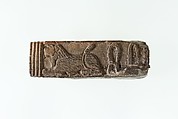
Apotropaic rod
Artwork Details
- Title: Apotropaic rod
- Period: Middle Kingdom
- Dynasty: Dynasty 12
- Reign: reign of Senwosret III
- Date: ca. 1878–1640 B.C.
- Geography: From Egypt
- Medium: Glazed steatite
- Dimensions: L. 27.5 cm (10 7/8 in.); W. 2.3 cm (7/8 in.); d-e) crocodiles: L. 3.5 cm (1 3/8 in.); f-g) lions: L. 3 cm (1 3/16 in.); h) turtle: L. 2.6 cm (1 in.); i-j) frogs: L. 2 cm (13/16 in.)
- Credit Line: Purchase, Edward S. Harkness Gift, 1926
- Object Number: 26.7.1275a–j
- Curatorial Department: Egyptian Art
Audio
1119. Kids: Magic rod with animals on top
[MUSIC]
The ancient Egyptians believed that this rectangular rod had magical power. It was buried in a tomb to protect the dead in the afterlife. A carved lion sits on top, at either end of the rod. These lions symbolize the horizon. Each day, the sun god, Re, rose over the eastern horizon, set in the west, then traveled through the underworld at night. This rod magically enacts the journey of the sun. The Egyptians believed that the dead would travel through the underworld with Re. And so the dead would be reborn with the rising sun. All of the animals on the magic rod represent enemies or helpers of the sun. Between the lions sit two crocodiles, two frogs or toads, and a turtle.
Look closely at the carvings on the side of the rod. At either end you’ll see a large eye. This is the eye of the god Horus, a symbol of protection and rebirth called a wedjat. Beside each wedjat eye sits a baboon with a lamp. You’ll also see another crocodile and a lion carved on the side of the rod. And can you find a cat?
More Artwork
Related Content

 Free to download
Research Resources
The Met provides unparalleled resources for research and welcomes an international community of students and scholars. The Met's Open Access API is where creators and researchers can connect to the The Met collection. Open Access data and public domain images are available for unrestricted commercial and noncommercial use without permission or fee.
To request images under copyright and other restrictions, please use this Image Request form.
Feedback
We continue to research and examine historical and cultural context for objects in The Met collection. If you have comments or questions about this object record, please contact us using the form below. The Museum looks forward to receiving your comments.
Content Notice
The Metropolitan Museum of Art presents over 5,000 years of art from around the world, and our online collection reflects ongoing work conducted over the course of our more than 150-year history. You may encounter objects or images that may be inappropriate for some viewers or information that may be outdated.