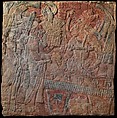
Relief: fecundity figure
Artwork Details
- Title: Relief: fecundity figure
- Period: Middle Kingdom
- Dynasty: Dynasty 12
- Reign: reign of Senwosret I
- Date: ca. 1961–1917 B.C.
- Geography: From Egypt, Memphite Region, Lisht South, Pyramid Temple of Senwosret I, MMA excavations, 1908–09
- Medium: Limestone, paint
- Dimensions: h. 71.8 cm (28 1/4 in); w. 76.3 cm (30 1/4 in); th. 13.3 cm (5 1/4 in)
- Credit Line: Rogers Fund, 1909
- Object Number: 09.180.7
- Curatorial Department: Egyptian Art
Audio
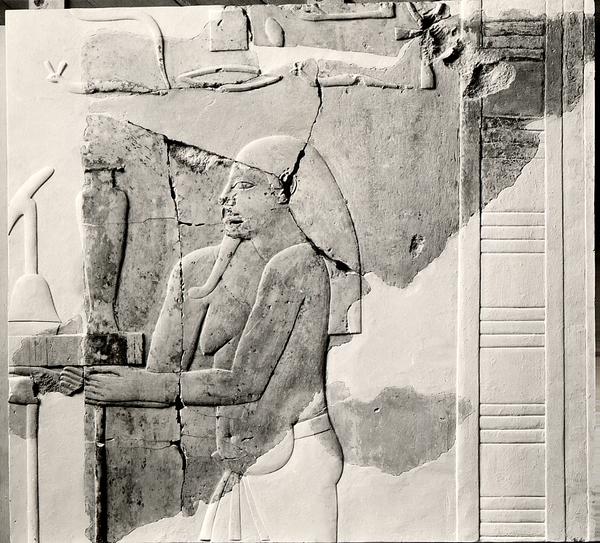
3320. Relief: fecundity figure
Many of the objects in this room came from the pyramid complex of the Middle Kingdom pharaoh, Senwosret the First. This label outlines the entire complex – but we’re going to be taking a closer look at some of its painted relief carvings. They’re in front of you and in the long wall case, to your left. Most of them come from the king’s pyramid temple, which illustrated ideas related to Egyptian kingship. It was in the temple that the cult of the king was celebrated.
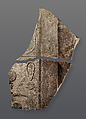
Near the center of the case, look for a square piece. The fragment on it shows a figure with a rounded belly, and a sagging breast. This is an interesting example of how the Egyptians combined side views with frontal views of the body. The hieroglyphs above the figure identify him as Nepri, the personification of grain. In the fragment just below him, we see a man kneeling in front of a low offering table. Above the table is an inscription listing food offerings intended to provide the king with sustenance in the afterlife. In the fragment immediately to the left are two offering bearers carrying figs, lotus flowers, ducks, and other offerings.
[FESTIVE-SOUNDING EGYPTIAN MUSIC]
Farther to the left are a number of pieces depicting male and female deities. They were originally arranged to reflect festival processions in which statues or other objects representing the deities were gathered together. At the far left end of the wall we see an image of Senwosret I himself, shown facing left, and wearing the distinctive folded royal headcloth called a nemes. The vertical notched palm frond behind him symbolizes the wish for his reign to last for millions of years.
More Artwork
Press the down key to skip to the last item.
Research Resources
The Met provides unparalleled resources for research and welcomes an international community of students and scholars. The Met's Open Access API is where creators and researchers can connect to the The Met collection. Open Access data and public domain images are available for unrestricted commercial and noncommercial use without permission or fee.
To request images under copyright and other restrictions, please use this Image Request form.
Feedback
We continue to research and examine historical and cultural context for objects in The Met collection. If you have comments or questions about this object record, please contact us using the form below. The Museum looks forward to receiving your comments.