Canopic Jar (with lid 30.8.54)
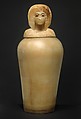
The striking face carved on the jar lid represents one of the royal women of Amarna. Her hairstyle of overlapping curls, known as the Nubian wig, was worn only by adults and was popular among the female members of Akhenaten's family. The hole at the center of the forehead once secured the separately carved upper body of a rearing cobra whose tail is visible across the top of the wig. This royal protector was exclusively worn by kings and queens.
Since its discovery in 1907, the face has been variously identified as that of Queen Tiye, Akhenaten's mother; Queen Nefertiti, his principal wife; Queen Kiya, his beloved secondary wife; and Princess Merytaten, his eldest daughter. For a time, it was even identified as Akhenaten himself. This confusion is understandable, since the inscription identifying the owner was almost completely erased. Faint traces of hieroglyphs indicate that the jar was originally inscribed for Kiya, and the Nubian wig is most frequently associated with this queen. In some respects, however, the face more closely resembles later representations of Tiye, and it is possible that the lid originally belonged to her burial equipment and was later placed on Kiya's canopic jar.
The tomb in which the jar was found, KV 55 in the Valley of the Kings, is probably the most controversial of all Egyptian tombs. It contained burial equipment inscribed for Queen Tiye and magical bricks with the name of Akhenaten. There were also four canopic jars (including this one) and an inlaid wooden coffin almost certainly made for Kiya. It appears that, for safekeeping, Tutankhamun had this material transferred to Thebes from Akhenaten's tomb at Amarna, which seems to have been plundered soon after Akhenaten's death. The jars and coffin of Kiya may have been reused at that time for the burial of another member of the royal family.
Artwork Details
- Title: Canopic Jar (with lid 30.8.54)
- Period: New Kingdom, Amarna Period
- Dynasty: Dynasty 18
- Reign: reign of Akhenaten
- Date: ca. 1347–1330 BCE
- Geography: From Egypt, Upper Egypt, Thebes, Valley of the Kings, Tomb KV 55, Davis/Ayrton excavations, 1907
- Medium: Travertine (Egyptian alabaster)
- Dimensions: Jar only: H. 36.9 cm (14 1/2 in.); Diam. 24 cm (9 7/16 in.)
Jar with lid: H. 53.2 cm (20 15/16 in.) - Credit Line: Gift of Theodore M. Davis, 1907
- Object Number: 07.226.1
- Curatorial Department: Egyptian Art
More Artwork


Related Content
 Free to download
Research Resources
The Met provides unparalleled resources for research and welcomes an international community of students and scholars. The Met's Open Access API is where creators and researchers can connect to the The Met collection. Open Access data and public domain images are available for unrestricted commercial and noncommercial use without permission or fee.
To request images under copyright and other restrictions, please use this Image Request form.
Feedback
We continue to research and examine historical and cultural context for objects in The Met collection. If you have comments or questions about this object record, please contact us using the form below. The Museum looks forward to receiving your comments.
Content Notice
The Metropolitan Museum of Art presents over 5,000 years of art from around the world, and our online collection reflects ongoing work conducted over the course of our more than 150-year history. You may encounter objects or images that may be inappropriate for some viewers or information that may be outdated.