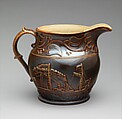
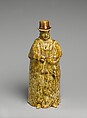
Pitcher
Artwork Details
- Title: Pitcher
- Designer: Probably designed by Daniel Greatbatch (active 1838–ca. 1861)
- Manufacturer: D. & J. Henderson Flint Stoneware Manufactory (active 1829–33)
- Date: 1829–33
- Geography: Made in Jersey City, New Jersey, United States
- Culture: American
- Medium: Stoneware
- Dimensions: H. 6 in. (15.2 cm); Diam. 5 3/8 in. (13.7 cm)
- Credit Line: Gift of John C. Cattus, 1967
- Object Number: 67.262.11
- Curatorial Department: The American Wing
Audio
4530. Overview: Yellow Ware and Rockingham Ware
MORRISON HECKSCHER: Around the mid-nineteenth century, a wave of immigration brought skilled English potters to American shores. And with them came a new type of pottery that was shaped in molds rather than thrown on the wheel. This case features the variety of inventive forms that followed. They range from figurines and picture frames to pots and pitchers, and are often embellished with sculptural decoration. Factories sprung up in Ohio, Maryland, Vermont, and New Jersey to produce these wares. Decorative Arts Curator Alice Cooney Frelinghuysen.
ALICE COONEY FRELINGHUYSEN: This was a middle-class genre. This was a ceramic that was made in multiples. It was much less expensive than fine porcelain and could really be brought into most middle-class homes.
MORRISON HECKSCHER: These molded wares shifted the skill from the potter to the designer of the molds. One of the greatest was English-born Daniel Greatbach. Among his accomplishments is introducing the popular pitcher with a handle shaped like a hound. You can see a number of examples here. You’ll also notice that many of these wares are mottled or streaked with a lustrous brown glaze. This was called Rockingham because pottery first glazed like this was made at the Rockingham estate in Swinton, England.
ALICE COONEY FRELINGHUYSEN: The brown glaze was really achieved by adding manganese to the glaze and it gave it this brown color. But if you look, particularly on the right-hand side of this case, you see wonderful greens and blues and yellows incorporated into the design, becoming almost like an abstract painting.
More Artwork
Related Content
 Free to download
Research Resources
The Met provides unparalleled resources for research and welcomes an international community of students and scholars. The Met's Open Access API is where creators and researchers can connect to the The Met collection. Open Access data and public domain images are available for unrestricted commercial and noncommercial use without permission or fee.
To request images under copyright and other restrictions, please use this Image Request form.
Feedback
We continue to research and examine historical and cultural context for objects in The Met collection. If you have comments or questions about this object record, please contact us using the form below. The Museum looks forward to receiving your comments.
Content Notice
The Metropolitan Museum of Art presents over 5,000 years of art from around the world, and our online collection reflects ongoing work conducted over the course of our more than 150-year history. You may encounter objects or images that may be inappropriate for some viewers or information that may be outdated.