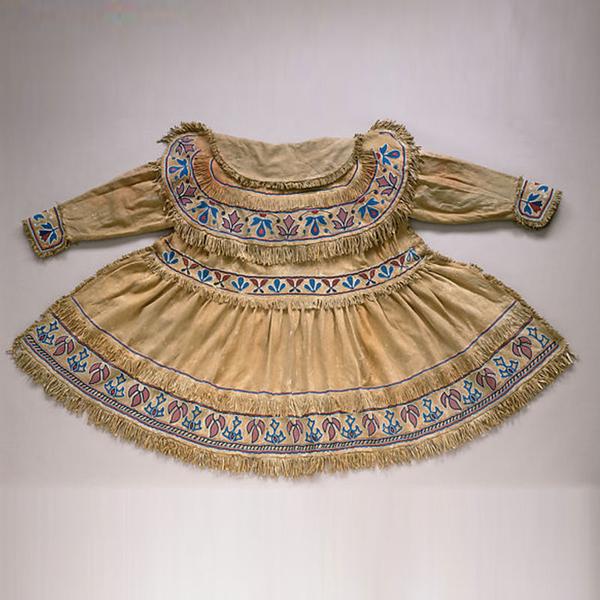
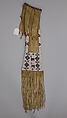
Shakhùkwiàn (Man’s Coat)
Artwork Details
- Title: Shakhùkwiàn (Man’s Coat)
- Artist: Lenni Lenape (Delaware) Artist
- Date: ca. 1840
- Geography: Made in Missouri or Kansas, United States
- Culture: Lenni Lenape/Delaware artist, Native American
- Medium: Hide, cloth, glass beads, cotton thread, sinew
- Dimensions: 39 × 63 in. (99.1 × 160 cm)
- Credit Line: The Charles and Valerie Diker Collection of Native American Art, Gift of Charles and Valerie Diker, 2025
- Object Number: 2025.860.1
- Rights and Reproduction: Image © Charles and Valerie Diker Collection/Photo: Dirk Bakker
- Curatorial Department: The American Wing
Audio
9805: Shakhùkwiàn (Man’s Coat), Lenni Lenape/Delaware Artist
717555
JOE BAKER: For me, encountering this coat is nothing short of inspirational…
TANTOO: That’s Joe Baker of the Lenape Nation.
JOE: I'm inspired by the beauty of the intricacy of the beadwork – the sort of fanciful and imaginary design of the coat itself. And it conjures in me feelings of reminiscence, of story, of experience.
TANTOO: Although the Lenape were displaced to Oklahoma in the 1860s, they originated on the east coast of North America.
JOE: The Metropolitan Museum of Art is located in our ancestral territories. Our territories began at the southern boundary of the Catskill Mountains, and extend south to include the island of Manhattan, all of New Jersey, into Pennsylvania and a portion of Delaware.
TANTOO: The layers of this deerskin coat would have kept the wearer comfortable through the chilly eastern winters. And the dynamic beadwork – lively patterns of alternating blue and red foliage – suggests spiritual health and well-being.
JOE: They're much more than just decorative. They really have meaning and power and voice. They're part of an identity, they are part of a community.
TANTOO: Joe recalls encountering similar garments for the first time as a child at community gatherings and dances in Oklahoma.
JOE: I began to understand and see firsthand the color and pattern and rhythm. All of that color was animated and moving on the dance path. And that, to me, became very exciting. How the beadwork itself would find a voice and find an expression in the movement of the person wearing it. And they come to life through these relationships.
More Artwork
Related Content

Research Resources
The Met provides unparalleled resources for research and welcomes an international community of students and scholars. The Met's Open Access API is where creators and researchers can connect to the The Met collection. Open Access data and public domain images are available for unrestricted commercial and noncommercial use without permission or fee.
To request images under copyright and other restrictions, please use this Image Request form.
Feedback
We continue to research and examine historical and cultural context for objects in The Met collection. If you have comments or questions about this object record, please contact us using the form below. The Museum looks forward to receiving your comments.
Content Notice
The Metropolitan Museum of Art presents over 5,000 years of art from around the world, and our online collection reflects ongoing work conducted over the course of our more than 150-year history. You may encounter objects or images that may be inappropriate for some viewers or information that may be outdated.