Storage jar
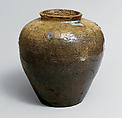
This monumental storage jar—a masterwork by the enslaved African American potter and poet David Drake—reveals his unmatched technical facility and command of language. Born into slavery at the turn of the nineteenth century, Drake worked throughout Edgefield District, South Carolina, the epicenter of alkaline-glazed stoneware in the American South in the decades before the Civil War. This vessel is inscribed with his signature, the date, and a poem of Drake’s own creation, a practice anomalous in the production of nineteenth-century stoneware in this country, and one he reserved for a very small percentage of his output. In the absence of written accounts from the hands of enslaved individuals, this jar offers a view into Drake’s regional milieu. The object boldly states its own function in the inscription: "when you fill this Jar with pork or beef / Scot will be there; to get a peace." Not only is Drake referencing the jar’s intended contents, but his creative word choice and declaration of authorship is manifest. Drake’s poetry speaks to the trauma of slavery, but also signals the agency and power of a gifted artisan in the plantation economy.
Artwork Details
- Title: Storage jar
- Maker: Dave (later recorded as David Drake) (American, ca. 1801–1870s) ; made at Stony Bluff Manufactory, Old Edgefield District, Sout
- Manufacturer: Stony Bluff Manufactory
- Date: 1858
- Culture: American
- Medium: Alkaline-glazed stoneware
- Dimensions: Height: 22 5/8 in. (57.5 cm); diameter: 27 in. (68.6 cm); circumference (widest): 72 in. (182.9 cm); 82 lbs (37.2 kg); approximately 25 gallon capacity
- Credit Line: Purchase, Ronald S. Kane Bequest, in memory of Berry B. Tracy, 2020
- Object Number: 2020.7
- Curatorial Department: The American Wing
Audio
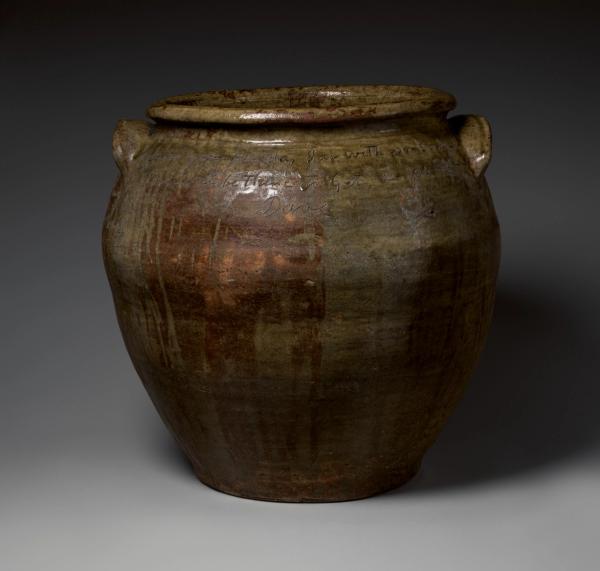
4005. Dave (David Drake), Storage jar, 1858
NARRATOR: In this jar from 1858, we have a remarkable and rare example of an enslaved potter signing his own work, boldly declaring himself the creator of this vessel. It is a masterwork among the surviving pots by Dave, or David Drake, who worked in the Old Edgefield District of South Carolina.
Not only did Dave sign and date this jar, but he also inscribed a four-line poem of his own around the shoulder, referencing people and places he knew. Here’s artist Glenn Ligon.
GLENN LIGON:“When you fill this jar with pork or beef, Scot will be there to get a peace.” It could be a misspelling or a pun; if it is a pun, it’s a quite funny one because after you eat, you're kind of sated, at peace, you know? (Laughs) There is something really interesting to me about how casually he addresses them.It’s hard to imagine how an enslaved man could even write these words. But there they are, and we’re still puzzling over them.
NARRATOR: Dave's display of his own literacy is remarkable at a time when it was illegal for an enslaved person to read or write under South Carolina law.
GLENN LIGON: There is somehow the idea that artistic agency is antithetical to enslavement. Dave could have just made ordinary jugs. But I think that extra-ness is a characteristic of African American art production in general. The filmmaker Arthur Jafa says there's no extra points that LeBron James gets by dunking the ball; it still gets two points. But the virtuosity from which he gets from the court up to the basket and dunks the ball is the extra-ness. I think the extra-ness in Dave’s production is about a kind of joy, which is ultimately about a kind of resistance.
More Artwork
Press the down key to skip to the last item.

Related Content
Research Resources
The Met provides unparalleled resources for research and welcomes an international community of students and scholars. The Met's Open Access API is where creators and researchers can connect to the The Met collection. Open Access data and public domain images are available for unrestricted commercial and noncommercial use without permission or fee.
To request images under copyright and other restrictions, please use this Image Request form.
Feedback
We continue to research and examine historical and cultural context for objects in The Met collection. If you have comments or questions about this object record, please contact us using the form below. The Museum looks forward to receiving your comments.
Content Notice
The Metropolitan Museum of Art presents over 5,000 years of art from around the world, and our online collection reflects ongoing work conducted over the course of our more than 150-year history. You may encounter objects or images that may be inappropriate for some viewers or information that may be outdated.