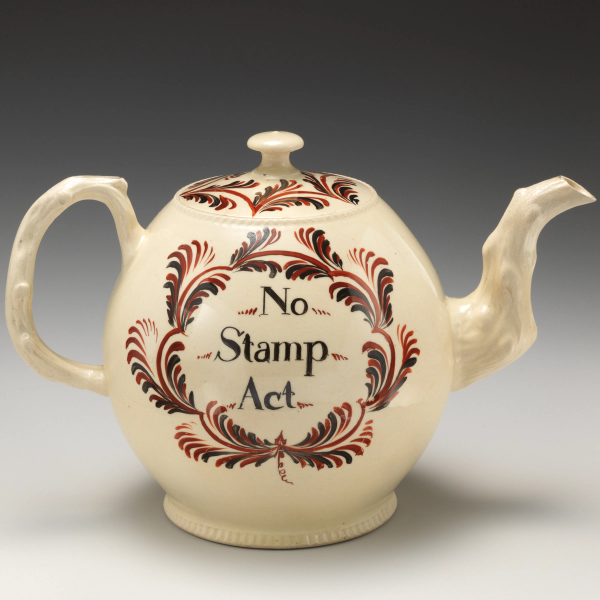
Teapot
Artwork Details
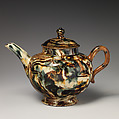
- Title: Teapot
- Date: 1766–75
- Geography: Made in Staffordshire, England
- Culture: British (American market)
- Medium: Earthenware
- Dimensions: H. 5 3/4 in. (14.6 cm)
- Credit Line: Rogers Fund, 1927
- Object Number: 27.232a, b
- Curatorial Department: The American Wing
Audio
407. Teapots
Gallery 510
NARRATOR: Three hundred years ago, Britain went completely mad… for tea. Two factors drove the craze: First, a newly developed international system of trade brought tea leaves to Britain, mostly harvested in Japan and China. The second? A steep drop in price. Before the 18th century, only the wealthiest aristocrats could import tea. Gradually, the price fell, and then the general public caught the fever, which continues today. Suddenly there was a brand-new commercial market… for teapots. Across Britain, new manufactories started popping up. Witness the hundreds you see here–dainty, funny, silly, coarse–something for everyone. Fancy a humorous design of monkeys and corn? Right this way. Or something more sophisticated? Perhaps a luxurious silver vessel or complex agateware set?
Even today, one of the most important things to consider is that this is an object that receives a lot of use, as contemporary mixed-media artist and ceramicist Morel Doucet knows well from crafting teapots of his own:
MOREL DOUCET: When I'm forming a teapot, I think about what is the intended use that I want the final outcome to be. Is it something that is a morning ritual? Is it something that is going to be used maybe three times a year? Or is it something that you want to never use, but you want to admire in the home?
NARRATOR: A tidal wave of teapot manufactories opened up during the tea craze. A few were only briefly in operation, failing after only a few years, if that. But the legacy of some, in places like Birmingham and Staffordshire, are still recognized as the creators of monumental crafts and beloved family heirlooms.
MOREL DOUCET: The teapots, bowls, saucers, that lives in each one of our homes, they hold weight. The legacy is passed on from one generation to the next. The legacy holds memory. and these memories are happy. They're celebratory. They're sad. There's so much emotion and history that are connected to these objects that they take on a life of their own.
NARRATOR: Teapots featured everything from imitations of Chinese designs to political messages, such as the one declaring, “No Stamp Act.” But to many living under imperial rule, teapots carried—and continue to carry—a much deeper meaning.
MOREL DOUCET: Slaves were considered uncivilized, savage, and unrefined to participate in drinking tea. For a lot of Haitians, the teapot is a symbolic gesture of independence; drinking tea is this affirmation that I'm refined, I'm not savage, and I can participate in drinking tea because I'm an individual myself. So, when you go to a household in the Caribbean, everybody has a set of teapots.
More Artwork
Related Content

Research Resources
The Met provides unparalleled resources for research and welcomes an international community of students and scholars. The Met's Open Access API is where creators and researchers can connect to the The Met collection. Open Access data and public domain images are available for unrestricted commercial and noncommercial use without permission or fee.
To request images under copyright and other restrictions, please use this Image Request form.
Feedback
We continue to research and examine historical and cultural context for objects in The Met collection. If you have comments or questions about this object record, please contact us using the form below. The Museum looks forward to receiving your comments.
Content Notice
The Metropolitan Museum of Art presents over 5,000 years of art from around the world, and our online collection reflects ongoing work conducted over the course of our more than 150-year history. You may encounter objects or images that may be inappropriate for some viewers or information that may be outdated.