Crucifix
The arrival of Portuguese navigator Diogo Cão at the estuary of the Congo River in 1483 inaugurated contact between two world leaders: the Kongo sovereign Nzinga a Nkwu (r. ca. 1420–1509) and King João II of Portugal (r. 1481–85). Within a decade, Nkwu elected to be baptized as João I. His court embraced literacy and adapted Christianity to their own cosmology.
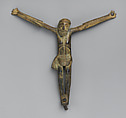
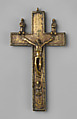
Portuguese missions to the Kongo Kingdom brought with them a range of material culture, including crucifixes and images of saints. By the sixteenth century, Kongo artists were adopting and adapting these forms to regional styles and systems of belief. The cross already held meaning in Kongo religion as a sign of the universe and the cycle of life and so was easily integrated into existing practices. Known as dikenga dia Kongo (circle of Kongo), the cross served as a cosmological diagram for the perceived positions of the Sun relative to Earth’s horizon and as a metaphor for the progression through birth, death, the spiritual realm, and rebirth. That emphasis on the four stations of the cross is evident in this early crucifix through the figures balanced on either arm and below the feet. Those figures have variously been interpreted as mourners or ancestral intercessors, guiding the passage through life and death.
Artwork Details
- Title: Crucifix
- Artist: Kongo artist
- Date: ca. 17th century
- Geography: Angola or Democratic Republic of the Congo, coastal region, Democratic Republic of the Congo; southern region, Republic of the Congo; or Cabind, Angola
- Culture: Kongo peoples
- Medium: Copper alloy
- Dimensions: H. 10 3/4 × W. 5 1/4 × D. 3/4 in. (27.3 × 13.3 × 1.9 cm)
- Classification: Metal-Sculpture
- Credit Line: Gift of Carol B. Kenney, in memory of Jerome P. Kenney, 2025
- Object Number: 2025.807.16
- Curatorial Department: The Michael C. Rockefeller Wing
More Artwork
Research Resources
The Met provides unparalleled resources for research and welcomes an international community of students and scholars. The Met's Open Access API is where creators and researchers can connect to the The Met collection. Open Access data and public domain images are available for unrestricted commercial and noncommercial use without permission or fee.
To request images under copyright and other restrictions, please use this Image Request form.
Feedback
We continue to research and examine historical and cultural context for objects in The Met collection. If you have comments or questions about this object record, please contact us using the form below. The Museum looks forward to receiving your comments.
Content Notice
The Metropolitan Museum of Art presents over 5,000 years of art from around the world, and our online collection reflects ongoing work conducted over the course of our more than 150-year history. You may encounter objects or images that may be inappropriate for some viewers or information that may be outdated.