Thomas Jefferson
Artwork Details
- Title: Thomas Jefferson
- Artist: Charles L. Hogeboom (American, ca. 1827–1895)
- Date: by 1884
- Medium: Plaster
- Dimensions: 18 1/2 × 16 1/4 × 2 3/16 in. (47 × 41.3 × 5.6 cm)
Framed: 26 3/8 × 24 3/8 × 3 1/4 in. (67 × 61.9 × 8.3 cm) - Credit Line: Gift of the sculptor, 1885
- Object Number: 85.16.2
- Curatorial Department: The American Wing
Audio
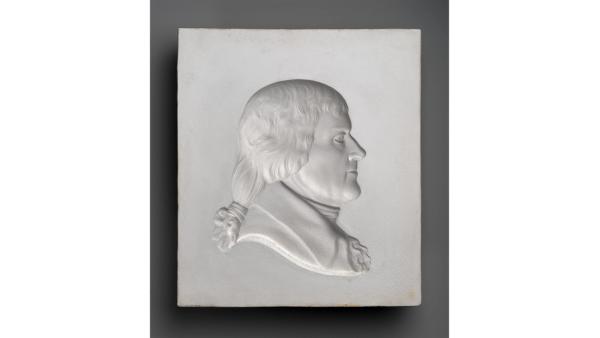
4001. Thomas Jefferson, Charles l. Hogeboom, (by 1884)
NARRATOR: Thomas Jefferson and Benjamin Franklin appear in these late nineteenth-century plaster reliefs as we are typically used to seeing them—as heroic figures.
Jane Kamensky, president and CEO of the Thomas Jefferson Foundation.
JANE KAMENSKY: We see in both the Franklin and the Jefferson images a kind of serenity. A serenity that almost resists life. These are figures beyond mortality.
NARRATOR: These sculptures suggest an America eager to reunite with a common, more harmonious origin story in the years after the Civil War. The Colonial Revival cultural phenomenon, which valued the founding narratives of the United States, was one such avenue to shared history and memory.
JANE KAMENSKY: I think the Colonial Revival Movement in arts, literature, the decorative arts, is part of an effort at national healing, in the wake of a civil war, and also an effort to tell a common American story in a period of massive social and demographic disruption.
The words that Jefferson wrote in the Declaration of Independence: We hold these truths to be self-evident, that all men, meaning all humanity, were created equal, these were words that women seeking suffrage embraced in the 19th-century, they were words that Frederick Douglass wrestled with, they were words that Gandhi took up, that have literally made their way around the globe. At the same time, Jefferson was an enslaver of hundreds of human beings; 600 or so over the course of his lifetime. So, there’s a tremendous contradiction baked into the history of this most brilliant and polymathic of American founders. That contradiction was known at the time was known especially by Jefferson, who knew that slavery was wrong. In our memorializations of the founders, we stopped wrestling with those contradictions and started remembering marble men, right?
An important thing to remember about America’s founders is that they did not view themselves as marble men. They viewed themselves as fallible human beings, as indeed they were.
More Artwork

Related Content

Research Resources
The Met provides unparalleled resources for research and welcomes an international community of students and scholars. The Met's Open Access API is where creators and researchers can connect to the The Met collection. Open Access data and public domain images are available for unrestricted commercial and noncommercial use without permission or fee.
To request images under copyright and other restrictions, please use this Image Request form.
Feedback
We continue to research and examine historical and cultural context for objects in The Met collection. If you have comments or questions about this object record, please contact us using the form below. The Museum looks forward to receiving your comments.
Content Notice
The Metropolitan Museum of Art presents over 5,000 years of art from around the world, and our online collection reflects ongoing work conducted over the course of our more than 150-year history. You may encounter objects or images that may be inappropriate for some viewers or information that may be outdated.