Bwami society headdress
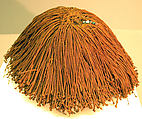
This elaborate headdress, with an arched plume of elephant hairs, was associated with the highest male grade of Bwami, lutumbo lwa kindi. The elephant is the largest and most powerful animal known to the Lega, and in Bwami teaching it represents both the society as a whole and the pinnacle of achievement within it. According to one proverb, “Bwami [is like] the stampeding of elephants; the place it has passed cannot be forgotten.” The expression alludes to the deep and enduring impact of Bwami teaching. By crowning his head with an elephant tail tuft, the wearer visually aligns himself with the elephant’s might, endurance, and leadership. The crest conveys that this person has immense spiritual strength and has trampled ignorance underfoot, leaving an unforgettable legacy in the community.
The moral authority of the wearer is further underscored through the extensive material additions to the raffia-fiber base. Seedpods (maseza) entirely cover the surface. The use of this medium to sheath the cap not only provided a beautifully textured surface, but also carried connotations of fertility, growth, and renewal. Strands of glass beads wrap around the elephant hair plume and extend from either side of the edge of the cap, and glass buttons adorn the plaited chinstrap. Bright European trade beads and buttons were prized for their exotic origins and shine. By the late 19th century, Lega artisans expertly incorporated them to enhance a hat’s prestige. The combined effect of these carefully arranged elements carried additional messages of the physical and moral excellence of its wearer. In Bwami philosophy, physical beauty and moral virtue are closely linked. The ordered rows of maseza and balanced arrangement of beads and buttons reflect the refinement expected of a person who has attained Bwami’s highest levels.
Artwork Details
- Title: Bwami society headdress
- Artist: Lega artist
- Date: first half of 20th century
- Geography: Democratic Republic of the Congo, eastern region
- Culture: Lega peoples
- Medium: Plant fiber, elephant hair, seed‑pods, glass buttons, beads
- Dimensions: H. 16 ¾ in.; L. 14 in.; Circ. 23 ½ in. (42.5 × 35.6 × 59.7 cm)
- Classification: Textiles-Costumes-Accessories
- Credit Line: Gift of Marie-Louise Laband, 2025
- Object Number: 2025.831.17
- Curatorial Department: The Michael C. Rockefeller Wing
More Artwork
Research Resources
The Met provides unparalleled resources for research and welcomes an international community of students and scholars. The Met's Open Access API is where creators and researchers can connect to the The Met collection. Open Access data and public domain images are available for unrestricted commercial and noncommercial use without permission or fee.
To request images under copyright and other restrictions, please use this Image Request form.
Feedback
We continue to research and examine historical and cultural context for objects in The Met collection. If you have comments or questions about this object record, please contact us using the form below. The Museum looks forward to receiving your comments.
Content Notice
The Metropolitan Museum of Art presents over 5,000 years of art from around the world, and our online collection reflects ongoing work conducted over the course of our more than 150-year history. You may encounter objects or images that may be inappropriate for some viewers or information that may be outdated.