Amusements at Kitano Shrine
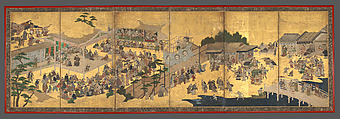
In this half-height six-panel folding screen—about three feet tall and nine feet wide—the artists have captured the appearance of the precincts and surrounding areas of Kitano Tenmangū Shrine in northwestern Kyoto, one of the most prominent Shinto establishments in Japan. The shrine, still active today, is dedicated to the Heian courtier Sugawara no Michizane (845–903), who came to be worshipped as a god of learning and calligraphy. What draws our attention, however, is not pilgrims visiting shrine buildings in the background, but rather the groups of people in the foreground enjoying elaborate picnicking, festive dancing and other outdoor entertainments. The detailed rendering of figures, including their lavish garments, musical instruments, ceramics and lacquerware, and various other accoutrements of merrymaking, vividly convey the atmosphere of celebration and conviviality.
In the background of the rightmost three panels is Kitano Shrine, with its two large entrance gates, and large central court that stands before the elaborate gabled buildings of the Main Shrine (Honden) and the connected Worship Hall (Haiden) right behind it. Rebuilt at the command of Toyotomi Hideyori in 1607, the configuration of the architecture provides a terminus post quem for the production of the screen. The buildings of the main shrine complex, which today maintain the same appearance, are designated National Treasures. The imposing structure in the upper section of the second panel from the left is the Buddhist Sutra Hall (Kyōōdō). Originally located to the south of the gate to Kitano Shrine, it features in sixteenth century paintings by Kano Sōshu and others. The Sutra Hall was dismantled in the late nineteenth century, when Shinto shrines were required to disassociate themselves from Buddhist temples. Since the orientation of the shrine complex is along a north-south axis, the activities in the foreground can be construed to be taking place just to the east of the shrine, a site that over the centuries was variously used for outdoor events such as archery contests or theatrical performances.
The foreground of the rightmost two panels is dominated by an extravagant picnic. The host of this outdoor banquet, a seated samurai with bushy sideburns and polka-dotted robes, is framed by a pair of gold screens. He is surrounded by female servants and courtesans plying him with drinks while his many guests, arrayed before him, indulge in music-making, dancing, and gaming.
Many of the elements pictured here invoke and perhaps satirize the arts celebrated in traditional East Asian paintings. The screens not only demarcate the outdoor space, they feature bold renderings of morning glory (asagao) flowers, a late-summer and autumn theme, and bush clover (hagi), associated with autumn. The depiction here anticipates by two centuries The Met’s iconic Morning Glories screen by Suzuki Kiitsu of the mid-nineteenth century—a reminder that the foundation of the Rinpa aesthetics was already being formulated in Kyoto in the early seventeenth century.
Other activities allude to the Four Gentlemanly Accomplishments (Kinki shoga), namely: musical instruments, board games, calligraphy, and painting. Yet, in the popularizing spirit of the time, instead of references to the qin (Japanese: kin) the chosen instrument of the elite, people are dancing merrily to the accompaniment of tsutsumi (handheld drums), a fue (transverse flute), and a shamisen, the three-string instrument that from around this time would become central to musical performances on the Kabuki stage and by geisha of the demimonde of urban centers. To represent board games, we see women using the elite go board as an armrest and instead engaging in an animated game of sugoroku, a backgammon-like game. The art of calligraphy is suggested not by scrolls or brushes, but rather by two women huddled together by the screen reading what no doubt is a love letter from a suitor. Painting is represented by the screens with their floral imagery.
In the center of the screen, a blue-and-white striped curtain has been hung to hide the activities of the chefs preparing sashimi to be served at the banquet. To their left is a stall where rice dumplings (mochi) and tea are being offered for sale to passersby.
In the foreground of the two left panels, men and women holding fans perform a popular dance style (furyū odori, literally “dancing with the wind”) that became the rage in early seventeenth-century Japan, when it was viewed as a temporary escape from the worries of everyday life. Observing the dancers at the lower left is a group of young ruffians (kabukimono—often unemployed ronin, or masterless samurai), who express their rebellious attitude by dressing in flamboyant costumes, flaunting their swords (which they probably would not have known how to use), imbibing copious amounts of sake, and generally causing trouble. Such kabukimono were often depicted in genre screens from the 1610s onwards. Further reminding viewers of how this new genre of fūzokuga captures merrymaking of all sorts, on the far left we see courtesans inviting potential patrons to join them in the small huts for a drink of tea or sake or perhaps to indulge in more intimate interaction. The depiction of the teahouses was not a figment of the artist’s imagination; historical records mention such establishments appearing near Kitano Shrine in the early seventeenth century.
This screen—based on its comparable format, paper sizes, and stylistic traits— is thought to be a companion to Women’s Kabuki (2017.730), a fūzokuga screen depicting a stage performance in the Gōjo District of Kyoto,
This screen represents a masterpiece of genre painting associated with the preeminent painting atelier of Kano Takanobu. In an earlier generation, the Kano school was noted for transmitting Chinese styles of ink painting into Japan, but by the late sixteenth century it had expanded its repertoire to create fan and screen paintings depicting famous sites of the capital, including the panoramic depictions of Kyoto known as Scenes in and around the Capital (Rakuchū rakugaizu). Gradually the Kano artists homed in on specific areas of the capital such as the Gōjo district along the Kamo River, which was famous for its erotically suggestive performances of Women’s Kabuki, or Higashiyama, or the Eastern Hills district.
Takanobu was the youngest son of the Kanō school head painter Kanō Eitoku (1543–90) and earned the patronage of the samurai elite. When Kanō Naganobu (1577–1654)—Eitoku’s brother—moved at the behest of the recently ascendant Tokugawa shogunate to its new administrative capital of Edo (modern Tokyo) around 1610–15, Takanobu remained in Kyoto, where the commissions he received indicate that he was also a favorite of the court. At the time only Takanobu and Naganobu had sufficient skill to head branches of the school.
Artwork Details
- 狩野孝信工房作 北野社頭遊楽図屏風
- Title: Amusements at Kitano Shrine
- Artist: Studio of Kano Takanobu (Japanese, 1571–1618)
- Period: Edo period (1615–1868)
- Date: mid- to late 1610s
- Culture: Japan
- Medium: Six-panel folding screen; ink, color, gold, silver, and gold leaf on paper
- Dimensions: Image: 32 1/16 in. × 8 ft. 9 7/8 in. (81.4 × 268.9 cm)
Overall with mounting: 37 3/16 in. × 9 ft. 3 in. (94.5 × 281.9 cm) - Classification: Paintings
- Credit Line: Purchase, Mary and James G. Wallach Foundation Gift and Mary Livingston Griggs and Mary Griggs Burke Foundation Fund, 2026
- Object Number: 2026.361
- Curatorial Department: Asian Art
More Artwork
Research Resources
The Met provides unparalleled resources for research and welcomes an international community of students and scholars. The Met's Open Access API is where creators and researchers can connect to the The Met collection. Open Access data and public domain images are available for unrestricted commercial and noncommercial use without permission or fee.
To request images under copyright and other restrictions, please use this Image Request form.
Feedback
We continue to research and examine historical and cultural context for objects in The Met collection. If you have comments or questions about this object record, please contact us using the form below. The Museum looks forward to receiving your comments.
Content Notice
The Metropolitan Museum of Art presents over 5,000 years of art from around the world, and our online collection reflects ongoing work conducted over the course of our more than 150-year history. You may encounter objects or images that may be inappropriate for some viewers or information that may be outdated.