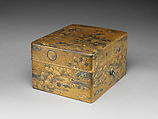
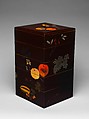
Writing Box (Suzuribako) with Chinese Lions, Peonies, and Tokugawa Family Crest
In both design and technique, this writing box—and the larger set to which it belongs—may be regarded as an outstanding example of early Edo-period lacquer wedding furnishings. Nineteen objects from the original set made for Princess Katsu are preserved today in the Hayashibara Museum, Okayama, and are designated Important Cultural Properties. Separated from the set during the Edo period and later exported to Europe, it was once part of the collection of Sir Trevor Lawrence (1831–1913), a noted English surgeon, horticulturalist, and art collector.
Artwork Details
- 綾杉地獅子牡丹葵紋蒔絵硯箱
- Title: Writing Box (Suzuribako) with Chinese Lions, Peonies, and Tokugawa Family Crest
- Artist: Kōami Chōjū (Japanese, 1599–1651)
- Period: Edo period (1615–1868)
- Date: 1628
- Culture: Japan
- Medium: Lacquered wood with gold and silver takamaki-e, hiramaki-e, togidashimaki-e and cut-out gold and silver foil on nashiji and maki-e ground
- Dimensions: H. 9 5/8 in. (24.5 cm); W. 9 in. (22.9 cm); D. 1 15/16 in. (5 cm)
- Classification: Lacquer
- Credit Line: Mary Livingston Griggs and Mary Griggs Burke Foundation Fund, 2026
- Object Number: 2026.535a–k
- Curatorial Department: Asian Art
More Artwork
Research Resources
The Met provides unparalleled resources for research and welcomes an international community of students and scholars. The Met's Open Access API is where creators and researchers can connect to the The Met collection. Open Access data and public domain images are available for unrestricted commercial and noncommercial use without permission or fee.
To request images under copyright and other restrictions, please use this Image Request form.
Feedback
We continue to research and examine historical and cultural context for objects in The Met collection. If you have comments or questions about this object record, please contact us using the form below. The Museum looks forward to receiving your comments.
Content Notice
The Metropolitan Museum of Art presents over 5,000 years of art from around the world, and our online collection reflects ongoing work conducted over the course of our more than 150-year history. You may encounter objects or images that may be inappropriate for some viewers or information that may be outdated.