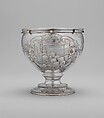
Waste Bowl
Two possibly scenarios account for the different makers. LeTelier and Shields were known to have a working relationship and it is possible that they collaborated on the production of this service. If a short-deadline commission was received by LeTelier it is possible that he looked to his fellow silversmith to help him accomplish the task on time, thus asking Shields to make the sugar bowl, or supply one from his stock to be engraved to match the rest of the set made by LeTelier. The possibility that a stock item was used would account for the visual difference and slightly older style of the sugar bowl.
A second scenario is that one or a few of the pieces were originally owned by Read and later pieces were added on in a second or multiple commissions. For example, if Read had owned the sugar bowl first and wished to update or add the rest of a tea service to match it, he may have commissioned LeTelier had Shields been unavailable, or vice versa. Matching sets of dining wares were not purchased as we would think them today. More often people would slowly buy their silver as they could afford it, adding pieces as they could. Resultantly, tea services that were used as a set did not always match.
Artwork Details
- Title: Waste Bowl
- Maker: John Letelier Sr. (ca. 1740–1798)
- Date: 1770–95
- Geography: Made in Philadelphia, Pennsylvania, United States
- Culture: American
- Medium: Silver
- Dimensions: Overall: 3 1/2 x 6 5/16 in. (8.9 x 16 cm); 11 oz. 2 dwt. (344.5 g)
Foot: Diam. 3 3/4 in. (9.5 cm) - Credit Line: Gift of Mrs. J. Amory Haskell, in memory of the families of John L. Riker and Jonathan Amory Haskell, 1940
- Object Number: 40.57.3
- Curatorial Department: The American Wing
More Artwork
Related Content
 Free to download
Research Resources
The Met provides unparalleled resources for research and welcomes an international community of students and scholars. The Met's Open Access API is where creators and researchers can connect to the The Met collection. Open Access data and public domain images are available for unrestricted commercial and noncommercial use without permission or fee.
To request images under copyright and other restrictions, please use this Image Request form.
Feedback
We continue to research and examine historical and cultural context for objects in The Met collection. If you have comments or questions about this object record, please contact us using the form below. The Museum looks forward to receiving your comments.
Content Notice
The Metropolitan Museum of Art presents over 5,000 years of art from around the world, and our online collection reflects ongoing work conducted over the course of our more than 150-year history. You may encounter objects or images that may be inappropriate for some viewers or information that may be outdated.