Search the collection

Filter By

Brocade
Geographic Location
Department
Date
Show Only:
  • As part of the Met's Open Access policy, you can freely copy, modify and distribute this image, even for commercial purposes.
    APIPublic domain data for this object can also be accessed using the Met's Open Access API
Showing 236 results
Sort by:
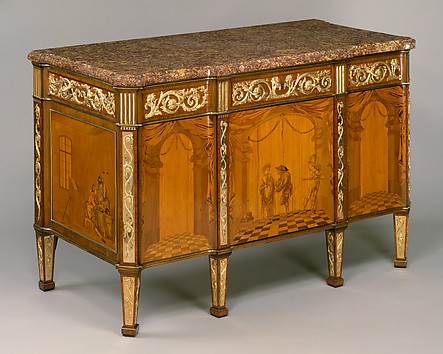
Commode à vantaux, David Roentgen  German, Oak, pine, walnut, mahogany, and cherry veneered with hornbeam (partially stained), tulipwood, walnut, holly and maple (both partially stained), boxwood, mahogany, and other woods; red brocatelle marble; gilt bronze; iron, steel, and brass, German, Neuwied am Rhein
Multiple artists/makers
ca. 1775–79 with later alterations
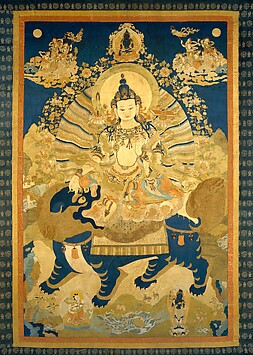
Kurukulla, Appliqued satin, brocade and damask, embroidered silk and painted details, Tibet
Tibet
19th century
Bookcase (one of a pair), Niccolo Michetti  Italian, Walnut and poplar; iron hinges and locks, metal wire; antique silk and linen brocatelle door curtains (not original), Italian, Rome
Niccolo Michetti
ca. 1715
Armchair (one of a pair), Claude Chevigny, Carved and gilded beech; modern silk brocade, French, Paris
Claude Chevigny
ca. 1768–70
Corner cabinet (encoignure) (one of a pair), Bernard II van Risenburgh, Oak veneered with ebony and Coromandel lacquer, cherry wood, and purplewood; gilt-bronze mounts; brocatelle marble top, French, Paris
Bernard II van Risenburgh
ca. 1745–49
Sofa (part of a set), Filippo Pelagio Palagi  Italian, Mahogany veneered with maplewood and mahogany, covered with modern silk brocade, Italian, Piedmont
Multiple artists/makers
ca. 1835
Pair of armchairs (part of a set), Filippo Pelagio Palagi  Italian, Mahogany veneered with maplewood and mahogany, covered with modern silk brocade, Italian, Piedmont
Multiple artists/makers
ca. 1835
Noh Robe (Karaori) with Pattern of Bamboo and Young Pines on Bands of Red and White, Twill-weave silk with resist-dyed warps, supplementary weft patterning in silk, and gold-leaf paper strips (karaori), Japan
Japan
first half 19th century
Drop-front secretary on stand (Secrètaire à abattant or secrétaire en cabinet) (one of a pair) (part of a set), Adam Weisweiler  French, Oak veneered with ebony, amaranth, holly, ebonized holly, satinwood, Japanese and French lacquer panels, gilt-bronze mounts, brocatelle marble top (not original); steel springs; morocco leather (not original), French, Paris
Adam Weisweiler
ca. 1790
Armchair (one of a pair), Claude Chevigny, Carved and gilded beech; modern silk brocade, French, Paris
Claude Chevigny
ca. 1768–70
Corner cabinet (encoignure) (one of a pair), Bernard II van Risenburgh, Oak veneered with ebony and Coromandel lacquer, cherry wood, and purplewood; gilt-bronze mounts; brocatelle marble top, French, Paris
Bernard II van Risenburgh
ca. 1745–49
Bookcase (one of a pair), Niccolo Michetti  Italian, Walnut and poplar; iron hinges and locks, metal wire; antique silk and linen brocatelle door curtains (not original), Italian, Rome
Niccolo Michetti
ca. 1715
Pair of armchairs (part of a set), Carved and polychromed walnut; received upholstered in beige silk brocade, currently upholstered with modern cotton and linen velvet (INST.1970.8.1, .2), Italian, Naples
Italian, Naples
ca. 1780
Fire screen (écran), Georges Jacob  French, Carved, gilded and silvered beech; 18th-century silk brocade (not original to frame), French, Paris
Georges Jacob
Philippe de Lasalle
ca. 1786
Commode (commode à vantaux) (part of a set), Adam Weisweiler  French, Oak veneered with ebony, amaranth, holly, ebonized holly, satinwood, Japanese and French lacquer panels; gilt-bronze mounts, brocatelle marble top (not original); steel springs; morocco leather (not original), French, Paris
Adam Weisweiler
ca. 1790
Drop-front secretary on stand (secrètaire à abattant or secrétaire en cabinet) (one of a pair) (part of a set), Adam Weisweiler  French, Oak veneered with ebony, amaranth, holly, ebonized holly, satinwood, Japanese and French lacquer panels, gilt-bronze mounts, brocatelle marble top (not original); steel springs; morocco leather (not original), French, Paris
Adam Weisweiler
ca. 1790
Japanese
19th century
Armchair, Carved walnut; brocatelle upholstery, French
French
18th century
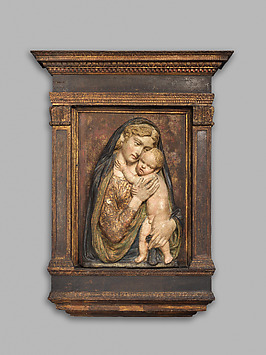
Madonna and Child, Donatello  Italian, Figures: terracotta, polychromed and gilded; later background: wood, painted to represent brocade; frame: carved and painted, mouldings gilt, Italian
Donatello
15th century
Armchair (fauteuil), Louis Delanois  French, Carved and gilded walnut; silk brocade upholstery not original to frame, French, Paris
Louis Delanois
ca. 1765
Sedan chair, Wood, painted and gilded; painted canvas, brocade velvet, Italian, Naples
Italian, Naples
18th century
Side chair, Lacquered walnut, brocade, Italian, Piedmont
Italian, Piedmont
18th century
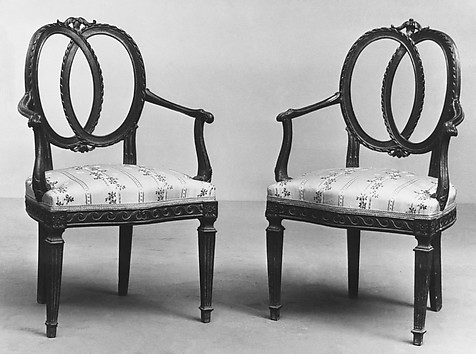
Pair of armchairs, Walnut, brocade, Northern Italian
Northern Italian
late 18th century
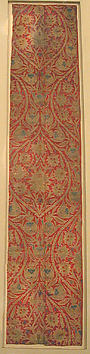
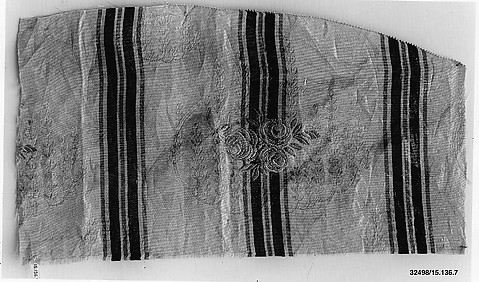
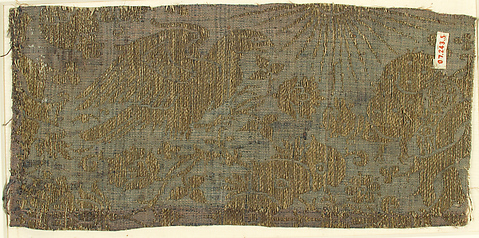
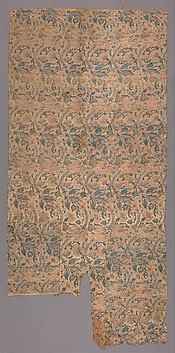
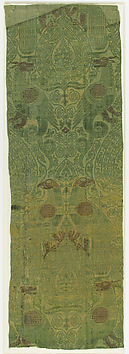
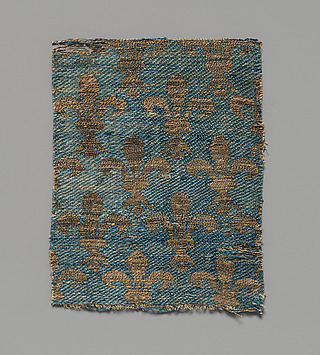
Brocade, Silk and metal thread, French
French
1760–70
Patchwork of Woven Textiles, Plain weave silk; silk satin brocade with metal thread; silk satin, China
China
13th–14th century
Book of Plowing and Weaving, Printed from metal blocks; copper engraved plates; contained in an 18th century brocade cover, China
China
1696
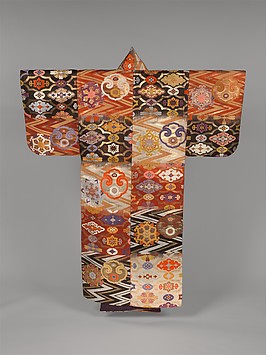
Noh Robe (Karaori) with Tortoise Shell Pattern and Crane Lozenges, Twill-weave silk brocade with supplementary weft patterning, Japan
Japan
first half of the 19th century
Noh Costume (Karaori) with Cherry Blossoms and Fretwork, Silk, brocaded twill, Japan
Japan
first half of the 18th century
Noh Costume (Karaori) with Court Carriages, Cherry Blossoms, and Dandelions, Twill-weave silk brocade with supplementary-weft patterning in metallic thread, Japan
Japan
late 18th–first half of the19th century
Panel with Rabbits amid Clouds, Simple gauze and plain weave silk with supplementary metal thread brocade patterning, China
China
late 16th–early 17th century
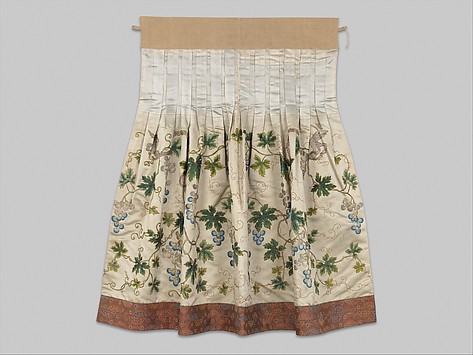
Theatrical skirt with peacock feather design, Silk and metallic thread embroidery on silk satin, brocade borders, China
China
18th century
Daoist priest’s ritual robe with Eight Trigrams, Silk appliqué with damask, satin, brocade, and embroidery with silk and metal thread, China
China
19th century
Noh Costume (Karaori) with Cypress Fans and Moonflower (Yūgao) Blossoms, Twill-weave silk with brocading in silk and supplementary-weft patterning in silk and metallic thread, Japan
Japan
18th–early 19th century
Noh Robe (Atsuita) with Cloud-Shaped Gongs and “Chinese Flowers”

, Twill weave silk brocade, Japan
Japan
first half of the 19th century
Noh Costume (Karaori) with Pattern of Fans Floating on Water, Twill-weave silk brocaded with silk and metallic thread, Japan
Japan
18th century
Noh Robe (Karaori)
, Twill-weave silk with supplementary weft patterning in silk and gold-leaf paper strips (karaori), Japan
Japan
first half 19th century
Theatrical Robe for a Military Role, Silk brocade with metallic thread, China
China
18th century
Noh Robe (Karaori), Twill-weave silk with brocading in silk and supplementary weft patterning in silk (karaori), Japan
Japan
second half 18th century
Noh Robe (Karaori), Twill-weave silk with supplementary weft patterning in silk and gold-leaf paper strips (karaori), Japan
Japan
late 18th–early 19th century
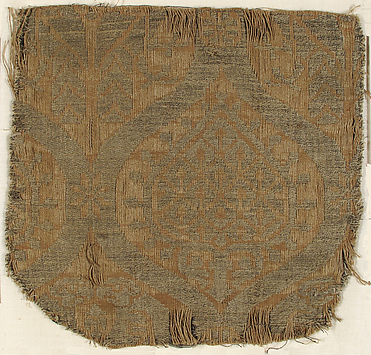
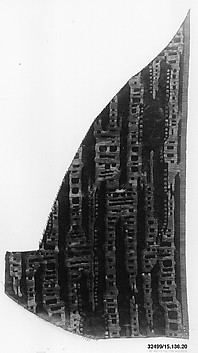
Fragment, Twill-weave silk with brocading in silk and supplementary weft patterning in silk (karaori), Japan
Japan
18th century