Search the collection

Filter By

Burins
Geographic Location
Department
Date
Show Only:
  • As part of the Met's Open Access policy, you can freely copy, modify and distribute this image, even for commercial purposes.
    APIPublic domain data for this object can also be accessed using the Met's Open Access API
  • Objects with changed or unknown ownership in continental Europe between 1933-1945. Learn more
Showing 221 results
Sort by:
Burin Spall, Flint
ca. 1184–664 B.C.
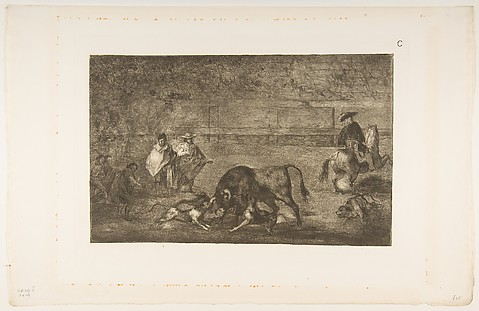
Plate C: The dogs let loose on the bull, from "Tauromaquia", Goya (Francisco de Goya y Lucientes)  Spanish, Etching, burnished aquatint, drypoint, burin
Goya (Francisco de Goya y Lucientes)
ca. 1816
Plate 44 from "Los Caprichos": They spin finely (Hilan delgado), Goya (Francisco de Goya y Lucientes)  Spanish, Etching, aquatint, drypoint, burin
Goya (Francisco de Goya y Lucientes)
1799
The Supper at Emmaus, Rembrandt (Rembrandt van Rijn)  Dutch, Etching, burin and drypoint; first of two states
Rembrandt (Rembrandt van Rijn)
1654
Evening in the Village, Jean Jacques de Boissieu  French, Etching with drypoint, burin and roulette; third state of three
Jean Jacques de Boissieu
1800
River Crossing, Jean Jacques de Boissieu  French, Etching with drypoint, burin and roulette; fifth state of five
Jean Jacques de Boissieu
1796
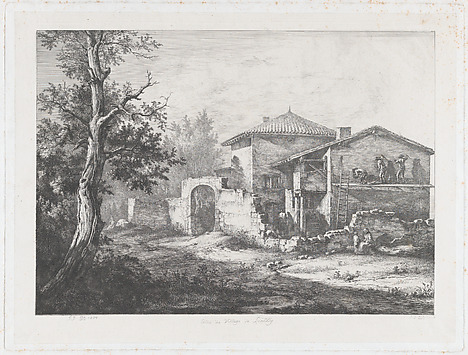
The Old Gate of Vaise, Lyon, Jean Jacques de Boissieu  French, Etching with drypoint, burin and roulette; third state of three
Jean Jacques de Boissieu
1803
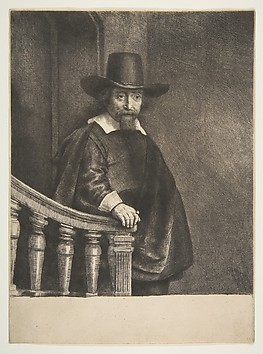
Jan Asselijn, Painter (Krabbetje), Rembrandt (Rembrandt van Rijn)  Dutch, Etching, drypoint, and burin (some plate tone); first of seven states
Rembrandt (Rembrandt van Rijn)
ca. 1647
St. Jerome, Jean Jacques de Boissieu  French, Etching with drypoint, burin and roulette; fifth state of six
Jean Jacques de Boissieu
1797
Christ at Emmaus: The Larger Plate, Rembrandt (Rembrandt van Rijn)  Dutch, Etching, burin, and drypoint, some hatching with a mezzotint rocker; fourth of four states
Rembrandt (Rembrandt van Rijn)
1654
The Image Seen by Nebuchadnezzar, Rembrandt (Rembrandt van Rijn)  Dutch, Etching, burin, and drypoint; third of five states
Rembrandt (Rembrandt van Rijn)
1655
Jacob's Ladder, Rembrandt (Rembrandt van Rijn)  Dutch, Etching, burin, and drypoint; first of four states
Rembrandt (Rembrandt van Rijn)
1655
David and Goliath, Rembrandt (Rembrandt van Rijn)  Dutch, Etching, burin, and drypoint, some plate tone; first of five states
Rembrandt (Rembrandt van Rijn)
1655
Peter and John Healing the Cripple at the Gate of the Temple, Rembrandt (Rembrandt van Rijn)  Dutch, Etching, drypoint, burin, and mezzotint; fifth of six states
Rembrandt (Rembrandt van Rijn)
1659
Plate 3 from " La Tauromaquia": The Moors settled in Spain, giving up the superstitions of the Koran, adopted this art of hunting, and spear a bull in the open, Goya (Francisco de Goya y Lucientes)  Spanish, Etching, burnished aquatint, drypoint, burin
Goya (Francisco de Goya y Lucientes)
1816
Plate 2 from "La Tauromaquia": Another way of hunting on foot, Goya (Francisco de Goya y Lucientes)  Spanish, Etching, burnished aquatint, drypoint, burin
Goya (Francisco de Goya y Lucientes)
1816
Plate 4 from "La Tauromaquia": They play another with the cape in an enclosure, Goya (Francisco de Goya y Lucientes)  Spanish, Etching, burnished aquatint, drypoint, burin
Goya (Francisco de Goya y Lucientes)
1816
Plate 7 from "La Tauromaquia": Origin of the harpoon or banderillas, Goya (Francisco de Goya y Lucientes)  Spanish, Etching, burnished aquatint, burin
Goya (Francisco de Goya y Lucientes)
1816
Plate 9 from "La Tauromaquia": A Spanish knight kills the bull after having lost his horse, Goya (Francisco de Goya y Lucientes)  Spanish, Etching, burnished aquatint, burin
Goya (Francisco de Goya y Lucientes)
1816
Plate 24 of "La Tauromaquia": The same Ceballos mounted on another bull breaks short spears in the ring at Madrid, Goya (Francisco de Goya y Lucientes)  Spanish, Etching, burnished aquatint, drypoint, burin
Goya (Francisco de Goya y Lucientes)
1816
Plate 22 from "La Tauromaquia": Manly courage of the celebrated Pajuelera in [the ring] at Zaragoza, Goya (Francisco de Goya y Lucientes)  Spanish, Etching, burnished aquatint, drypoint, burin
Goya (Francisco de Goya y Lucientes)
1816
Plate 19 of "La Tauromaquia": Another madness of his in the same ring, Goya (Francisco de Goya y Lucientes)  Spanish, Etching, burnished aquatint, drypoint and burin
Goya (Francisco de Goya y Lucientes)
1816
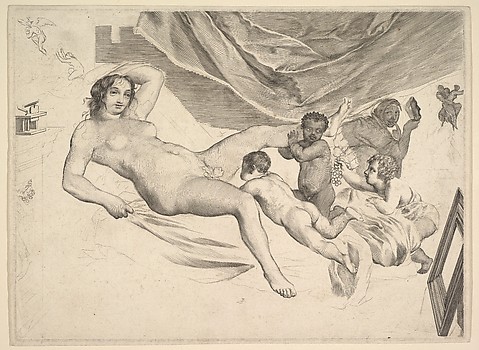
Allegorical Subject: Nude Woman, Three Children and a Mousetrap (La Sourcière), Claude Mellan  French, Engraving (burin and drypoint); second state of two (unfinished)
Claude Mellan
Rembrandt with Raised Sabre, Rembrandt (Rembrandt van Rijn)  Dutch, Etching with touches of burin
Rembrandt (Rembrandt van Rijn)
1634
Entrance to the Village of Lentilly, Jean Jacques de Boissieu  French, Etching with drypoint, burin and roulette; second state of two
Jean Jacques de Boissieu
1804
Jan Asselijn, Painter (Krabbetje), Rembrandt (Rembrandt van Rijn)  Dutch, Etching, drypoint, and burin; second of seven states
Rembrandt (Rembrandt van Rijn)
ca. 1646
Jan Asselijn, Painter (Krabbetje), Rembrandt (Rembrandt van Rijn)  Dutch, Etching, drypoint, and burin; fifth state of seven states
Rembrandt (Rembrandt van Rijn)
ca. 1646
Beggars Receiving Alms at the Door of a House, Rembrandt (Rembrandt van Rijn)  Dutch, Etching, burin, drypoint; third of five states
Rembrandt (Rembrandt van Rijn)
1648
Plate 1 from "Los Caprichos": Self-portrait, Goya (Francisco de Goya y Lucientes)  Spanish, Etching, aquatint, drypoint and burin
Goya (Francisco de Goya y Lucientes)
1799 (published 1881–86)
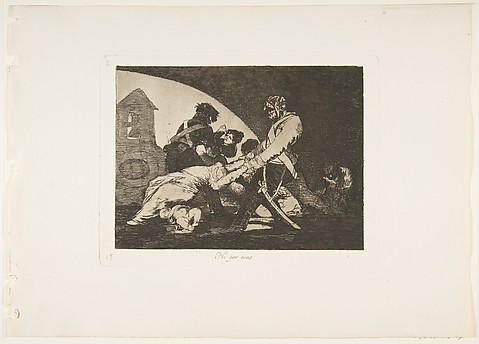
Plate 17 of "La Tauromaquia": The Moors use donkeys as a barrier to defend themselves against the bull whose horns have been tipped with balls, Goya (Francisco de Goya y Lucientes)  Spanish, Etching, burnished aquatint, drypoint, burin
Goya (Francisco de Goya y Lucientes)
1816
Plate 16 of "La Tauromaquia": The same man throws a bull in the ring at Madrid, Goya (Francisco de Goya y Lucientes)  Spanish, Etching, burnished aquatint, drypoint, burin
Goya (Francisco de Goya y Lucientes)
1816
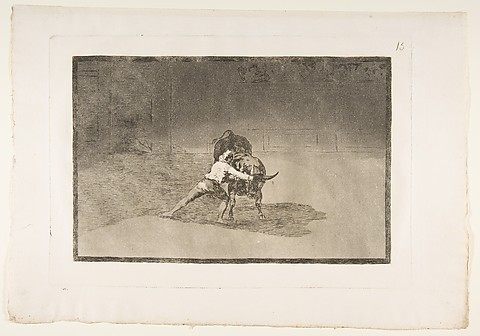
Plate 13 of  "La Tauromaquia": A Spanish mounted knight in the ring breaking short spears without the help of assistants, Goya (Francisco de Goya y Lucientes)  Spanish, Etching, burnished aquatint, drypoint, burin
Goya (Francisco de Goya y Lucientes)
1816
Plate 32 from "La Tauromaquia": Two teams of picadors thrown one after the other by a single bull, Goya (Francisco de Goya y Lucientes)  Spanish, Etching, burnished aquatint, drypoint, burin
Goya (Francisco de Goya y Lucientes)
1816
Plate 31 of  "La Tauromaquia": Banderillas with firecrackers, Goya (Francisco de Goya y Lucientes)  Spanish, Etching, burnished aquatint, drypoint, burin
Goya (Francisco de Goya y Lucientes)
1816
Plate 30 from "La Tauromaquia": Pedro Romero killing the halted bull, Goya (Francisco de Goya y Lucientes)  Spanish, Etching, burnished aquatint, burin
Goya (Francisco de Goya y Lucientes)
1816
Plate 15: Pretty Advice (Bellos Consejos), from "Los Caprichos", Goya (Francisco de Goya y Lucientes)  Spanish, Etching, aquatint, burin, touches of pen and ink
Goya (Francisco de Goya y Lucientes)
1799
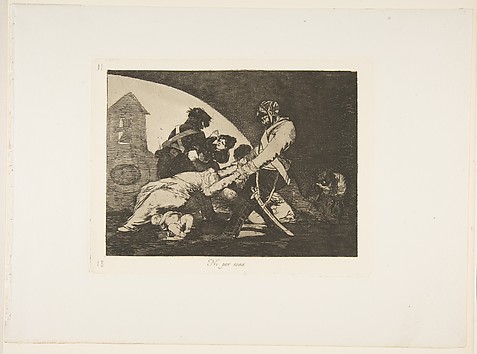
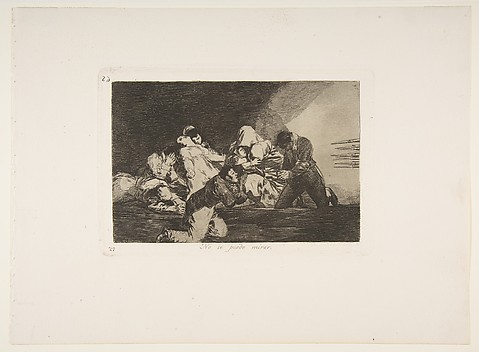
Plate18 from "The Disasters of War" (Los Desastres de la Guerra): 'Bury them and keep quiet' (Enterrar y callar), Goya (Francisco de Goya y Lucientes)  Spanish, Etching, drypoint, burin (working proof)
Goya (Francisco de Goya y Lucientes)
1810
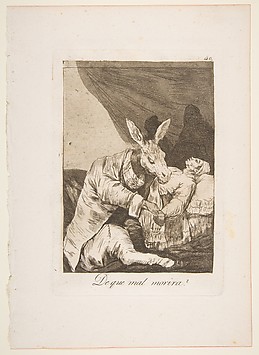
Self-Portrait; Plate 1 from "Los Caprichos", Goya (Francisco de Goya y Lucientes)  Spanish, Etching, aquatint, drypoint, burin
Goya (Francisco de Goya y Lucientes)
1799
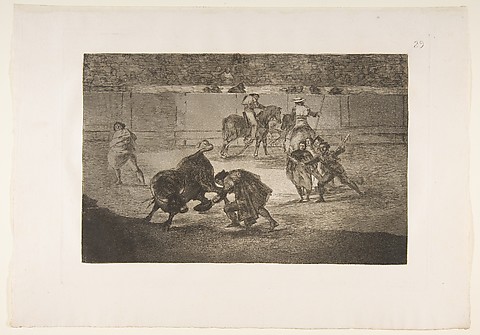
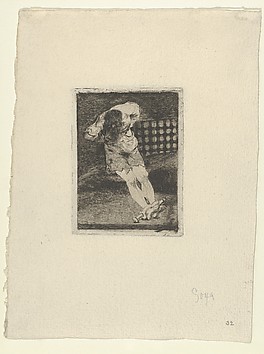
The garroted man (El agarrotado), Goya (Francisco de Goya y Lucientes)  Spanish, Etching, burin
Goya (Francisco de Goya y Lucientes)
ca. 1775–78 (published 1868)
Plate 58 from 'The Disasters of War' (Los Desastres de la Guerra): 'It's no use crying out.' (No hay que dar voces.), Goya (Francisco de Goya y Lucientes)  Spanish, Etching, burnished aquatint, burin, burnisher (proof impression)
Goya (Francisco de Goya y Lucientes)
1811–12