English
DonateMembershipTickets

Search for Art

Search Tips
1-42 of 11,649 results
Sort by:
Show only
Images
Date
For BCE dates, enter a negative number. E.g. For 2000 BCE, enter -2000.
Artist / culture
Object type / material
1
Match
 
Show results matching
selected filters.
Geographic location
Match
 
Show results matching
selected filters.
Department
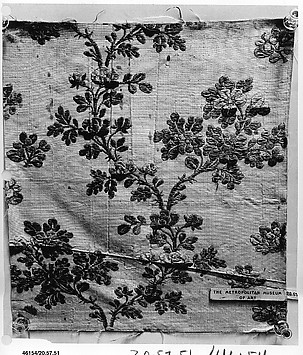
Two panels from the 'Verdures du Vatican' series, Jean Démosthène Dugourc  French, Woven silk and metal thread with applied silk and chenille embroidery, French, Lyon
Designer Designed by Jean Démosthène Dugourc
Manufactory Woven by Maison Pernon et Cie.– Camille Pernon (French, 1753 – 1808)
ca. 1799
Grere'o (shield), Solomon Islands artist, Fiber, parinarium-nut paste, chambered-nautilus shell, pigment, Solomon Islands
Solomon Islands artist
Early to mid-19th century
Shirt, Moche artist(s), Camelid hair, cotton, Moche
Moche artist(s)
500–850 CE
Crib of the Infant Jesus, Wood, polychromy, lead, gilded silver, painted parchment, silk embroidery with seed pearls, gold thread, translucent enamels, South Netherlandish
South Netherlandish
15th century
Tunic with Confronting Catfish, Camelid hair, tapestry-weave, Nasca-Wari
Nasca-Wari
800–850 CE
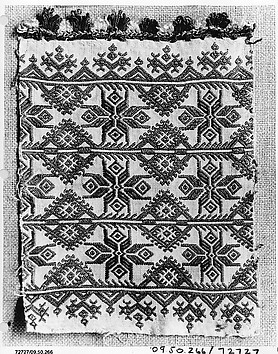
Border Fragment, Cotton, camelid hair, Paracas
Paracas
450–175 BCE
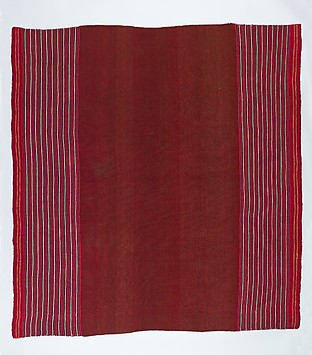
Woman's Dress, Camelid hair, Chuquibamba
Chuquibamba
14th–early 16th century
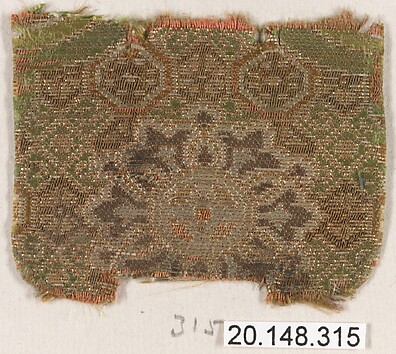
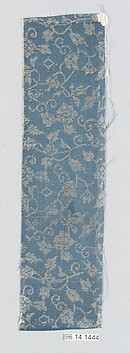
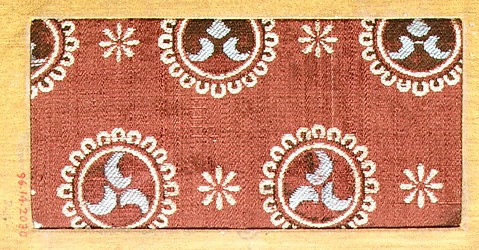
Textile Fragment, Silk; lampas
14th century
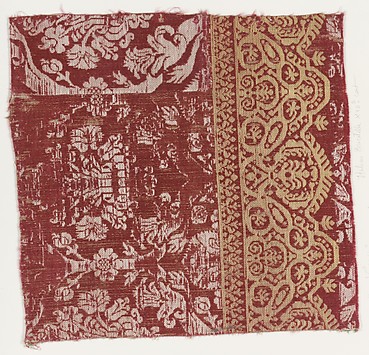
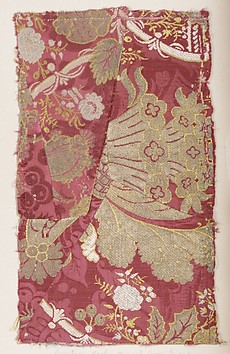
Textile Fragment, Silk, metal wrapped thread; lampas (kemha)
mid-16th century
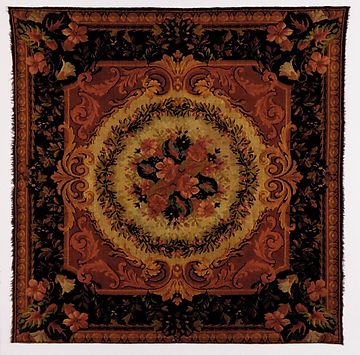
Woven Carpet, Wool, woven, British
British
ca. 1850
Woven carpet, Woven wool, French
French
ca. 1800
Poet's-narcissus textile, Associated Artists  American, Linen, woven and printed, American
Designer Associated Artists
1883–1900
Length, Séguin et Cie, Silk and two types of metal thread, French, Lyons
Manufactory Woven by Séguin et Cie
Patron Comissioned by Napoléon Bonaparte
ca. 1805–15
Carpet (tapis), Savonnerie Manufactory, Knotted and cut wool pile (Ghiordes knot) (woven with about 44 knots per sq. inch), French, Paris
Manufactory Savonnerie Manufactory
mid-17th century
Carpet (tapis), Savonnerie Manufactory, Knotted and cut wool pile, woven with about 90 knots per square inch, French, Paris
Manufactory Savonnerie Manufactory
third quarter 17th century
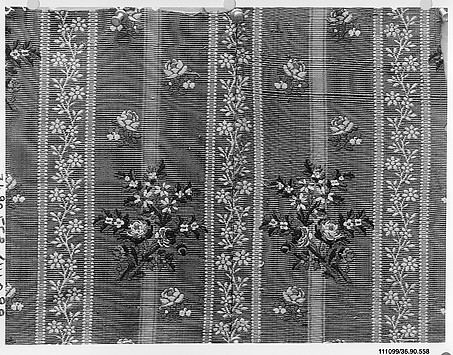
Length of furnishing fabric, Silk, French
French
first quarter 19th century
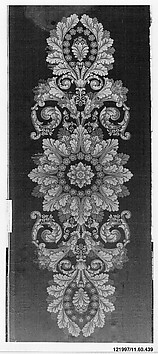
Strapwork with Flowers and Jewels, Silk; compound weave, brocaded, French, possibly Lyon
French, possibly Lyon
ca. 1885
Chandos, Owen Jones  British, Woven wool, silk and cotton, British, Braintree, Essex
Designer Owen Jones
Manufacturer Warner, Sillett & Ramm
Woven by Sam Watson
ca. 1873
Shawl, Emile-Frédéric Hébert  French, active 1851–1867, Wool and silk, French, Paris
Workshop director Emile-Frédéric Hébert
ca. 1860
Piece, Silk damask, Spanish
Spanish
late 15th century
Piece, Silk and metal-wrapped thread, Italian, Venice
Italian, Venice
ca. 1720
Dress for a statuette, Polychromed lead, glass; silver; silk and silver-gilt lace, Spanish
Spanish
18th century
Capelet for a statuette, Polychromed lead, glass; silver; silk and silver-gilt lace, Spanish
Spanish
17th–18th century
Bib for a statutette, Polychromed lead, glass; silver; silk and silver-gilt lace, Spanish
Spanish
18th century
Length of painted silk, Woven silk taffeta, painted with pigments, gilt and silver, Chinese, possibly Canton
Chinese, possibly Canton
mid-18th century
Bronze hook-pin, Bronze, Minoan
Minoan
2nd millennium BCE
Four-Cornered Hat, Camelid hair, cotton, Wari
Wari
7th–9th century
Kafigeledjo (oracle figure), Senufo artist, Wood, iron, bone, porcupine quills, feathers, commercially woven fiber, applied organic materials, Senufo peoples
Senufo artist
19th–mid-20th century
Cloak, New Zealand Flax (phormium tenax species), wool, Maori people, Kaitaka
Maori people, Kaitaka
19th century
Baban riga (man’s ceremonial robe), Amadou Ahejo, Kano, Nigeria  Nigerian, Cotton, tsamiya silk, Hausa peoples
Amadou Ahejo, Kano, Nigeria
ca. 1940
Tunic with Felines, Cotton, camelid hair, Chimú
Chimú
1450–1550
Turuturu (weaving peg), Māori artist, Wood, Maori people
Māori artist
Late 18th–early 19th century
Jaki-ed (dress mat), Marshall Islands artist, Pandanus leaves, hibiscus fiber, Marshallese
Marshall Islands artist
late 19th–early 20th century
Ashetu prestige cap, Grassfields artist, Cotton, other material (?), Cameroon
Grassfields artist
early 20th century

Content Notice

The Metropolitan Museum of Art presents over 5,000 years of art from around the world, and our online collection reflects ongoing work conducted over the course of our more than 150-year history. You may encounter objects or images that may be inappropriate for some viewers or information that may be outdated.